Title page, executive summary and table of contents of "Transition Plan for Transfer of the Effluents Program from Palo Verde Units #1, 2, & 3 to the Effluents Department", written by Thomas H. Valley on 1 November 1989 for the Palo Verde Nuclear Generating Station (PVNGS): consolidating responsibility for radioactive effluents and the Radiation Monitoring System in one department.
Document · 1 Nov 1989 · Maricopa, Arizona, United States
Linked to Thomas Henry Valley, Jr
5 pages. Open one to read it full size.
Page 1

Page 2

Page 3

Page 4
Page 5
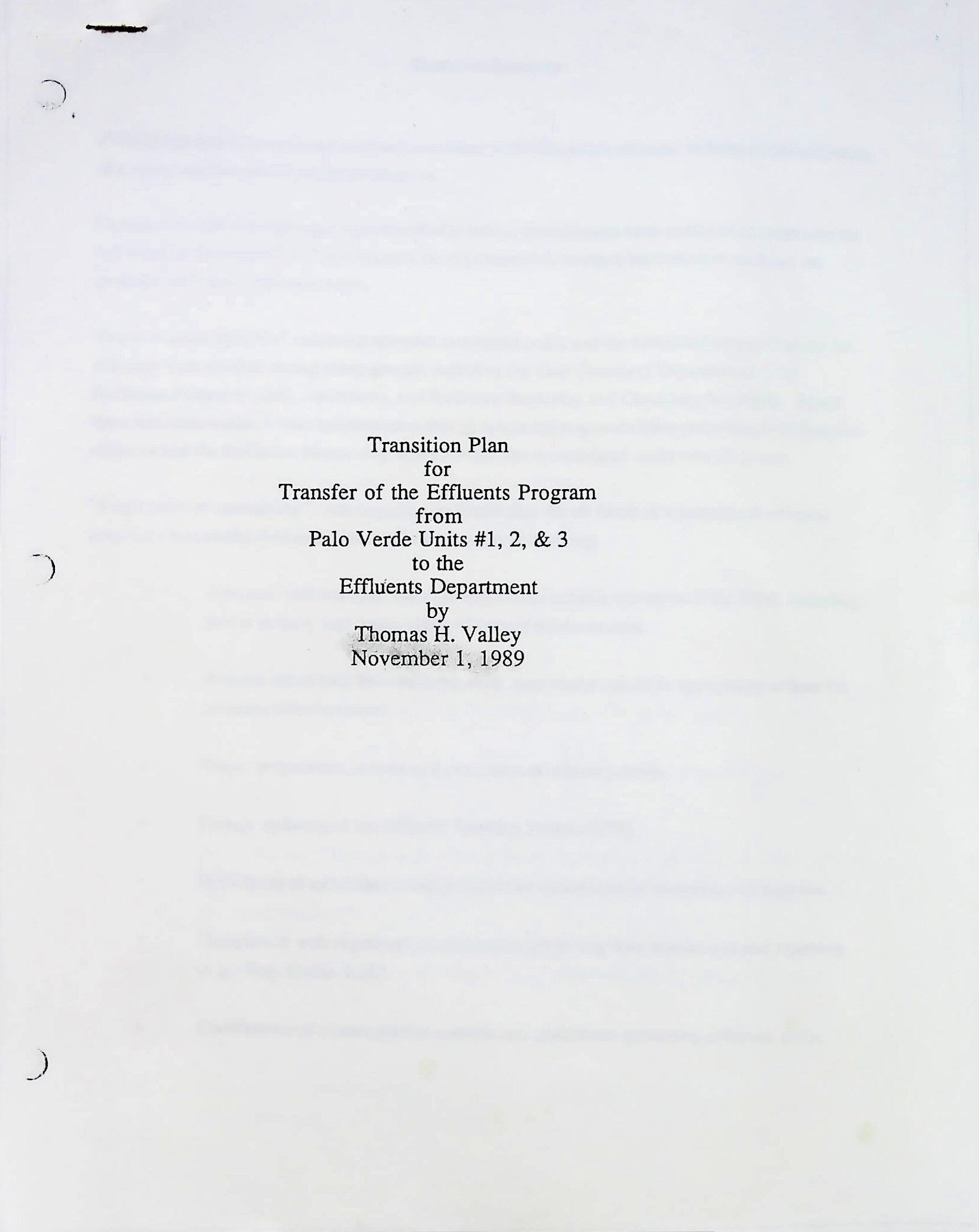



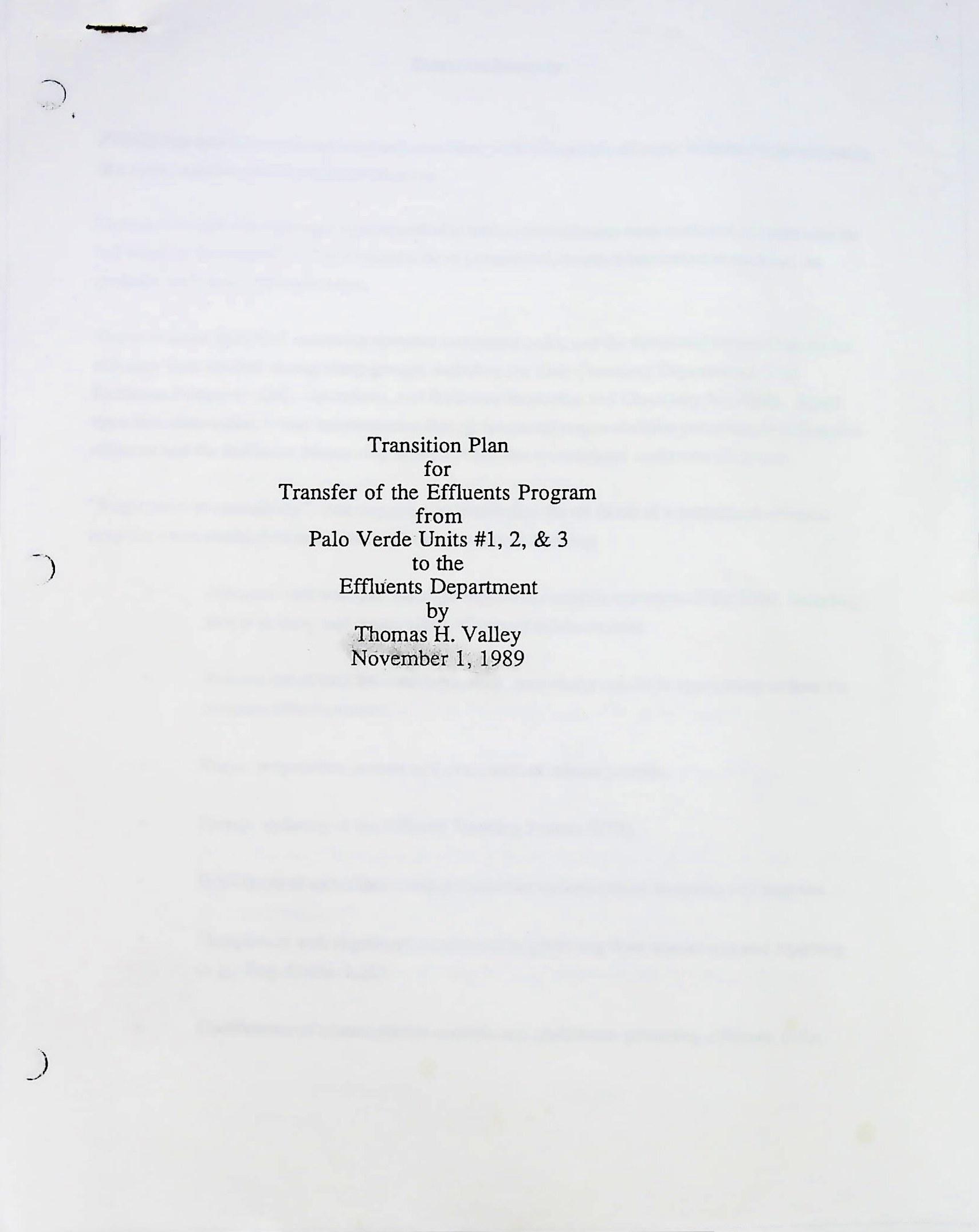
Transition Plan for Transfer of the Effluents Program from Palo Verde Units #1, 2, & 3 to the Effluents Department by Thomas H. Valley November 1, 1989
Executive Summary PVNGS has thus far conducted activities associated with radioactive effluents without the development of a clear, comprehensive policy or program. Current activities and regulations associated with radioactive effluents were evaluated to determine the full scope of the program and to formulate the organizational structure best suited to ensuring the program's effective implementation. This evaluation identified numerous complex and varied tasks, and the functional responsibilities for effluents were divided among many groups, including the Unit Chemistry Departments, Unit Radiation Protection, I&C, Operations, and Radiation Protection and Chemistry Standards. Based upon this observation, it was recommended that all functional responsibilities pertaining to radioactive effluents and the Radiation Monitoring System (RMS) be consolidated under one (1) group. "Single point accountability" - one organization responsible for all facets of a centralized effluents program - was established as the most effective means of ensuring: • Adequate hardware and software support for reliable operation of the RMS, including proper priority and coordination of system enhancements. • Assessment of data from environmental monitoring results in appropriate actions for program improvements. • Proper preparation, review and evaluation of release permits. • Prompt updating of the Effluent Tracking System (ETS). • Fulfillment of surveillance requirements for radiochemical sampling and analysis. • Compliance with regulatory commitments governing dose assessment and reporting (e.g., Reg. Guide 1.21). • Clarification of administrative controls and procedures governing effluents tasks.
Executive Summary Continued The following key factors requiring improvement in order to conduct an effective Effluents Monitoring Program can be summarized as follows: 1. Standardize the responsibilities associated with monitoring, upkeep, operation, analysis, and reporting of effluents by establishing single point accountability with one organization. 2. Streamline administrative processes. Minimize use of unit-specific Administrative Night Orders for routine activities. 3. Simplify the program and procedures. 4. Improve effectiveness of management oversight. 5. Improve availability and accessibility of data. 6. Eliminate problems experienced with Emergency Dose Assessment (EDA) for multi-unit sites. 7. Reduce likelihood of exceeding offsite dose limits through use of computer automation, thereby enhancing the protection of the health and safety of the public. 8. Eliminate repetitive and labor-intensive manual functions by using computer automation. 9. Implement recommendations of American Nuclear Insurers (ANI) Information Bulletin 86-1 "Environmental Monitoring Programs" and 80-1A, "Nuclear Liability Insurance Records Retention". In order to implement these tasks the following requirements are needed by the following dates: a. Office Space - November 15th b. Contract Services for Program and Department - On going
Executive Summary Continued c. Upgrade of ND9900 systems (Chem. gamma Spec) - November 15th d. Effluent Management Software system to; e. replace P.C. based system - November 15th If items a - d cannot be processed soon then the completion of the key-factors listed (items 1 - 9) can be impacted or not accomplished until later in 1990.
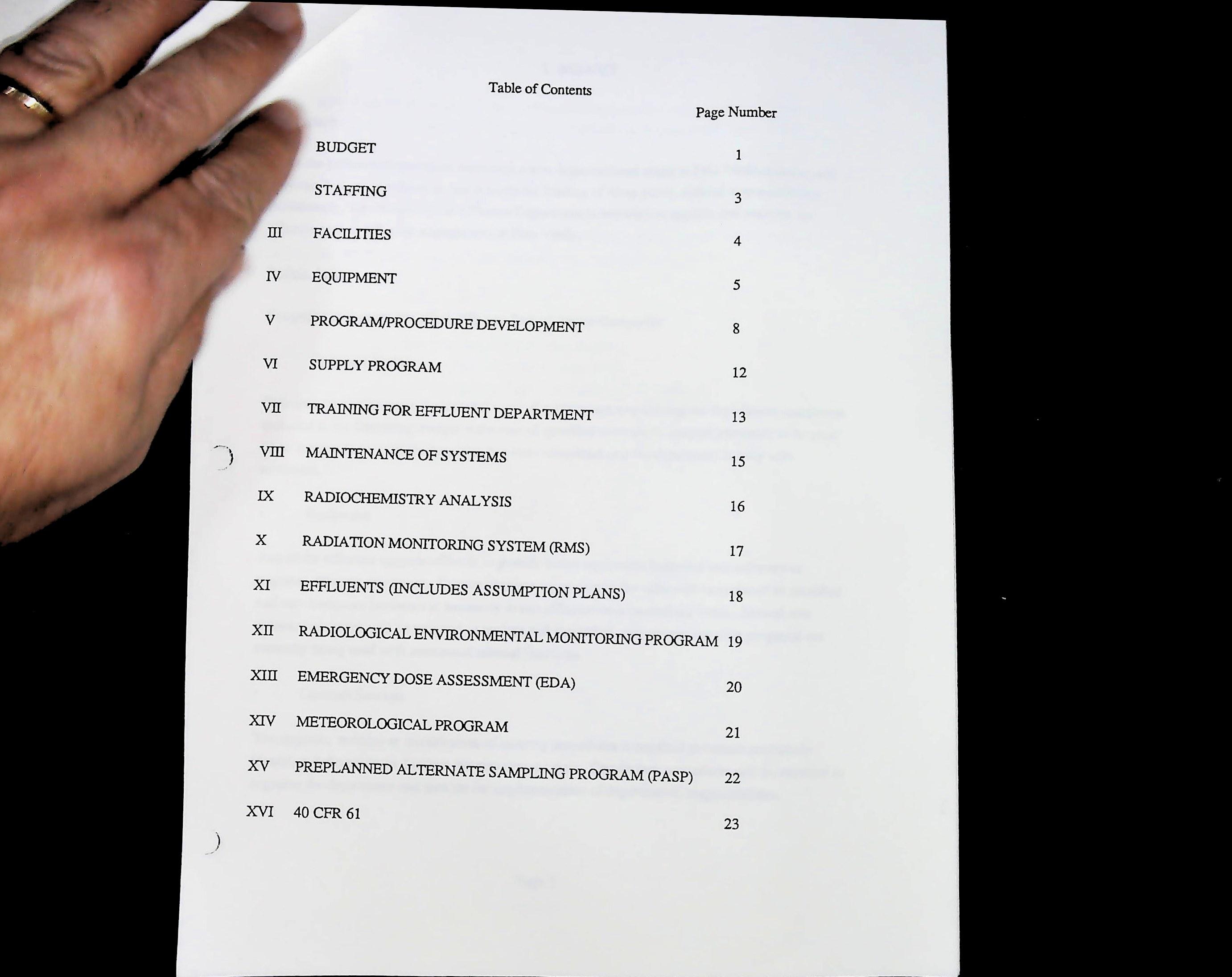
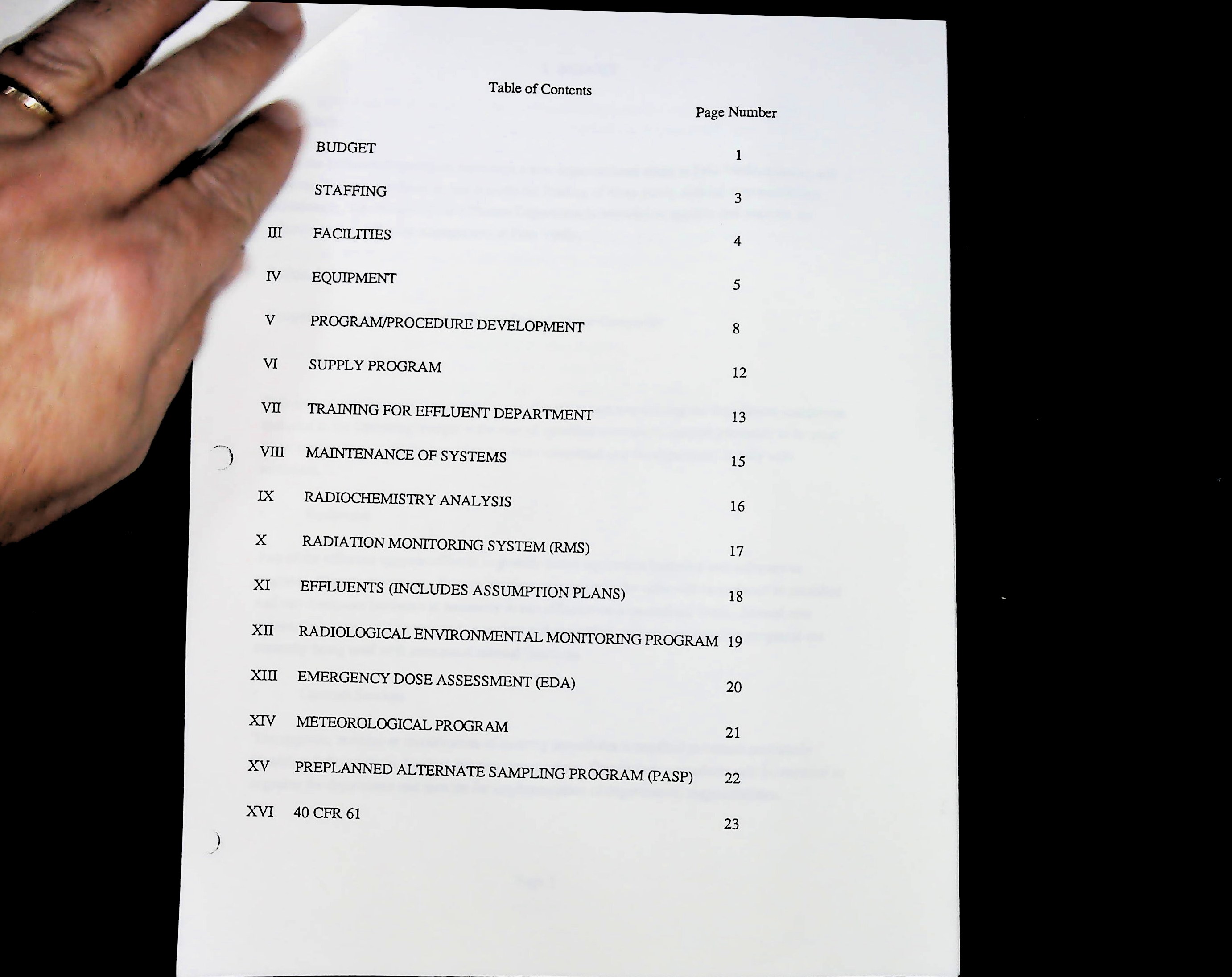
Table of Contents / Page Number I Budget 1 II Staffing 3 III Facilities 4 IV Equipment 5 V Program/Procedure Development 8 VI Supply Program 12 VII Training for Effluent Department 13 VIII Maintenance of Systems 15 IX Radiochemistry Analysis 16 X Radiation Monitoring System (RMS) 17 XI Effluents (Includes Assumption Plans) 18 XII Radiological Environmental Monitoring Program 19 XIII Emergency Dose Assessment (EDA) 20 XIV Meteorological Program 21 XV Preplanned Alternate Sampling Program (PASP) 22 XVI 40 CFR 61 23 [A hand holds the page flat.]
Notes
Source: "Transition Plan for Transfer of the Effluents Program from Palo Verde Units #1, 2, & 3 to the Effluents Department" by Thomas H. Valley, 1 Nov 1989 (title page, executive summary and contents) Location: report Found by: Claude research assistant