Bob Olson's chapters on his own family, the Swansons' closest friends: his grandparents Gustave (Hedberg) Olson and Marie, who came from Sweden in 1880 and were renamed Olson on landing, and Gustave and Katharina Nilsson of Helsingborg; his father Robert Harold Olson Sr. (1887-1942) and his illness; and his mother Gertrude Patricia Nelson Olson (Gerda, 1888-1983), who came to America in 1903 at 15, worked for the Swanson family in Wilkes-Barre, married Robert Olson in 1917 and raised four children at 14 East Linden Street, Wilkes-Barre, through the depression. With family photographs, their wedding announcement and the "love letter" Robert wrote to Gertrude before the wedding.
Document
Linked to Emma Louise Nygren, Charles Swanson, Clara Louise Bengtsdotter and Edwin Albert Swanson
13 pages. Open one to read it full size.

Page 1

Page 2

Page 3

Page 4

Page 5

Page 6

Page 7

Page 8

Page 9

Page 10

Page 11

Page 12

Page 13
[Pages of the bound booklet "Saying Good-bye" (1998). Typed pages are machine-read from photographs of the open book, so words lost in the binding or misread are left out and a few stray words from the facing page may remain; captions and handwritten pages were read by eye. Living people's birth days and months are not transcribed.]
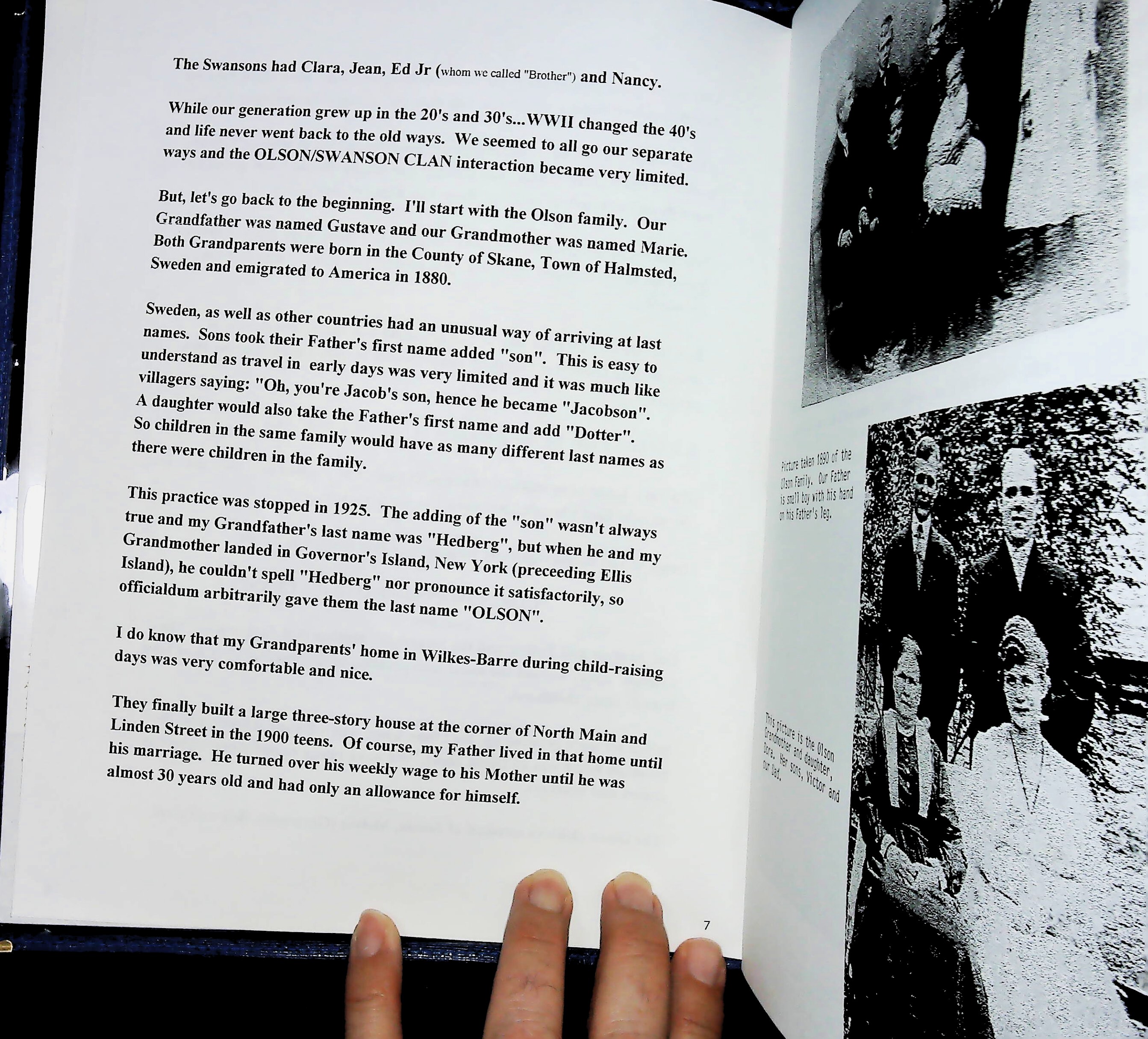
had Clara, Jean, Ed Jr (whom we called "Brother") and Nancy, While our generation grew up in the 20's and 30's... WWII changed the and life never went back to the old ways. We seemed to all go our Separate ways and the OLSON/SWANSON CLAN interaction became very limited 4 But, let's go back to the beginning. I'l] Start with the Olson family, Our Grandfather was named Gustave and our Grandmother was named Mari Both Grandparents were born in the County of Skane, Town of Sweden and emigrated to America in 1880. mae a Sweden, as well as other countries had an unusual way of arriving at last ie names. Sons took their Father's first name added "son" This fei as travel in early days was very limited and it was much lik ese villagers saying: "Oh, you're Jacob' 'son, hence he became 4 eee would also take the Father's first name and add 0 children in the same famil ; ay of the Would have as many diff tn (3) 08 Fete EE I there were children in the family. ess as a ai tr Feet Was stopped in 1925. The adding of the "can" oe true and my Grandfather g Son" wasn last name was "Hedberg", but when he and landed in Governor' a Island, New Island), he co a oe t Spell 'Hedberg" nor pronounce it satisfactorily, so "a arbitrarily gave them the last name "OLSON". I do know ae hat my Grandparents' home in Wilkes-Barre during YS Was very comfortable and nice. They fin ae built a large three-story house at the corner of North Main and St th Street in the 1900 teens. Of cour ; : , i tis Sm pee on se, my Father lived in that home unti] ta Se He turned Over his weekly wage to his Mother until he was ied Mt ee 78 years old and had only an allowance for himself. ieee "a a
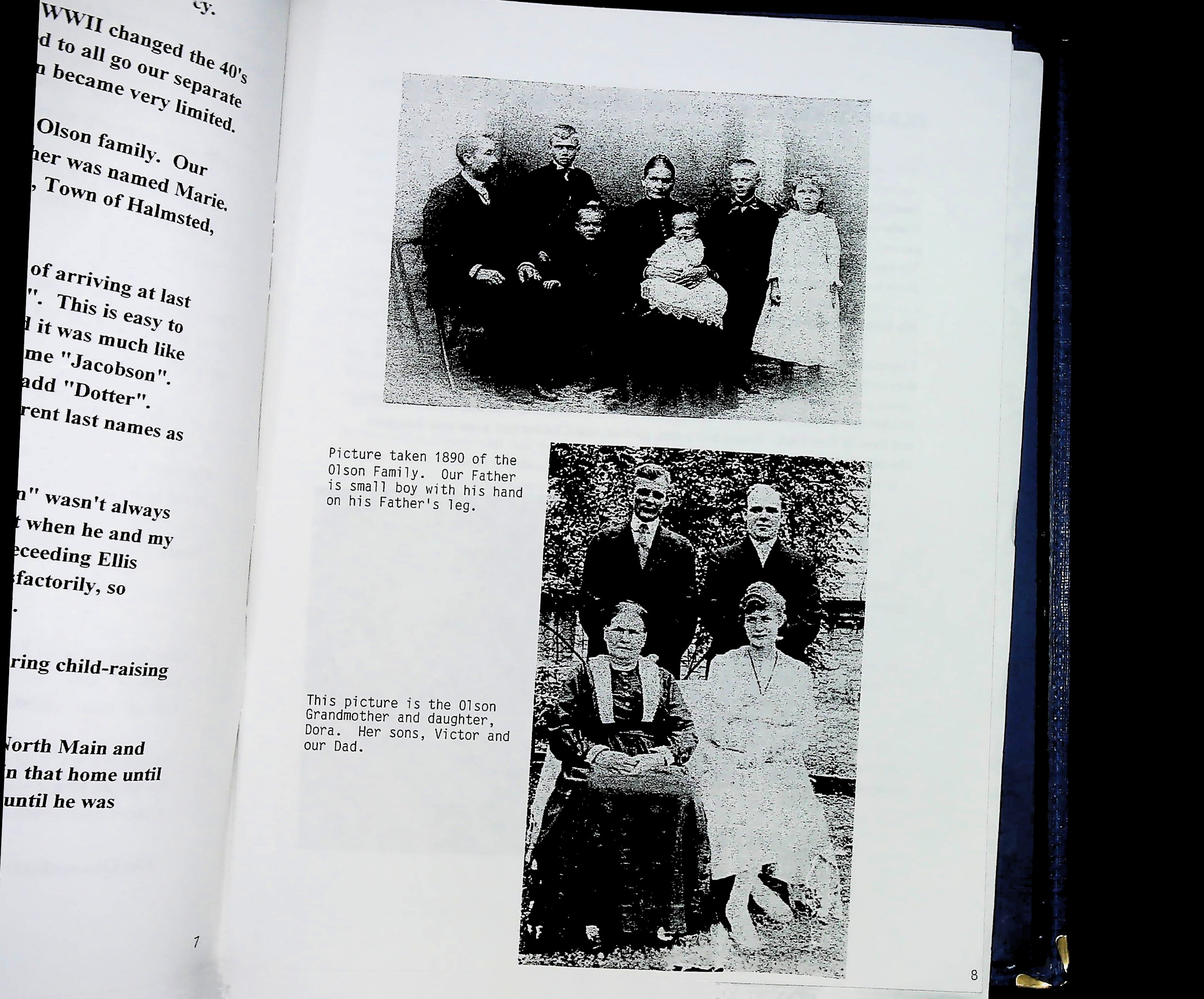
[Booklet page 8, photographs] Picture taken 1890 of the Olson Family. Our Father is small boy with his hand on his Father's leg. This picture is the Olson Grandmother and daughter, Dora. Her sons, Victor and our Dad.
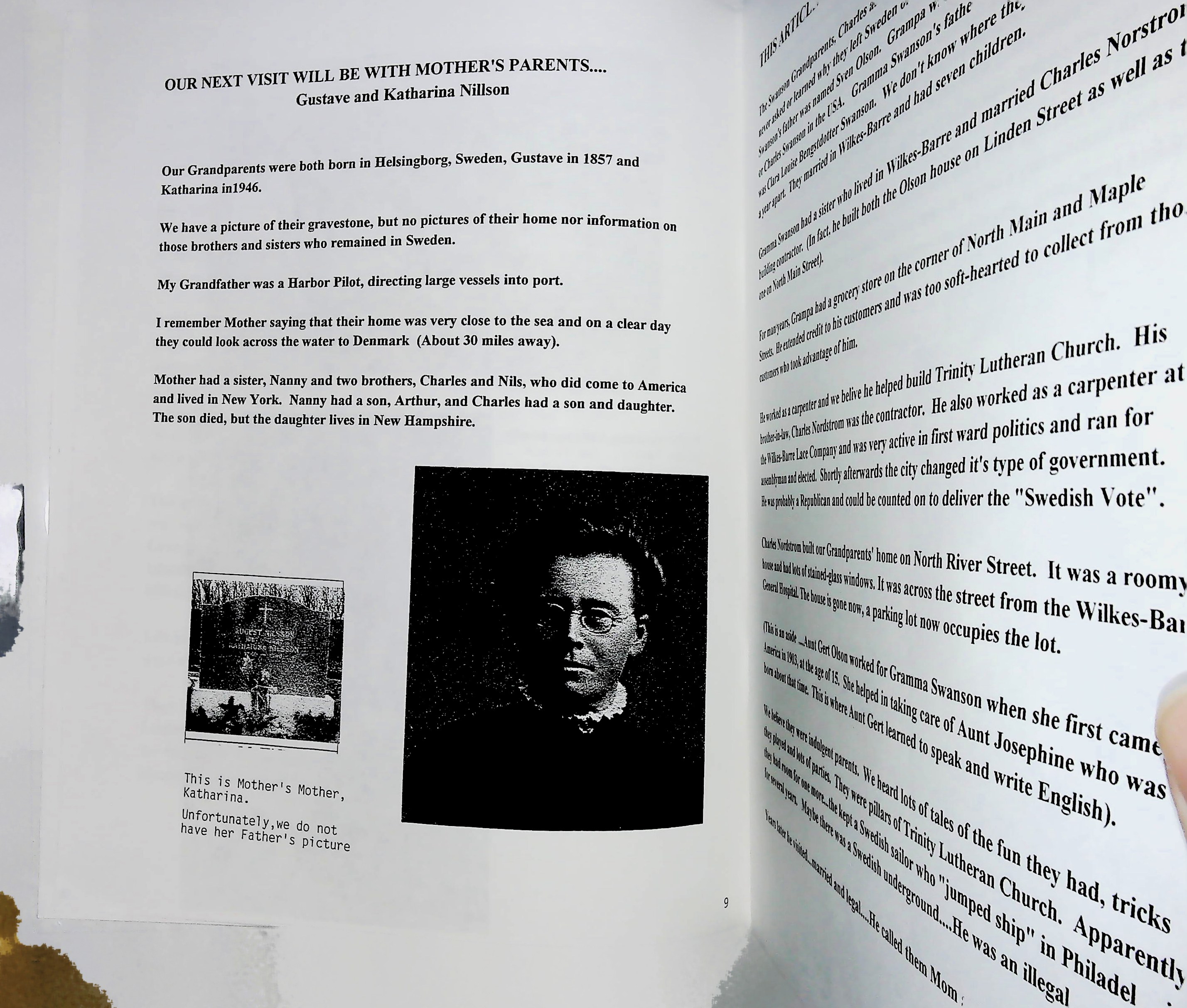
MOTHER'S PAR oe OUR NEXT VISIT WILL BE WIT. Gustave and Our Grandparents were both born in Helsingborg, Sweden, Gustave in 1857 and We have a picture of their gravestone, but no pictures of their home nor information on those brothers and sisters who remained in Sweden. eo My Grandfather was a Harbor Pilot, directing large vessels into port. remember Mother saying that their home was very close to the sea and on a clear day aft they could look across the water to Denmark About 30 miles away), KS Mother had a sister, Nanny and two brothers, Charles and Nils, who did come to America al and lived in New York. Nanny had a son, Arthur, and Charles had a son and daughter, 4 The son died, but the daughter lives in New Hampshire, ti is Mother P'S Picture
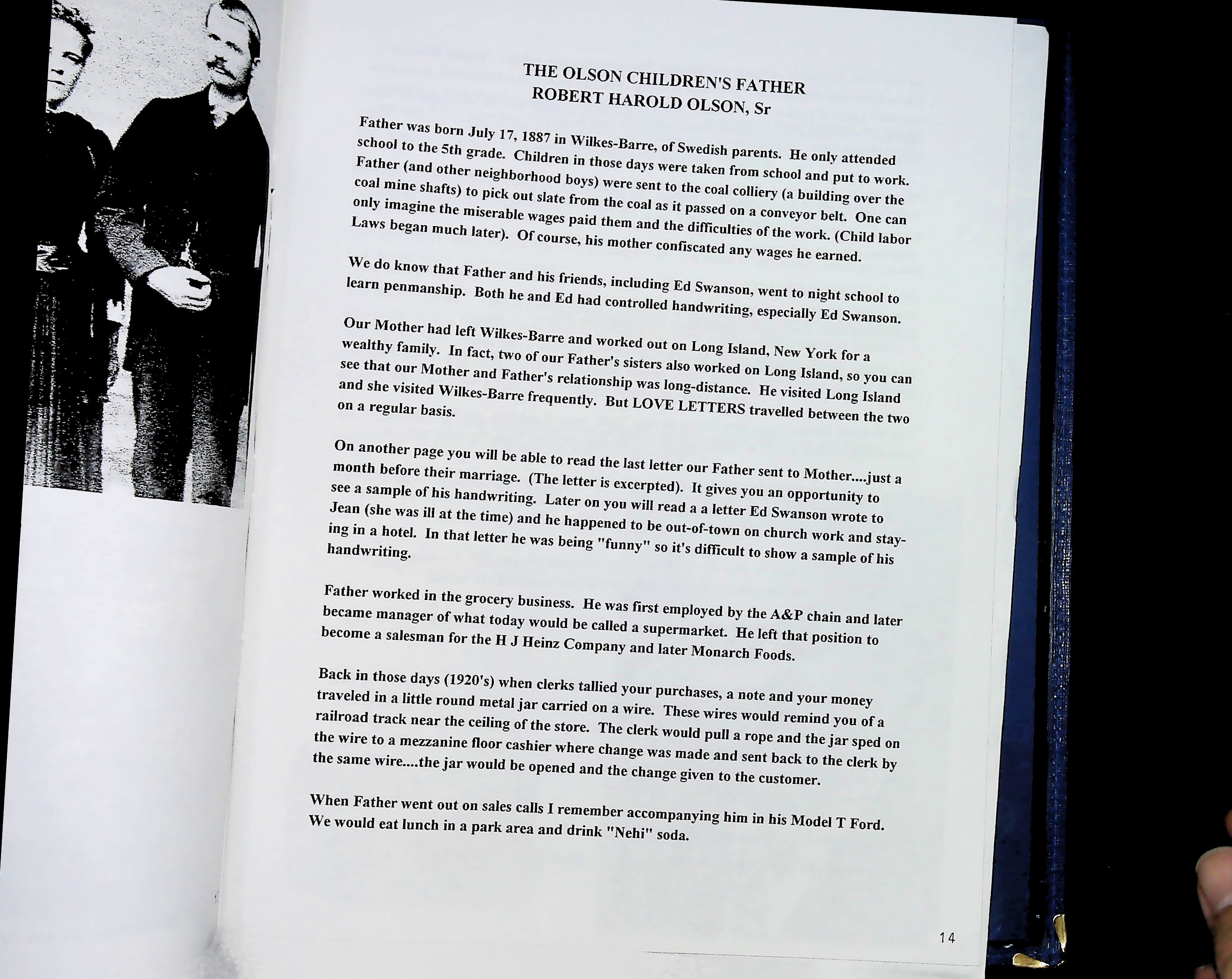
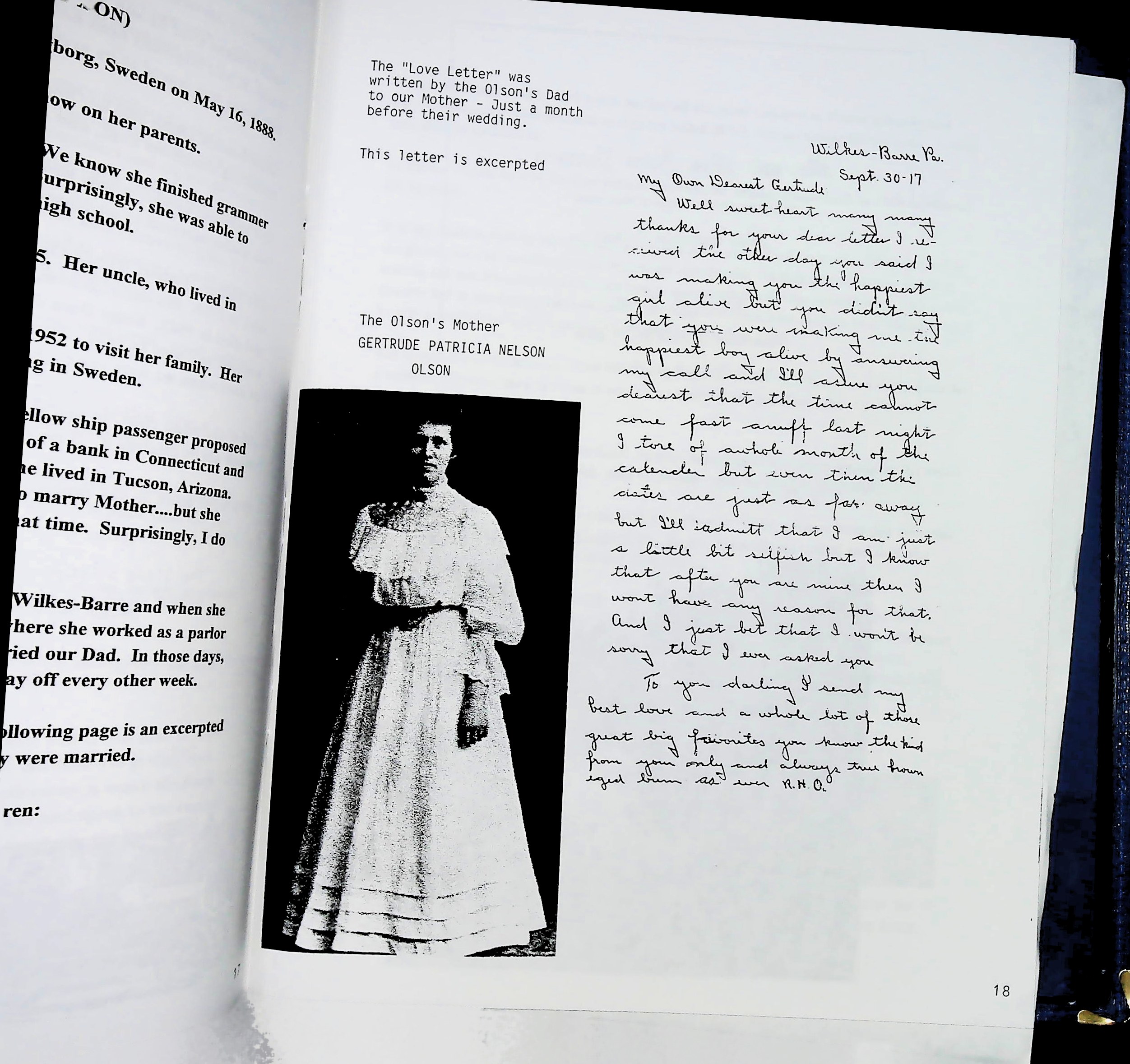
THE OLSON CHILDREN'S FATHER ROBERT HAROLD OLSON, Sr Father was born July 17, 1887 in Wilkes-Barre, of Swedish parents. He only attended school to the Sth grade. Children in those days were taken from school and put to work. Father (and other neighborhood boys) were sent to the coal colliery (a building over the 1. coal mine shafts) to pick out slate from the coal as it passed on a conveyor belt. One can only imagine the miserable wages paid them and the difficulties of the work. (Child labor Laws began much later). Of course, his mother confiscated any wages he earned. We do know that Father and his friends, including Ed Swanson, went to night school to ke Both he and Ed had controlled handwriting, especially Ed Swanson. 7 Our Mother had left Wilkes-Barre and worked out on Long Island, New York for a wealthy family. In fact, two of our Father's sisters also worked on Long Island, so you can ies see that our Mother and Father's relationship was long-distance. He visited Long Island Hs and she visited Wilkes-Barre frequently. But LOVE LETTERS travelled between the two on a regular basis. se On another page you will be able to read the last letter our Father sent to Mother....just a pl month before their marriage. (The letter is excerpted). It gives you an opportunity to see a sample of his handwriting. Later on you will read a a letter Ed Swanson wrote to iH Jean (she was ill at the time) and he happened to be out-of-town on church work and stay- ing in a hotel. In that letter he was being "funny" so it's difficult to show a sample of his jit handwriting. te Father worked in the grocery business. He was first employed by the A&P chain and later became manager of what today would be called a supermarket. He left that position to His become a salesman for the H J Heinz Company and later Monarch Foods. a Back in those days (1920's) when clerks tallied your purchases, a note and your money 4 traveled in a little round metal jar carried on a wire. These wires would remind you of a railroad track near the ceiling of the store. The clerk would pull a rope and the jar sped on the wire to a mezzanine floor cashier where change was made and sent back to the clerk by 4 the same wire....the jar would be opened and the change given to the customer. 'a When Father went out on sales calls I remember accompanying him in his Model We would eat lunch in a park area and drink
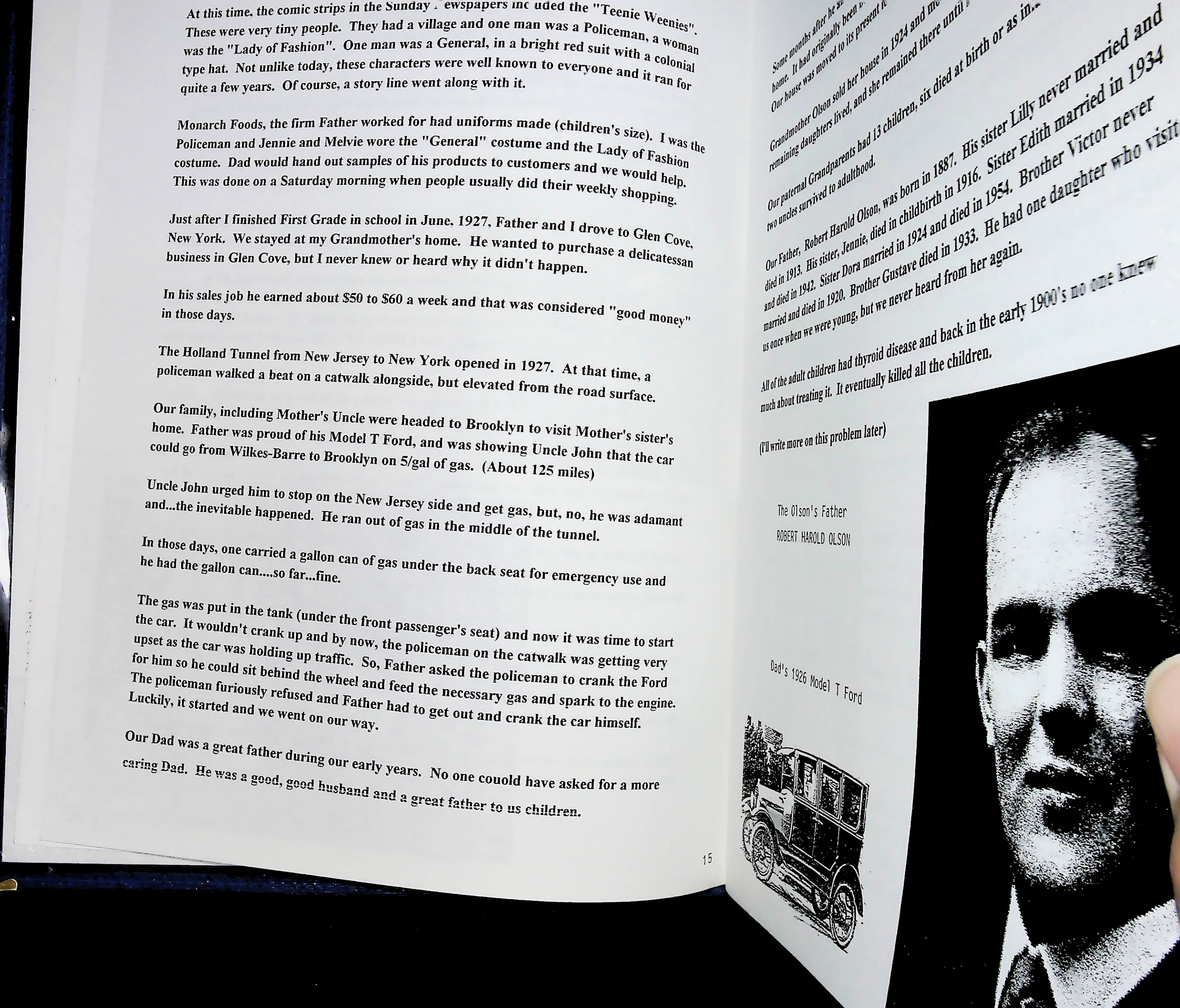
At this time, the comic They had a village and one man was a Policeman, ie rae opie. A These were very tiny Nea One man was a General, in a bright red suit With a cay gf was the "Lady ont = z these characters were well known to everyone and it ran f po ae i ye! is type hat. Not unlike today, ine went along with it. an to go gf Of course, a story line ()! sg 10 quite a few years. te ie ds, the firm Father worked for had uniforms made ( children's Size), I Wag th it Monarch oe eee and Melvie wore the "General" costume and the Lady of eee would hand out samples of his products to customers and we would help pt e (0 if did their cee when people usually eir weekly sh This was done on a Saturday morning P penne b rae i (10 ae Just after I finished First Grade in school in June. 1927, Father and drove to Glen Cove, hel R o tel je? vt New York. We stayed at my Grandmother's home. He wanted to Purchase a delicatessay tl gf: Bs : ter port business in Glen Cove, but I never knew or heard why it didn't happen. iid ip gf Gis In his sales job he earned about $50 to $60 a week and that was considered good money" ie in those days. The Holland Tunnel from New Jersey to New York opened in 1927. At that time, a ul sftbe adult? Part eventually policeman walked a beat on a catwalk alongside, but elevated from the road Surface, «problem later Our family, including Mother's Uncle were headed to Brooklyn to visit M Other's sister's qi write wore 0 this prob home. Father was proud of his Model T F ord, and was Showing Uncle John that the car could go from Wilkes-Barre to Brooklyn on S/gal of gas. (About 125 miles) Father urged him to stop on the New Jersey side and get gas, but, no, he was adamant inevitable happened. He ran Out of gas in the middle of the tunnel, In those days, one carried a gallon can of under the back seat for emergency use and The gas was put in the tank (under th fi the car, It wouldn't crank € iront Passenger's Seat) and now it was time to start car wes oe uP and by now, the Policeman on the catwalk was getting very lid 996 for him so he could sit behind eo So, Father asked the policeman to crank the Ford te} 7 Fong The Policeman furiously refused and aren = oy, es ee ae 3 Luckily, it Started ater had to Set out and crank the car himself. LAN yay. Pate Ao Was a great father during our early are Ih a iN ay STEED, Wore cee eee Sion couold ave asked for alutare AN Ry 2nd a groat father to ng children, Tas. Ws a SS SaaS
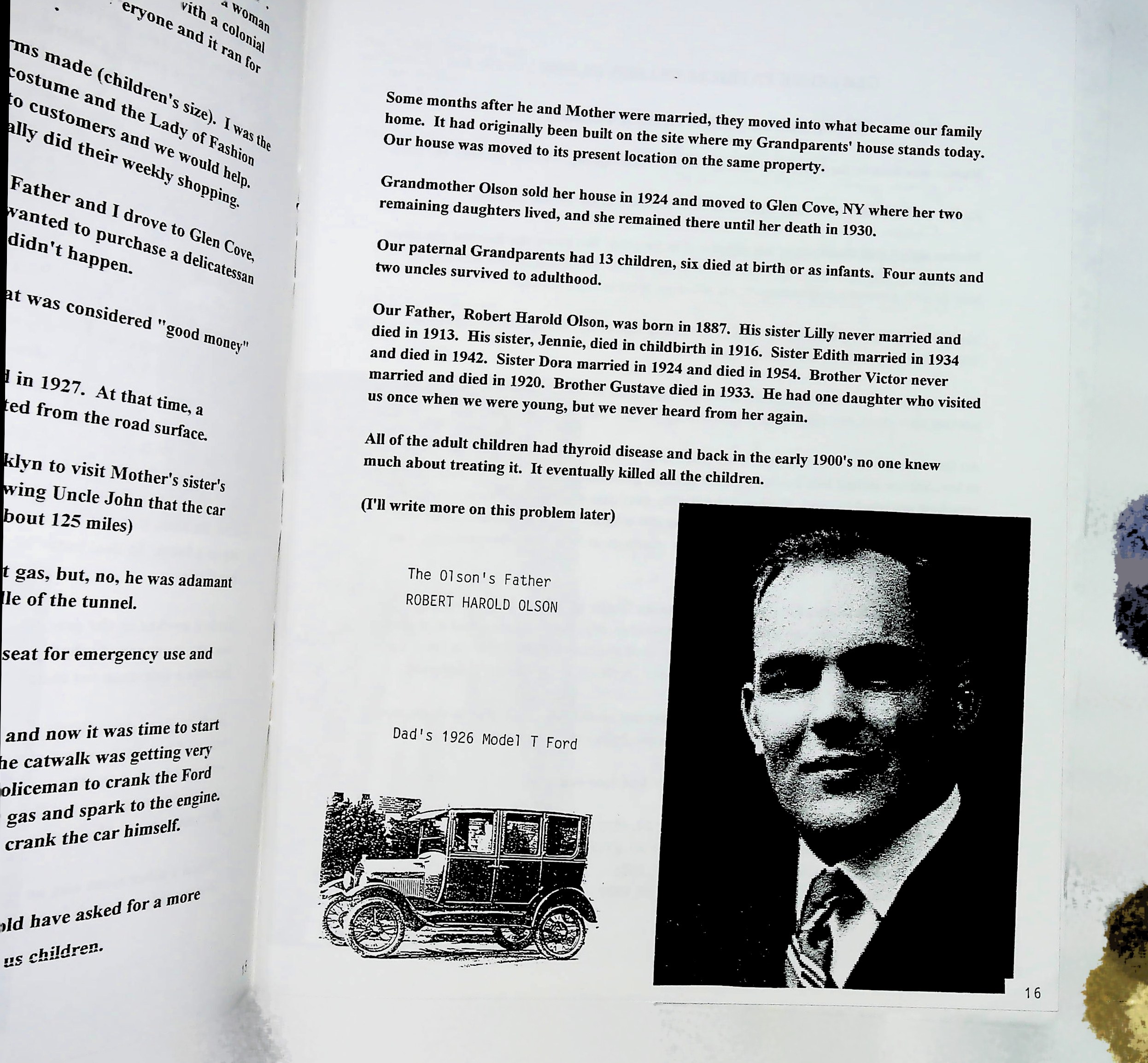
Some months after he and Mother were married, they moved into what became our family home. It had originally been built on the site where my Grandparents' house stands today. Our house was moved to its present location on the same property. Grandmother Olson sold her house in 1924 and moved to Glen Cove, NY where her two remaining daughters lived, and she remained there until her death in 1930. Our paternal Grandparents had 13 children, six died at birth or as infants. Four aunts and two uncles survived to adulthood. Our Father, Robert Harold Olson, was born in 1887. His sister Lilly never married and died in 1913. His sister, Jennie, died in childbirth in 1916. Sister Edith married in 1934 and died in 1942. Sister Dora married in 1924 and died in 1954. Brother Victor never married and died in 1920. Brother Gustave died in 1933. He had one daughter who visited us once when we were young, but we never heard from her again. All of the adult children had thyroid disease and back in the early 1900's no one knew much about treating it. It eventually killed all the children. (I'll write more on this problem later) dade et Saree Father iz ROBERT HAROLD OLSON fae Dad's 1926 Model T Ford 'age a vert BP Feta Te a Seen faa
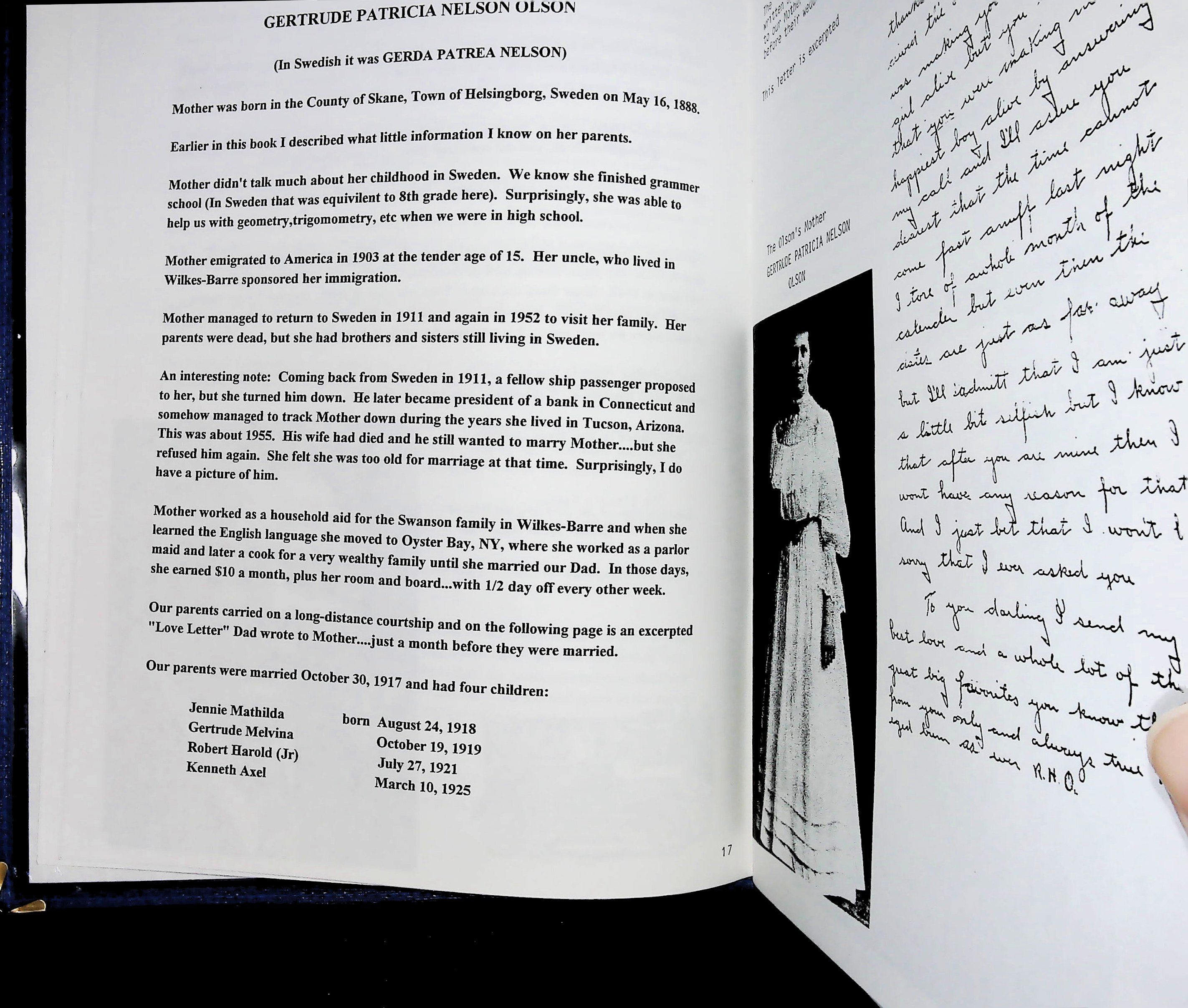
OLSON fr GERTRUDE PATRICIA NELSON) me 3 County of Skane, Town of Helsingborg, Sweden on May ig, Mother was born in the Co information I know on her parents. Earlier in this book I described what little talk much about her childhood in Sweden. We Know she finished grammer Mother didn Seas equivilent to Sth grade here). Surprisingly, she was able to etc when we were in high school. Mother emigrated to America in 1903 at the tender age of 15. Her uncle, who lived in Wilkes-Barre sponsored her immigration. Mother managed to return to Sweden in 1911 and again in 1952 to visit her family. Her parents were dead, but she had brothers and sisters still living in Sweden. An interesting note: Coming back from Sweden in 1911, a fellow ship passenger proposed 4 to her, but she turned him down. He later became president of a bank in Connecticut and a somehow managed to track Mother down during the years she lived in Tucson, Arizona. a This was about 1955. His wife had died and he still wanted to marry refused him again. She felt she was too old for marriage at that time. Surprisingly, I do have a picture of him. Mother worked as a household aid for the Swanson family in Wilkes-Barre and when she ned the English language she moved to Oyster Bay, NY, where she worked as a parlor maid and later a cook for a very wealthy family until she married our Dad. In those days, she earned $10 a month, plus her room and board...with 1/2 day off every other week. ee rae on a long-distance courtship and on the following page is an omer' Had wrote to Mother --..Just a month before they were married. Our parents cre married October 30, 1917 and had four children Gathers born August 24,1918 July 27, 1921 Kenneth Axel] March 10, 1925
[Booklet page 18] The "Love Letter" was written by the Olson's Dad to our Mother - Just a month before their wedding. This letter is excerpted The Olson's Mother GERTRUDE PATRICIA NELSON OLSON [photograph] [Handwritten letter:] Wilkes-Barre Pa. Sept. 30-17 My Own Dearest Gertrude Well sweet-heart many many thanks for your dear letter I received the other day you said I was making you the happiest girl alive but you didn't say that you were making me the happiest boy alive by answering my call and I'll assure you dearest that the time cannot come fast enuff last night I tore of a whole month of the calender but even then the dates are just as far away but I'll admitt that I am just a little bit selfish but I know that after you are mine then I wont have any reason for that. And I just bet that I won't be sorry that I ever asked you To you darling I send my best love and a whole lot of those great big favorites you know the kind from your only and always true brown eyed bum as ever R.H.O.
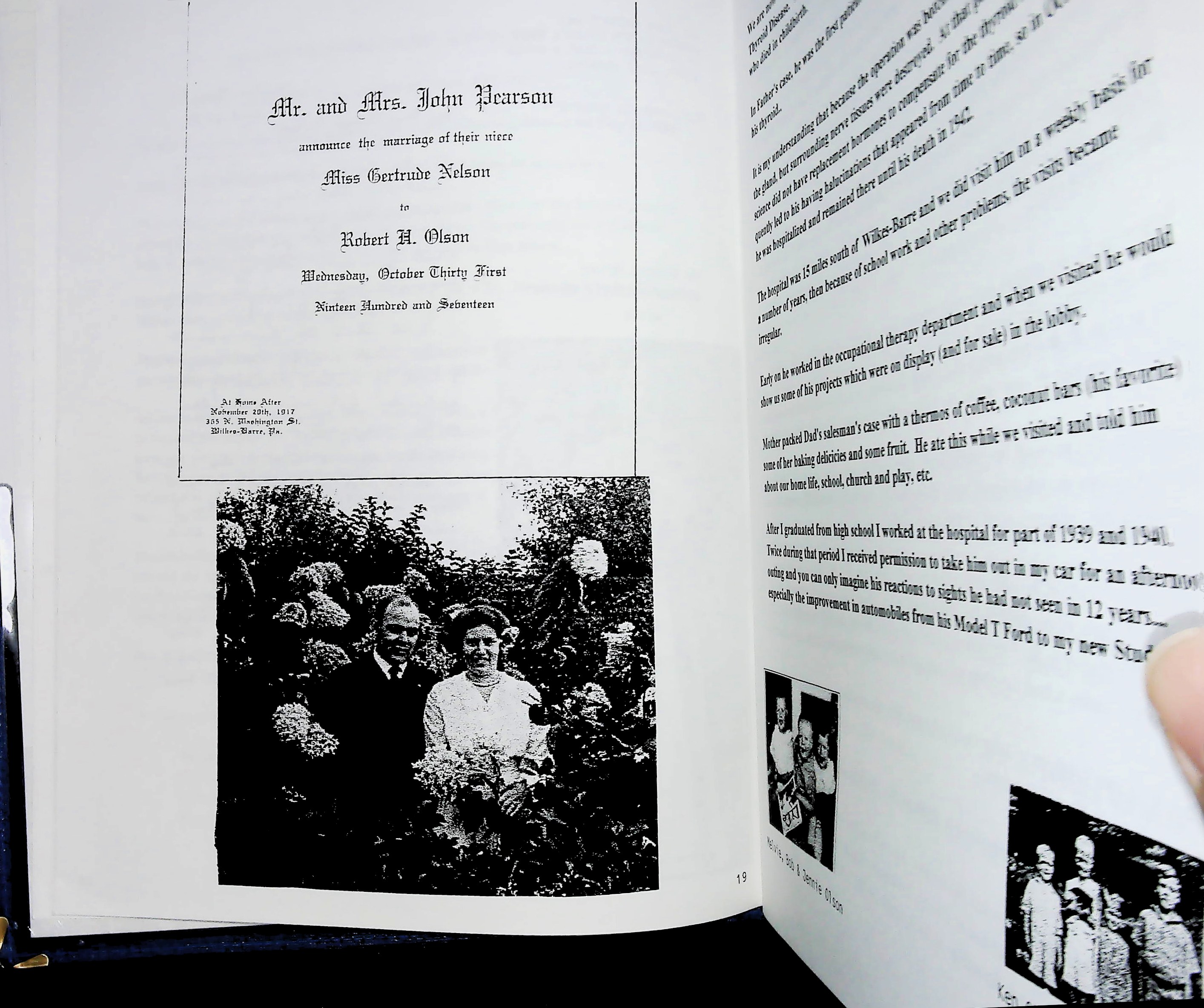
[Booklet page 19: a printed wedding announcement and a photograph] Mr. and Mrs. John Pearson announce the marriage of their niece Miss Gertrude Nelson to Robert H. Olson, Wednesday, October Thirty First, Nineteen Hundred and Seventeen. At Home After November 20th, 1917, 335 N. Washington St., Wilkes-Barre, Pa. [Photograph of the couple among hydrangeas.] [A small photograph on the facing page is captioned "Melvie, Bob & Jennie Olson".]
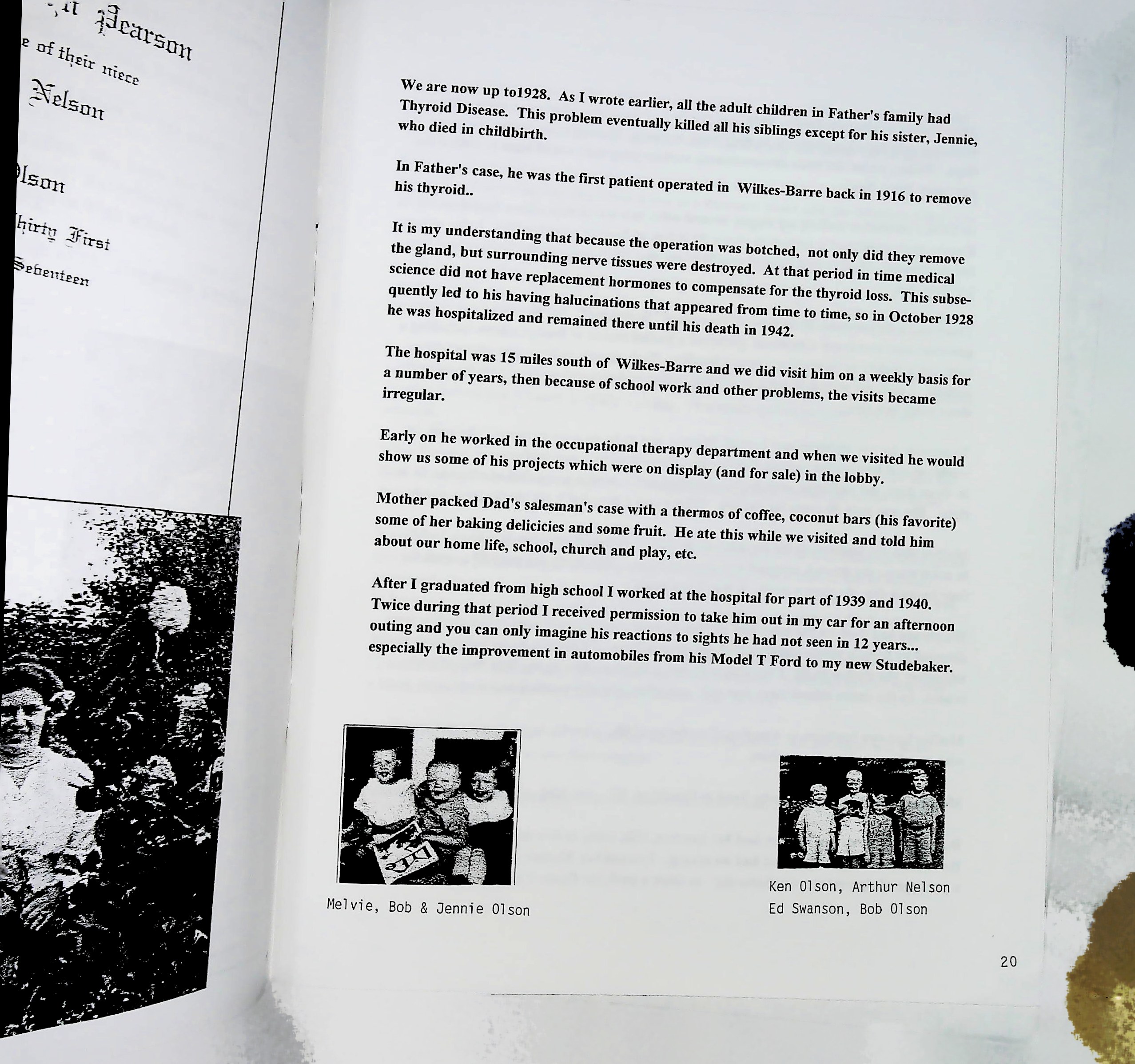
as pee oe up LOE As I wrote earlier, all the adult children in Father's family had seas This problem eventually killed all his siblings except for his sister, Jennie, who died in childbirth. case, he was the first patient operated in Wilkes-Barre back in 1916 to remove his thyroid.. It is my understanding that because the operation was botched, not only did they remove ae end but surrounding nerve tissues were destroyed. At that period in time medical science did not LENG replacement hormones to compensate for the thyroid loss. This led to his having halucinations that appeared from time to time, so in October 1928 he was hospitalized and remained there until his death in 1942. The hospital was 15 miles south of Wilkes-Barre and we did visit him on a weekly basis for a number of years, then because of school work and other problems, the visits became irregular. Early on he worked in the occupational therapy department and when we visited he would show us some of his projects which were on display (and for sale) in the lobby. Mother packed Dad's salesman's case with a thermos of coffee, coconut bars (his favorite) some of her baking delicicies and some fruit. He ate this while we visited and told him about our home life, school, church and play, etc. After I graduated from high school I worked at the hospital for part of 1939 and 1940. Twice during that period I received permission to take him out in my car for an afternoon outing and you can only imagine his reactions to sights he had not seen in 12 years... especially the improvement in automobiles from his Model T Ford to my new a rs "an eae Ken Olson, Arthur Nelson 7 Ed Swanson, Bob Olson Melvie, Bob & Jennie Olson
source of income, ex we hospitalized in 1928, our family had no . ee for After Father was ee ed in their bank account. There was no welfare in those whatever may =e the same circumstances, various programs would have provided the days. Today, un er ys necessary living funds. a miles to a warehouse where President it In 1930, I remember pulling my wagon : Pe pe ne "ad established a project to give a 50 Ib bag of Hour to poor Hoover ha 50 Ib bag into the 9) to get that g chen and ip ber the struggle Mother and I had (I was 9) to her flour bin. There was a Department Store downtown named "Bergmans". Mr Bergman was a very 1 generous man and every Christmas prepared : bushel basket cf food products including ham and a turkey to be given to certain families. Each church in town was allocated two bf baskets. I took my wagon to town to get our basket and remember doing this for two or gc three years in a row. su ie To provide for her children and herself, Mother had to be an entrepreneur. She took in and ironing for various families but specialized in nurse uniforms and caps. After In those days, the uniforms were highly starched and it took a great deal of effort to do it right. She was paid 50 cents for the job. (There was a hospital 1 1/2 blocks from our home) time Mother also did housework for certain people and then began working in a bank building in town where she dusted, mopped and cleaned toilets. The bank job paid $8 a week for tho pe four hours a day, six days a week. It was hard work. We always pao food on the table and clothes to wear even though most of the clothes were by friends whose children had out-grown them. Of course, many hours were spent Many, ee us eee the Clothes to fit. Iremember wearing knickers during my first year of high "ath School. In the entire school there was only one other boy still wearing knickers. tb Mother had two brothers in Amer he erica, Charles and Nils. Cornelia who now lives in New Mo arclire ; s. Charles has a daughter, Mother had a sister, Nan "ad 9 hy, who lived in Brooklyn, NY. She had one son, named Arthur. During the depression He was unable to get : job a = her brother, N ils, come to live with us for quite a a package of ci a@ 00 money. I remember Mother giving me the price of to fetch a pack for Uncle Nils.
oe have pubmed: Mother DID NOT have an easy life. Faced with raising four children th, ee the terrible depression years was a real struggle but Mother was always upbeat and id not show any depression to us children. She just did not talk about her struggles. a da, Mother and Aunt Emma Swanson were closer than sisters. They talked on the phone every chs a day and as I wrote earlier, the Olson home as a Swanson home and the Swanson home was an Olson home. These two women even helped each other every year at "spring housecleaning" time. I Was A. hated this time of year, and when I arrived home from school at lunchtime and saw carpets on the clothes line for beating the dust out of them...curtains off the windows....I felt like running away. DW or In spite of all the time Mother spent working she still took time to participate in church activities. Our church was across the street from our house and it was mandatory to attend Sunday School and Church EVERY Sunday. You really had to be quite sick to be 'took in excused. "to do; After Sunday School, a gang of kids would head for our house where Mother had laid out little candy tokens which they all enjoyed before rushing back across the street to be on time for church. Naturally, a collection was taken at Sunday School, and each of us four children were given two pennies to put in the plate. Other kids were able to put in a nickle, but as Mother explained, she was really putting in 8 cents total, whereas, families with working Dads put in 5 cents or even with two children 10 cents, so she really participated with her 8 cents. were 4 2 spent Many activities of our youth were spent at the church. The young peoples group, called "Luther League" put on plays and other type entertainment. A branch library was only a block from our home and we spent many hours there as well. The boys played all the sports in the street and in nearby fields. Ed Swanson will write more on those activities in another chapter. pear I did most of the food shopping from the time I was 8 or 9 and my household chore was to
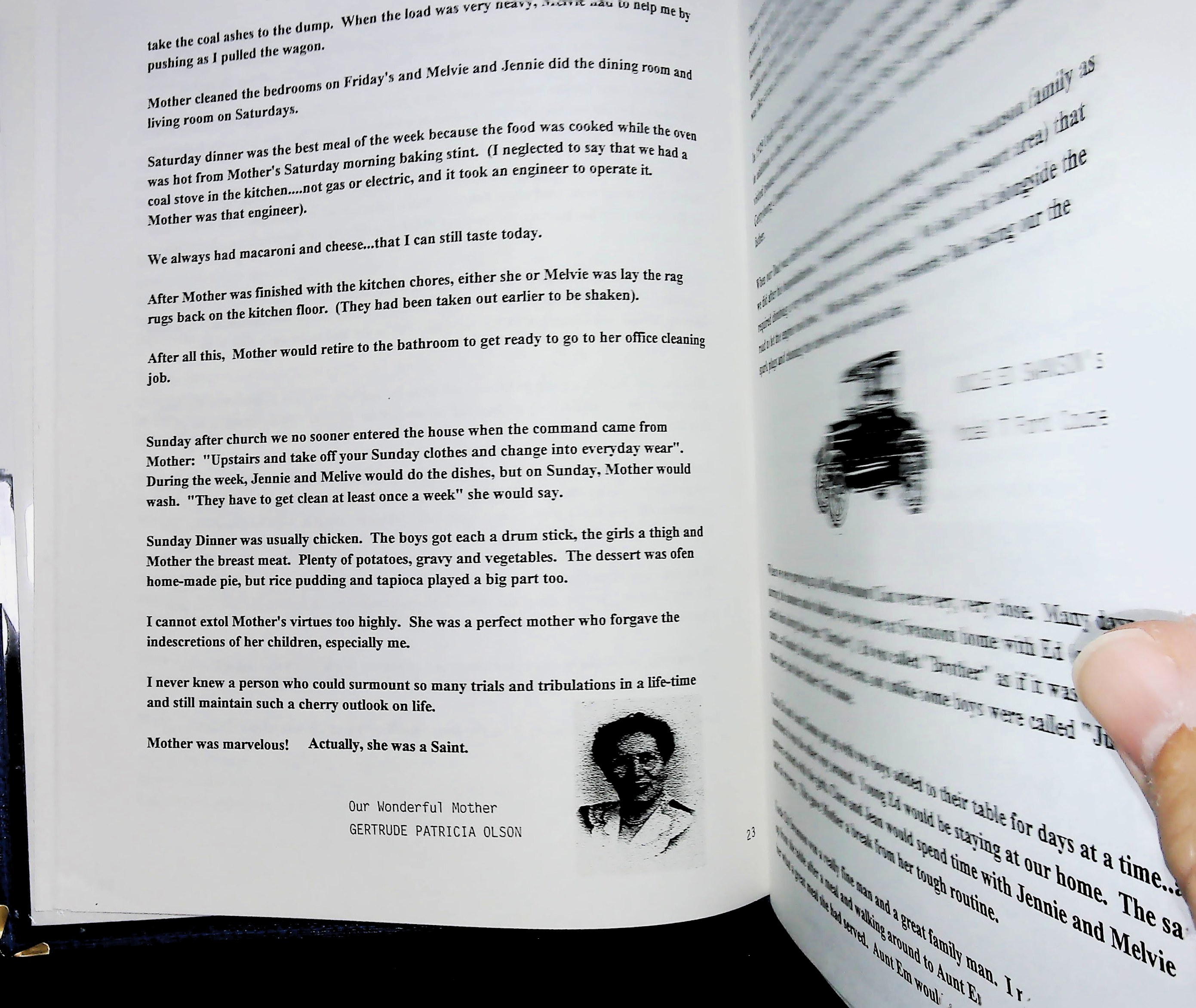
When the igad Was Vere EAT oe ae ee to the dump, take the coal ashes wagon. pushing 4% J pulled the : oat oe, on Friday's and Melvie and Jennie did the dining room, and Mother cleaned the bedrooms on if living room on Saturdays. meal of the week because the food was cooked while the Oven Saturday dinner wa? ay rday morning paking stint. (I neglected to say that we had mas neon" age s or electric, and it took an engineer to operate it. Sf Fs 3 coal stove in the Mother was that engineer). I can still taste today. We always had After Mother was finished with the kitchen chores, either ae ners ae lay the rag ish rugs back on the kitchen floor. (They had been taken CBE saa iO Mf ot After all this, Mother would retire to the bathroom to get ready to go to her office cleaning it a Sunday after church we no sooner entered the house when the command came from 7 Mother: "Upstairs and take off your Sunday clothes and change into everyday wear". During the week, Jennie and Melive would do the dishes, but on Sunday, 'other would wash. 'They have to get clean at least once a week" she would say. Sunday Dinner was usually chicken. The boys got each a drum stick. the girls a thigh and Mother the breast meat. Plenty of potatoes, gravy and vegetables. The dessert was home-made pie, but rice pudding and tapioca played a big part too. Nt cannot es Mother's virtues too highly. She was a perfect mother who forgave the Sig ig a of her children, especially me. les I never knew a pers a on who could surmount so many trials and tribulations in a life-time a a such a cherry outlook on life. was marvelous! Actually, she was a Saint. = sz = X ee ty Our Wonderful Mother gt = .* wy my, 3 GERTRUDE PATRICIA OLSON SE a me
Notes
Source: "Saying Good-bye: A Tale of Two Families, The Olson/Swanson Clan", booklet assembled by Robert H. Olson, 1998: Robert H. Olson's chapters on the Olson and Nilsson grandparents and on his parents Robert H. Olson Sr. and Gertrude Nelson Olson Location: "Saying Good-bye: A Tale of Two Families, The Olson/Swanson Clan", booklet assembled by Robert H. Olson, 1998 Found by: Claude research assistant