G. E. Valley Jr.'s research of 26-29 May 1985 to date the tintype labelled "Grandma Cummins": a picture of Queen Victoria in 1867 in the same pose, dictionary and Britannica entries on ferrotypes and the wet-collodion process, his reckoning of Thomas Henry and Frances Jane Cummins's ages, dress styles from costume books, and studio poses from Collecting Photographica, Cartes de Visite in 19th Century Photography and The Daguerreotype in America. He concluded that the picture was taken about 1875-85 and shows his grandmother Frances Jane Baack Cummins, not Rebecca Ringgold Cummins. Also notes of a fruitless library search on bugles and blockade running.
History · May 1985 · Concord, Middlesex, Massachusetts, United States
Linked to Charles Mortimer Cummins, Henry George Cummins, Katharina Donnecker, Frances Jane Baack, Thomas Henry Cummins, Rebecca B Ringgold, Edith Ringgold Cummins, Heinrich Eduard Baack, Sr. and George Edward Valley Jr
14 pages. Open one to read it full size.
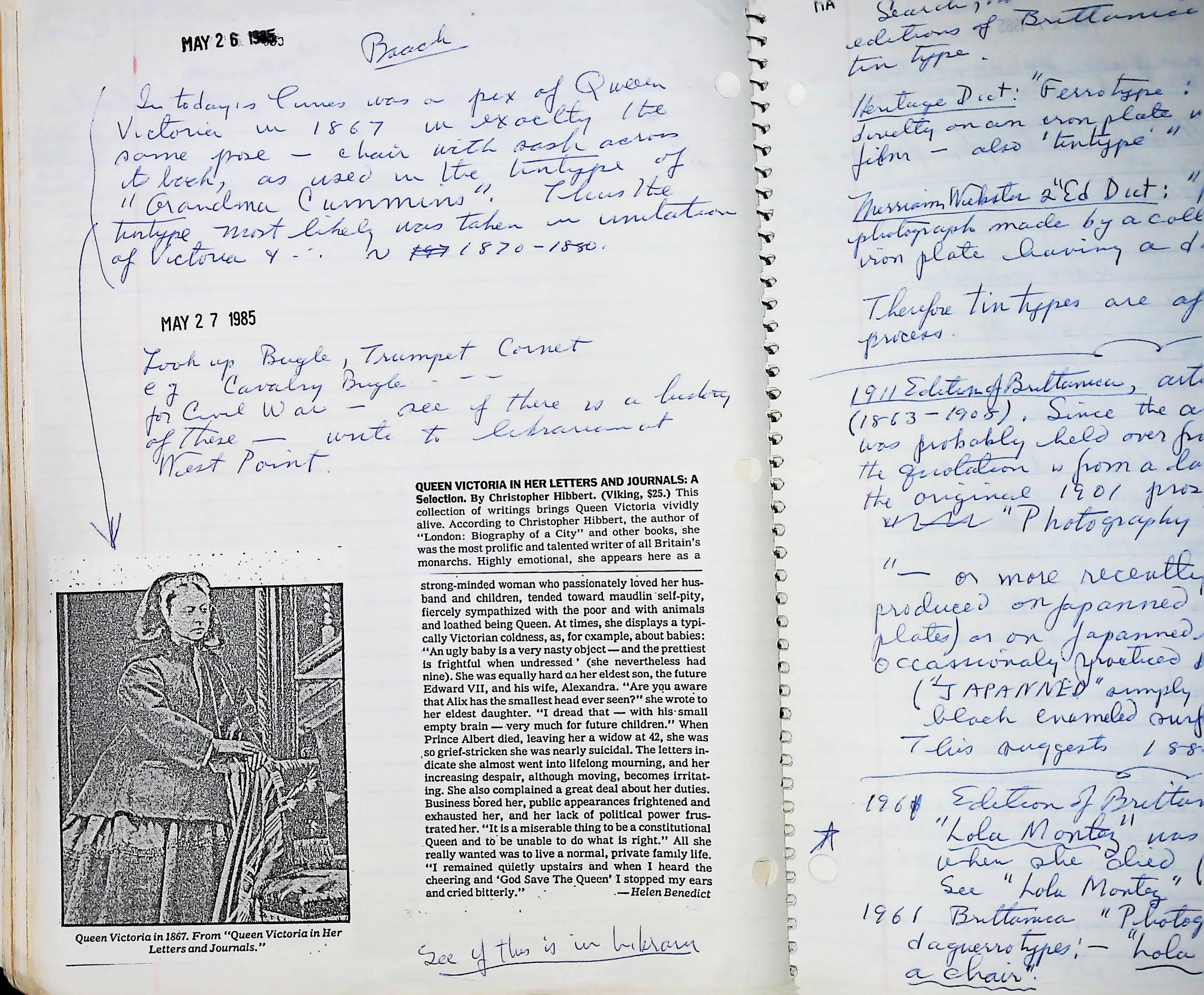
Notebook p. 102
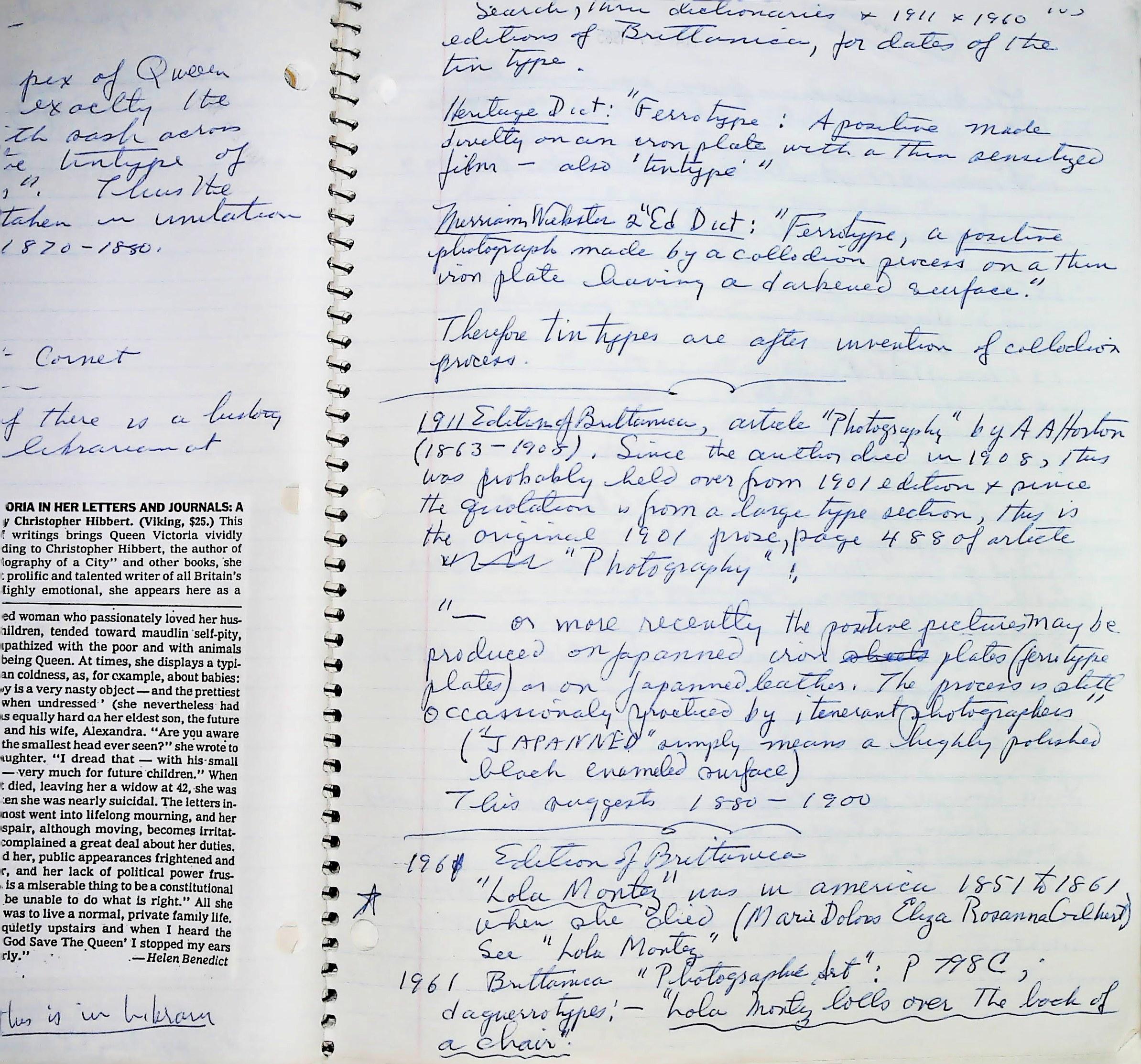
Notebook p. 103
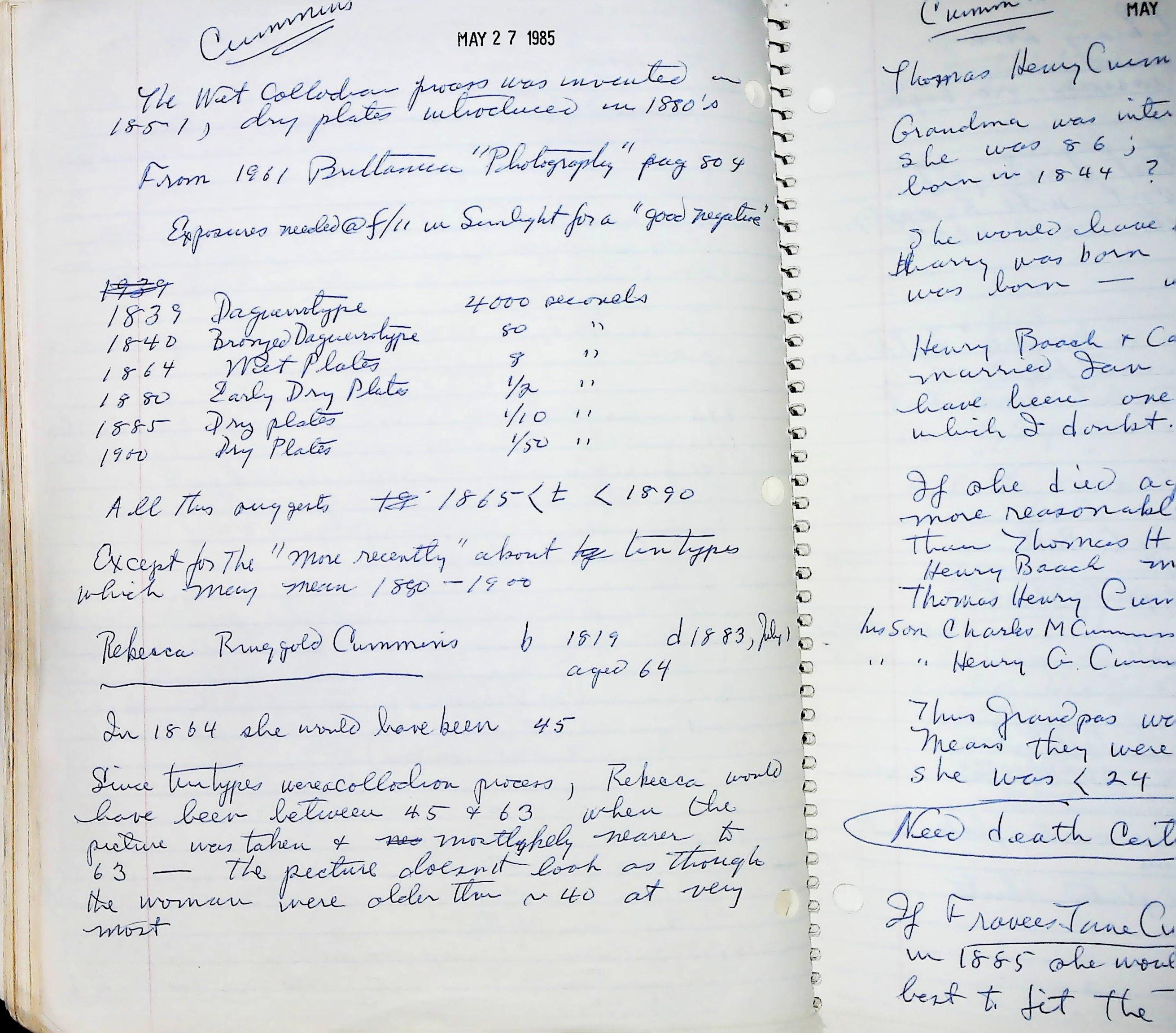
Notebook p. 104
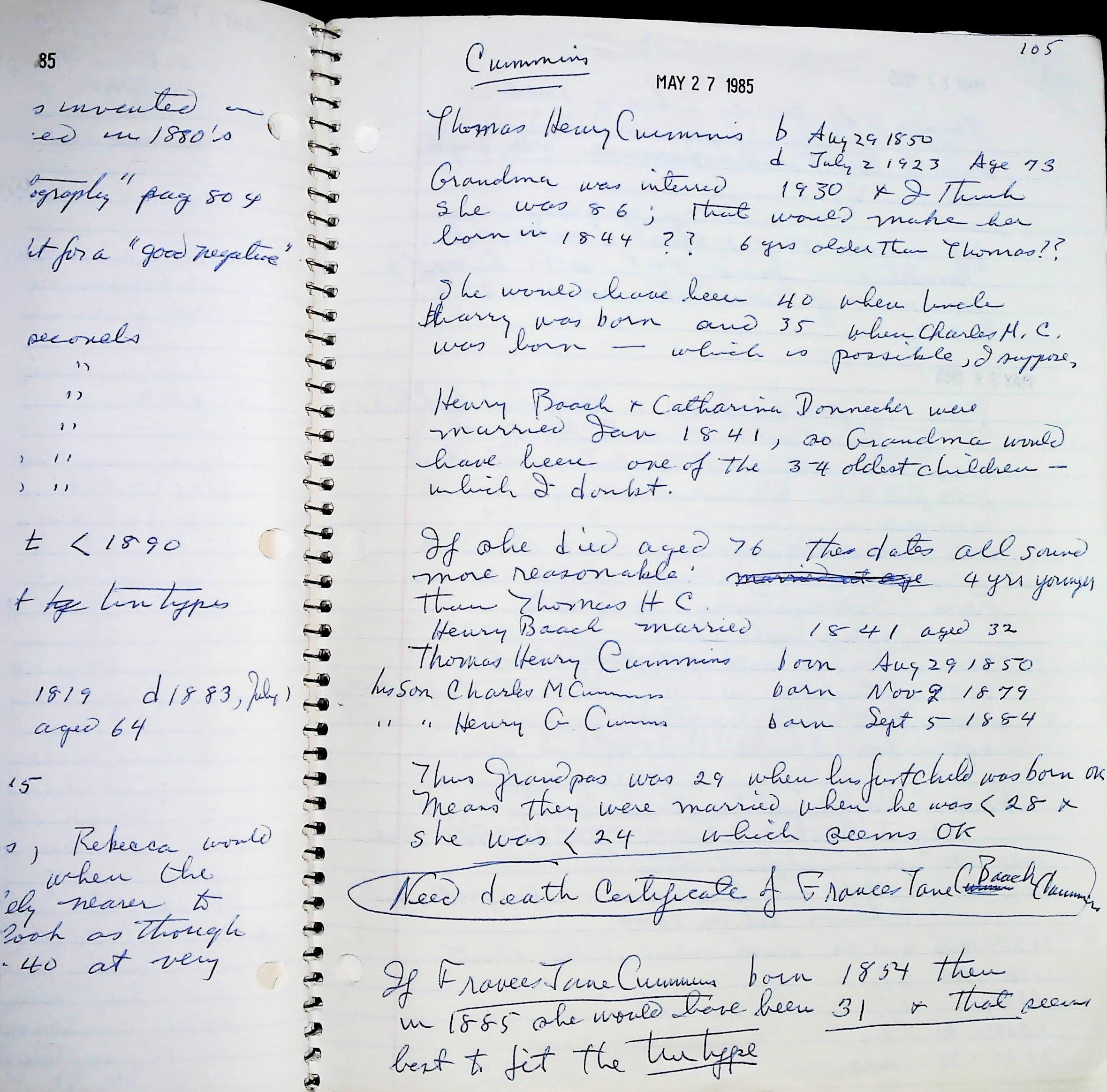
Notebook p. 105
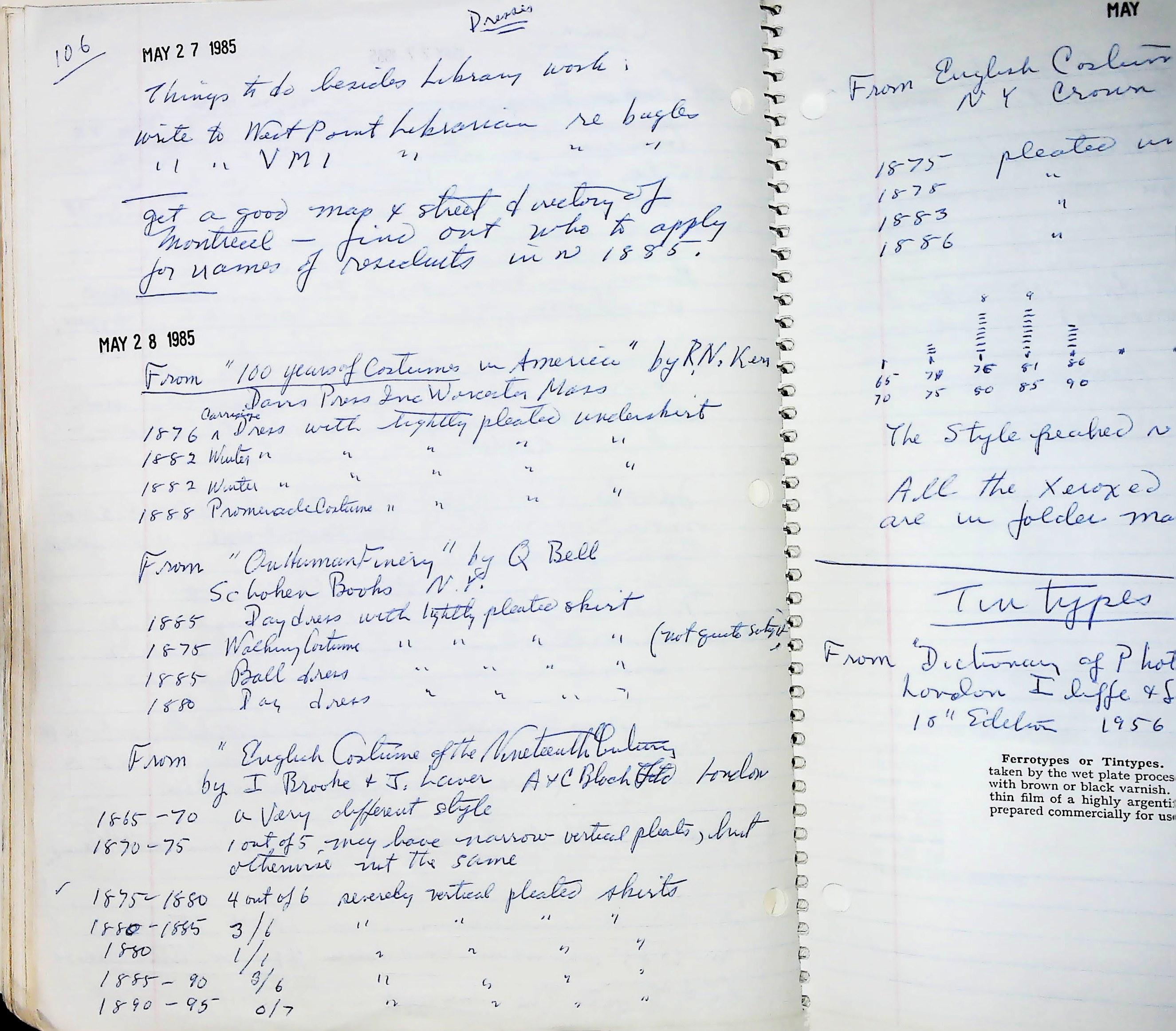
Notebook p. 106
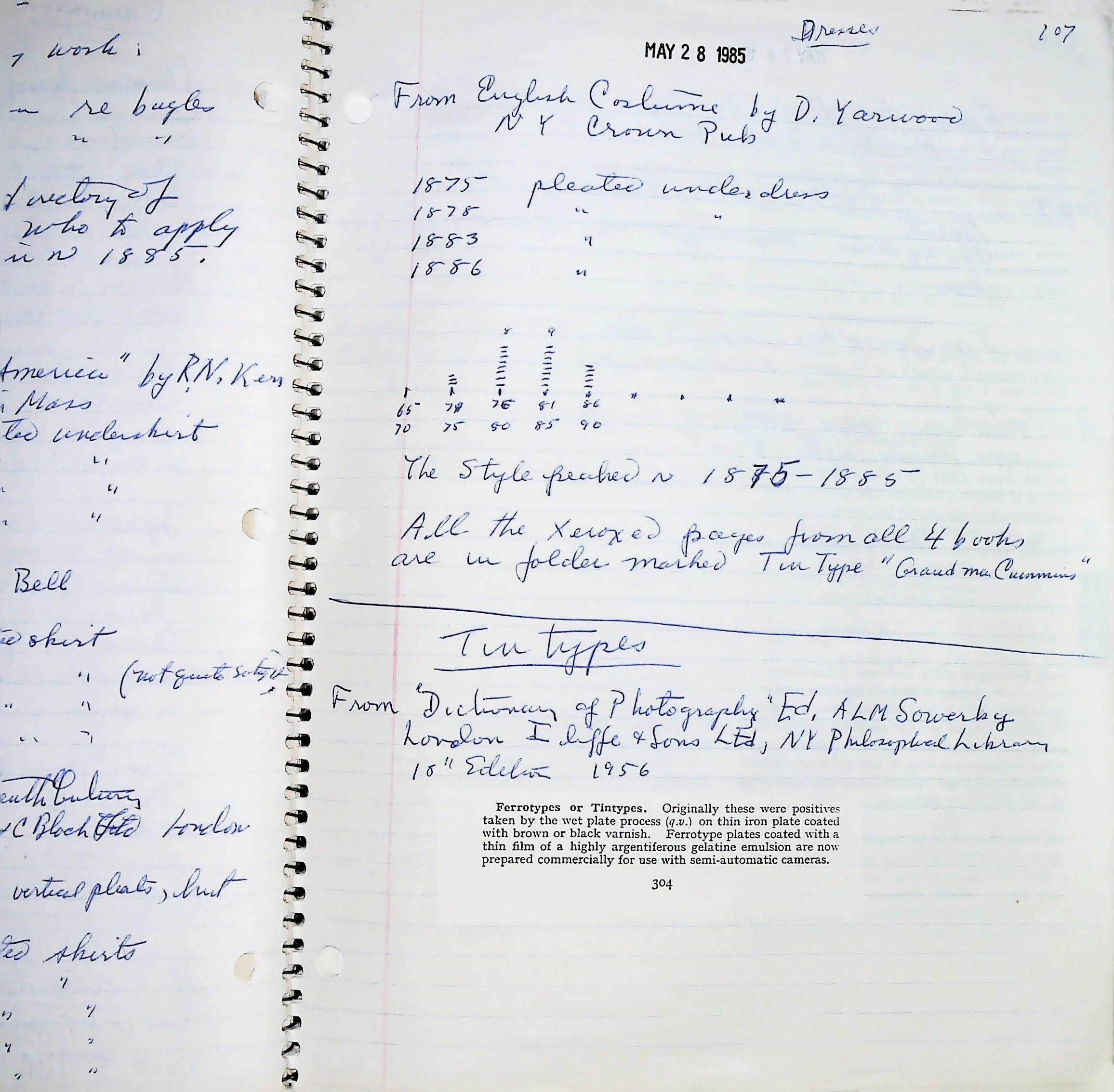
Notebook p. 107
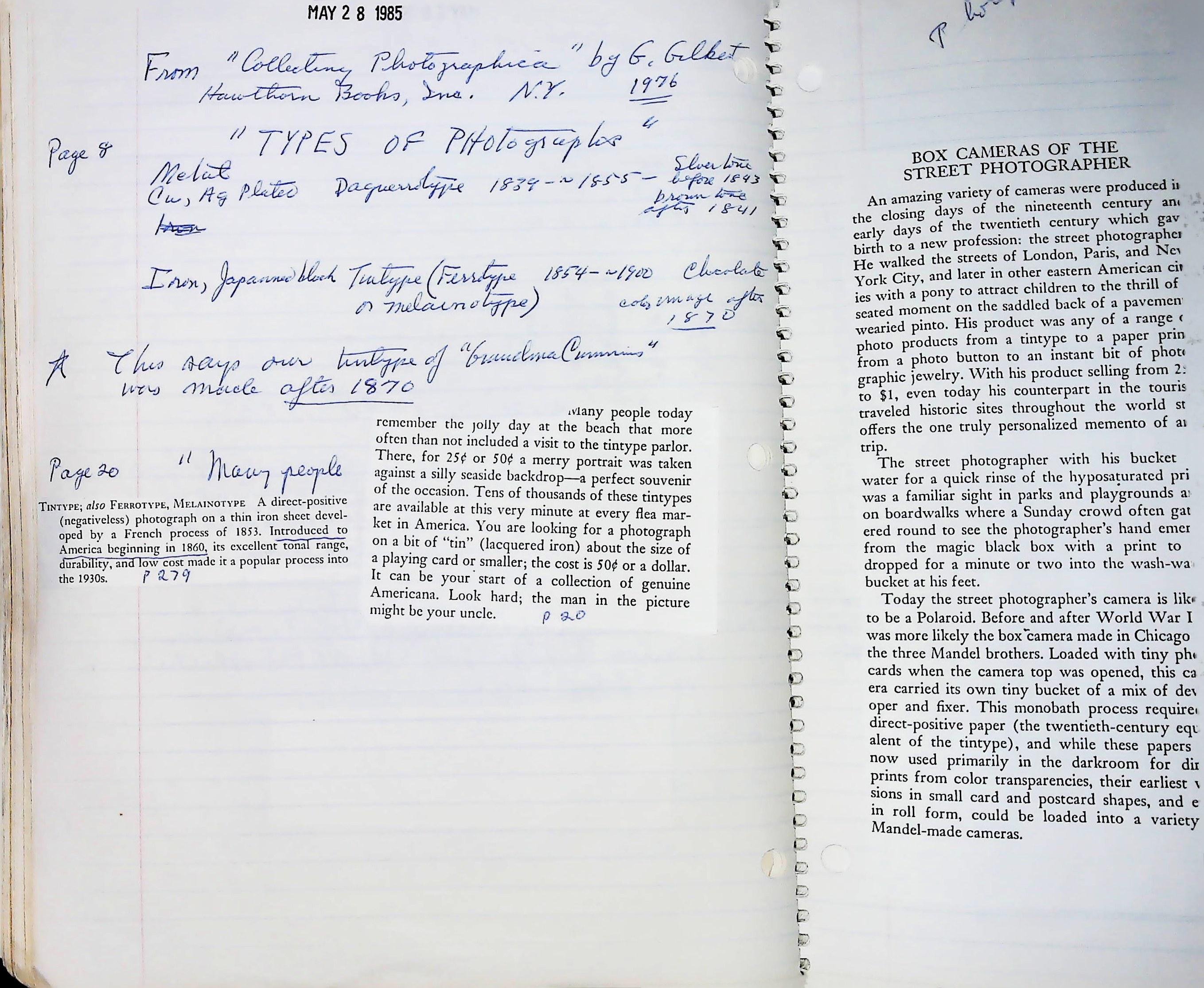
Notebook p. 108
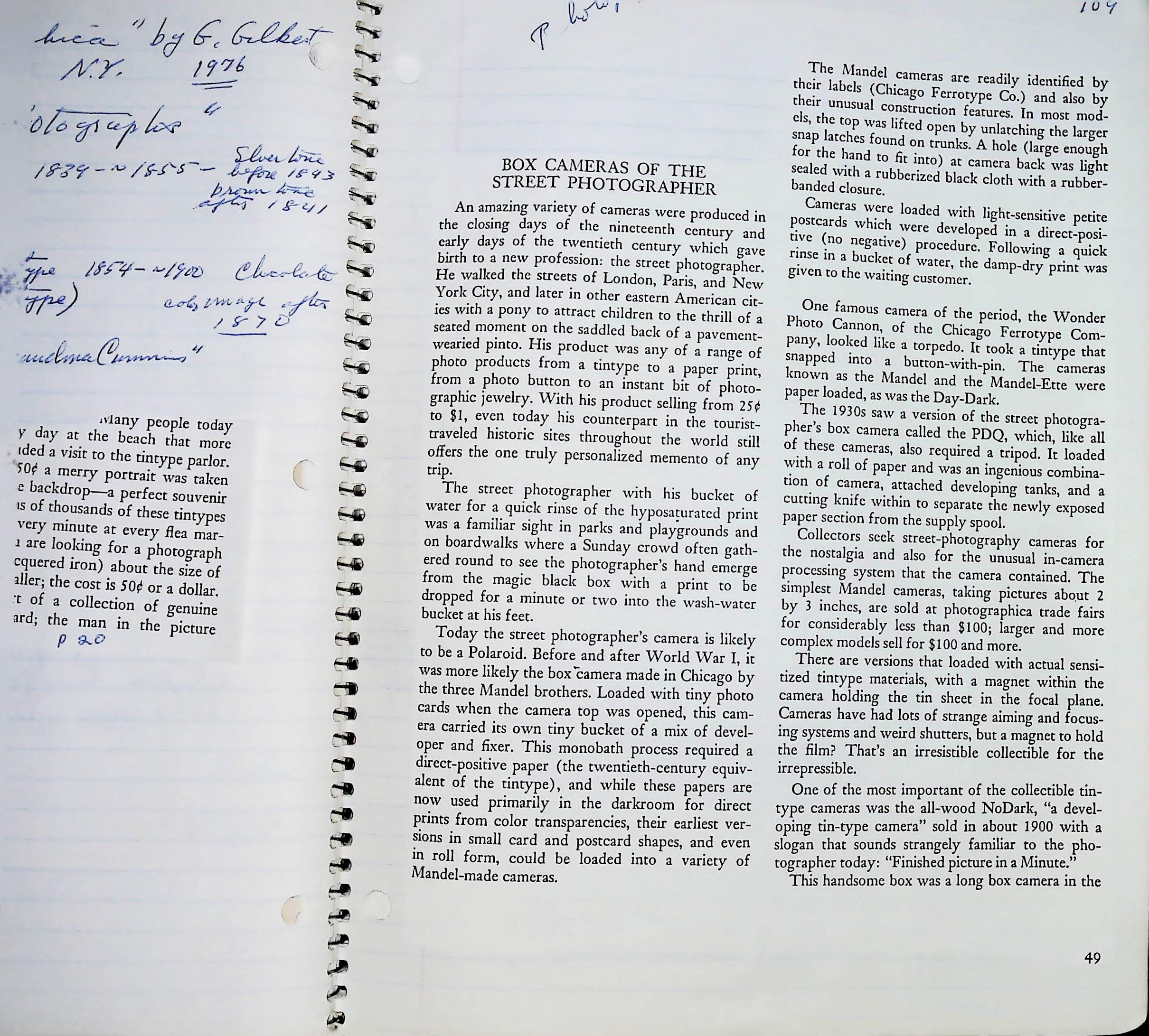
Notebook p. 109
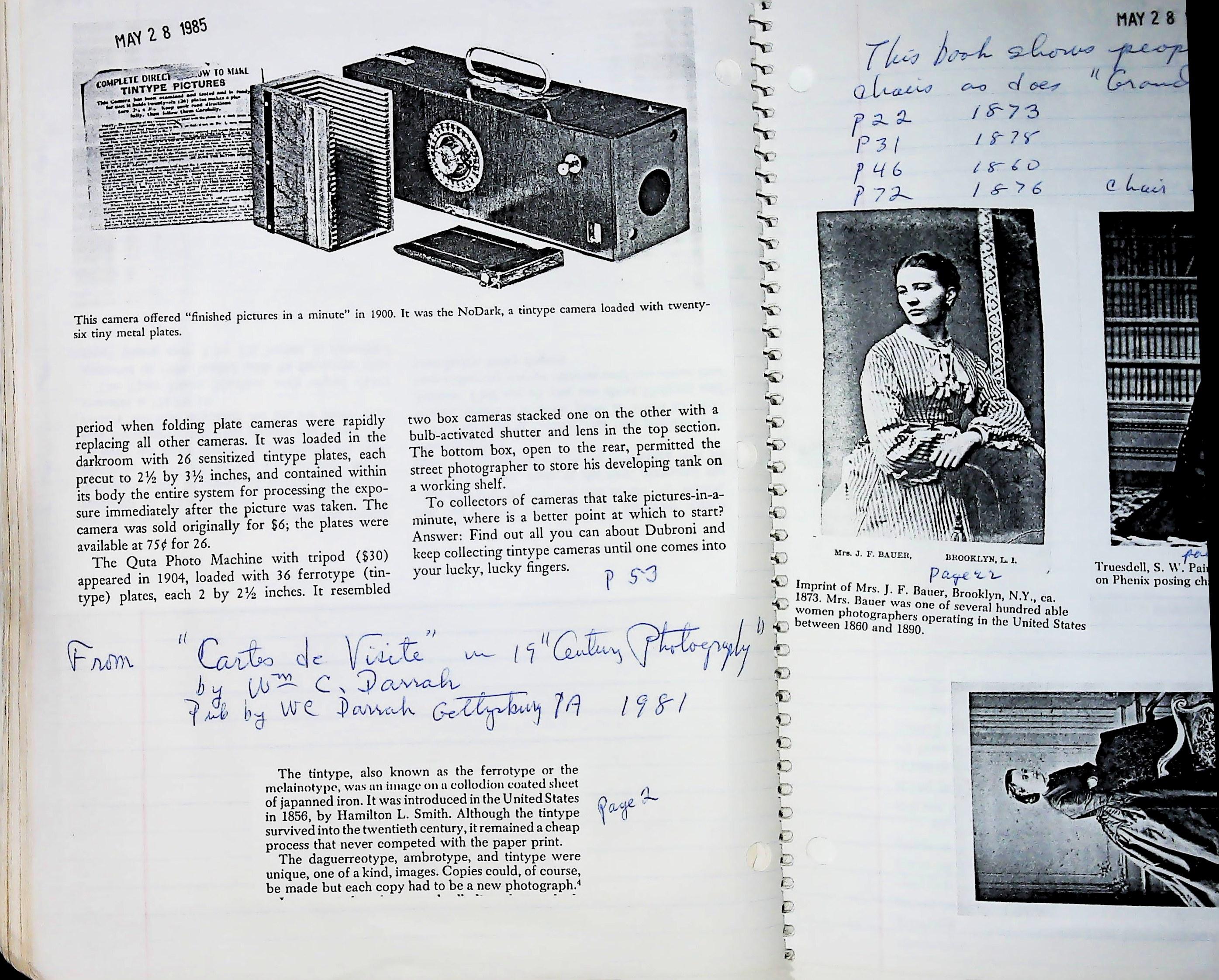
Notebook p. 110
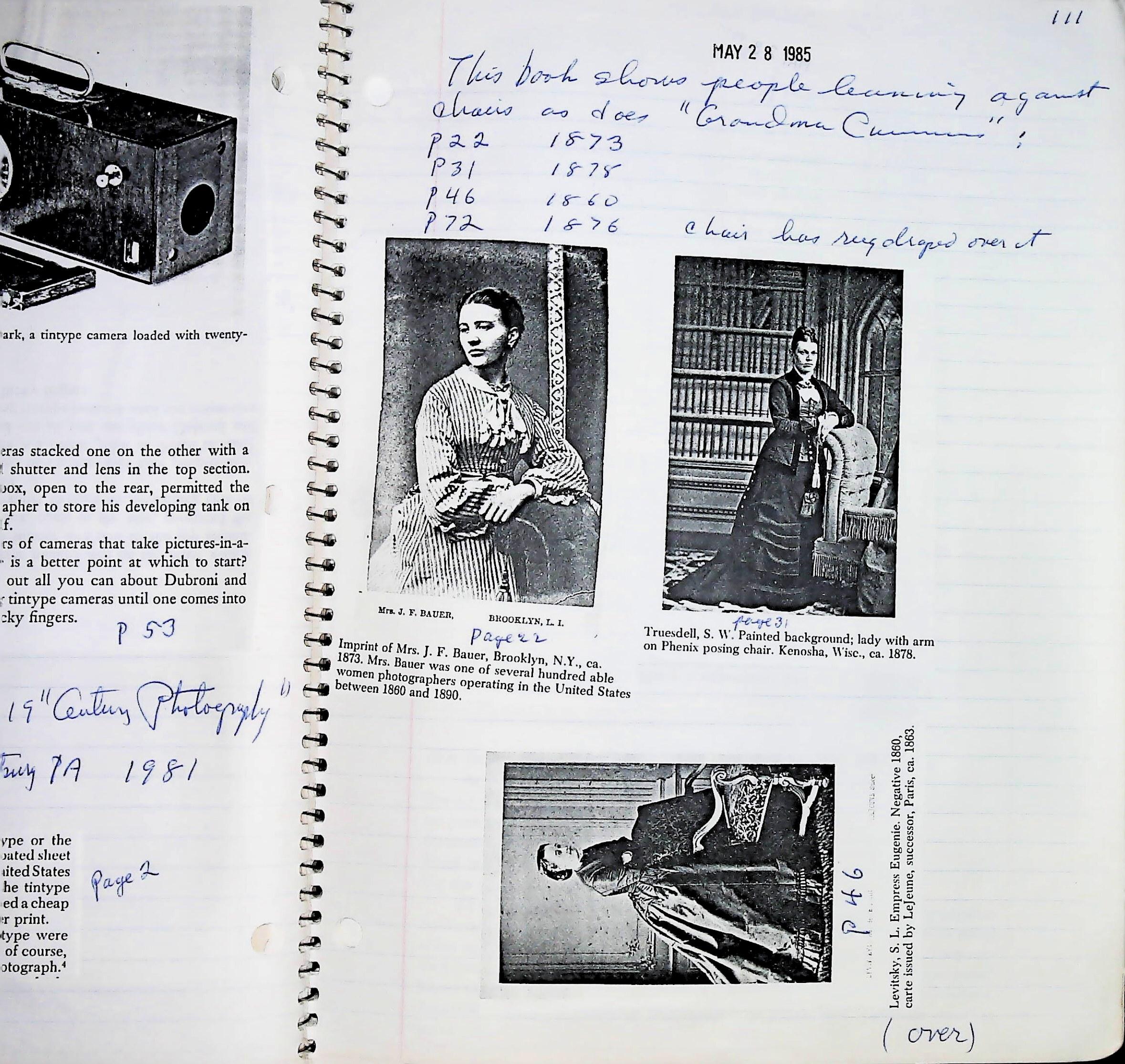
Notebook p. 111
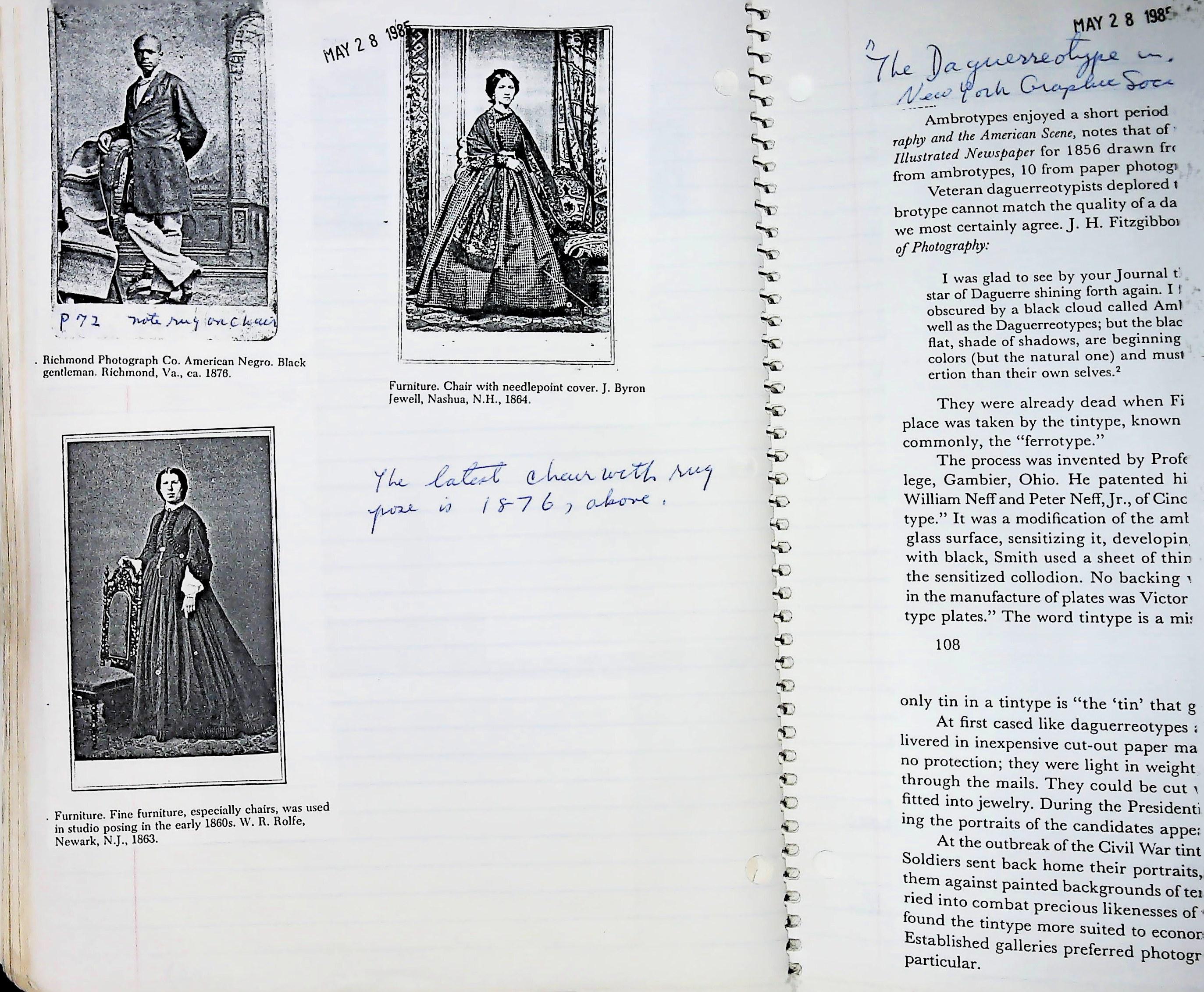
Notebook p. 112
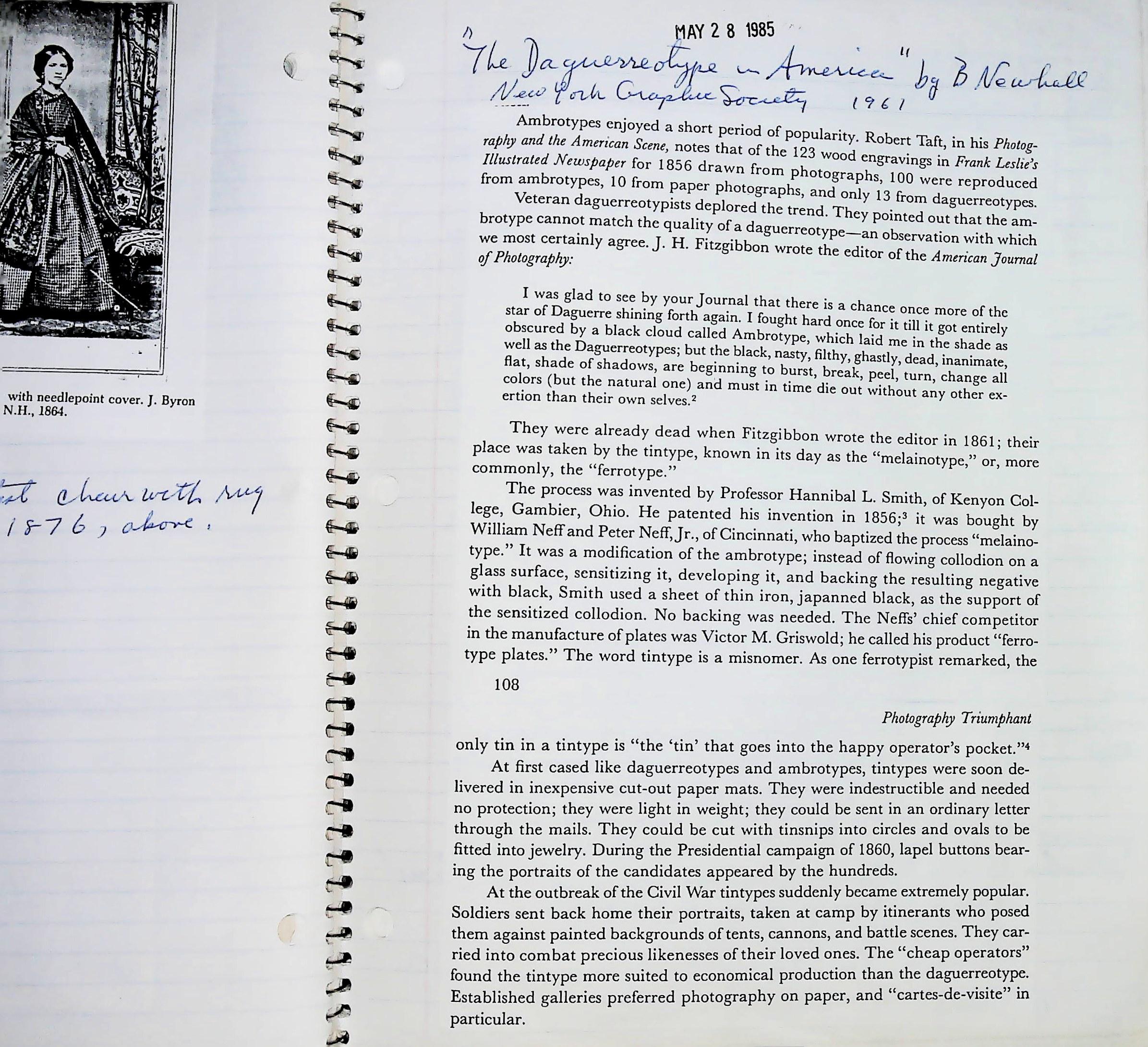
Notebook p. 113
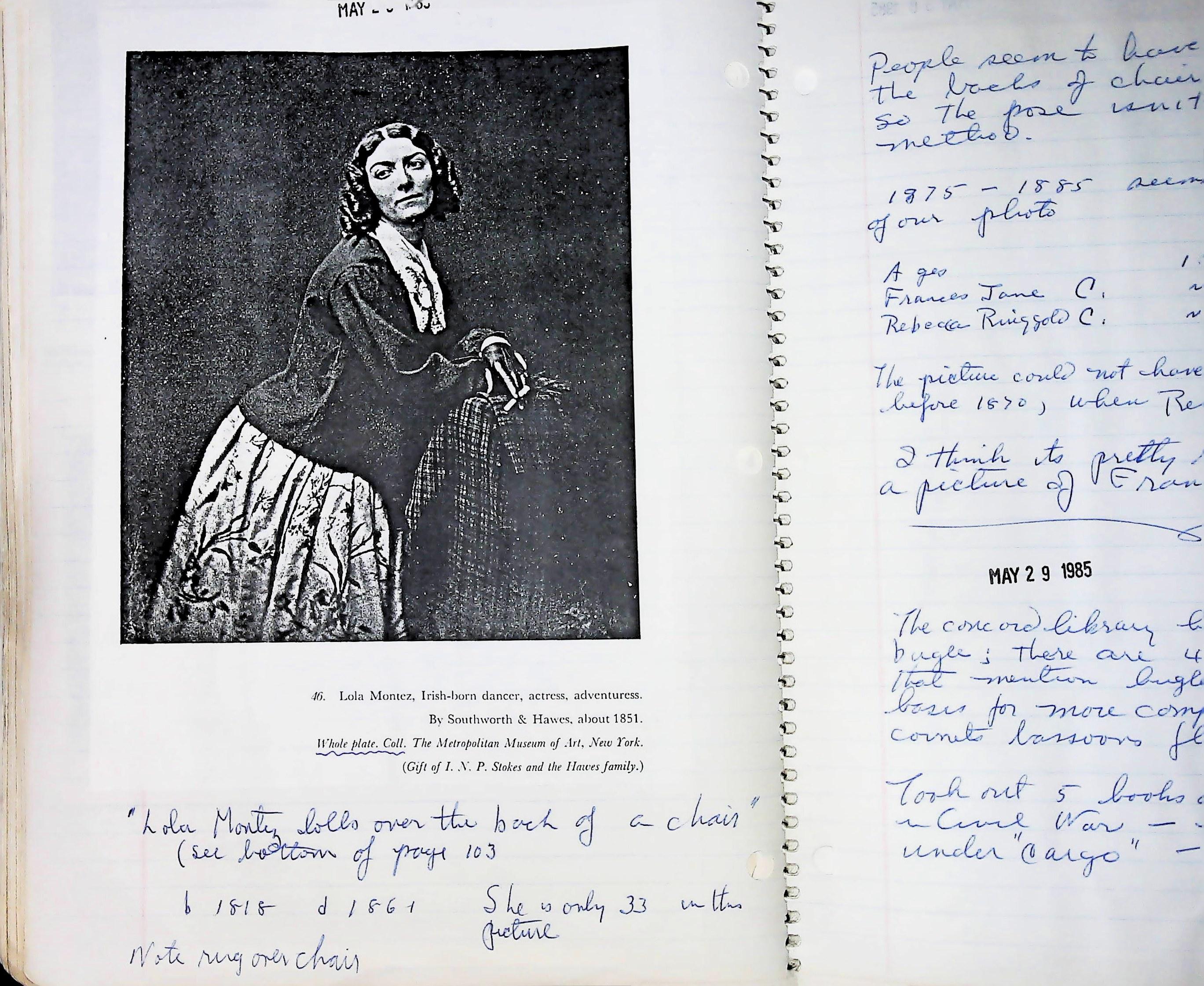
Notebook p. 114
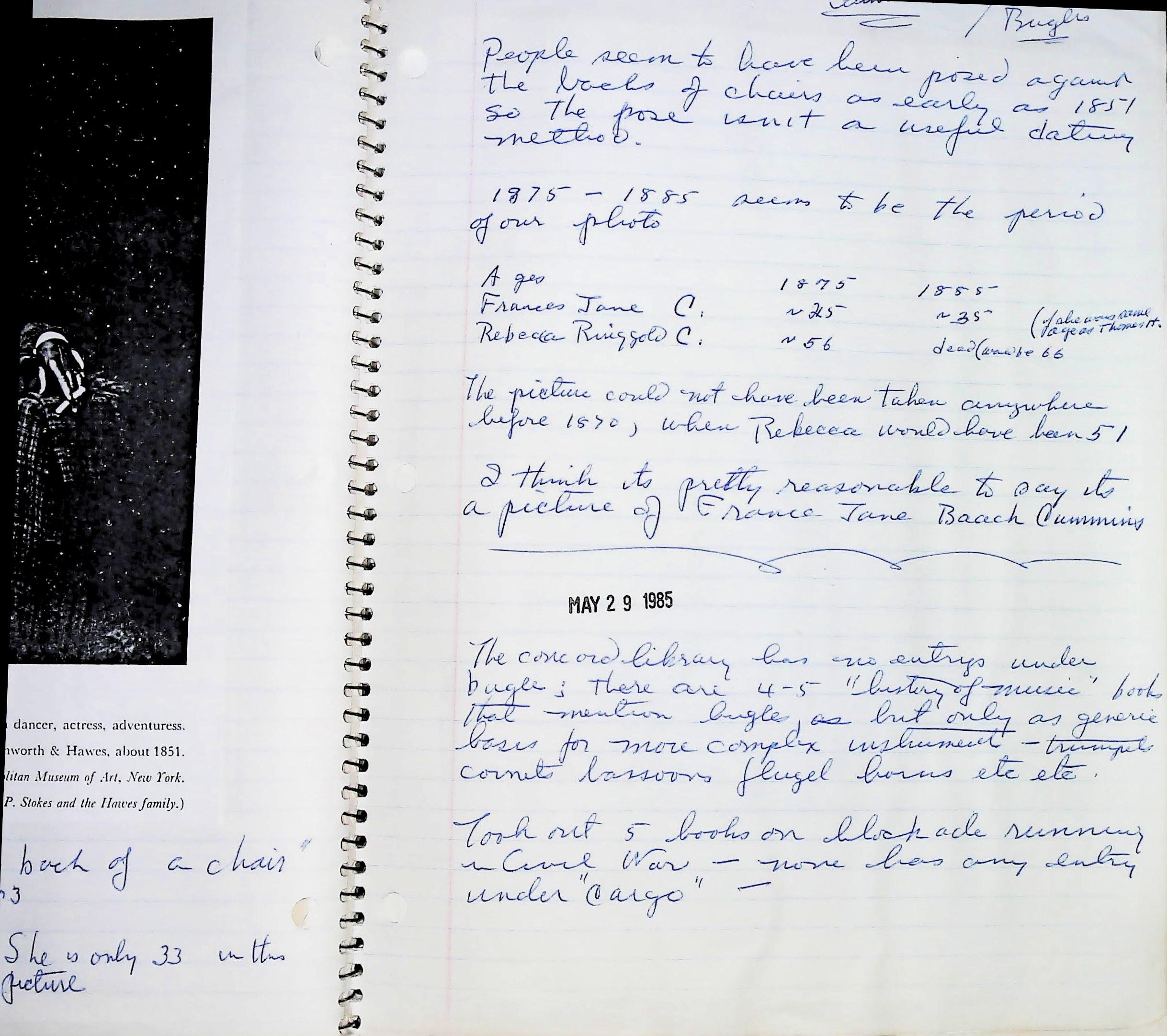
Notebook p. 115


[Notebook p. 102] Baack [date stamp] MAY 26 1985 In today's Times was a pix of Queen Victoria in 1867 in exactly the same pose - chair with sash across its back, as used in the tintype of "Grandma Cummins". Thus the tintype most likely was taken in imitation of Victoria & ~ 1870-1880. [date stamp] MAY 27 1985 Look up Bugle, Trumpet Cornet e.g. Cavalry Bugle -- for Civil War - see if there is a history of these - write to Librarian at West Point. [Pasted newspaper clipping: a photograph captioned "Queen Victoria in 1867. From 'Queen Victoria in Her Letters and Journals'", with a short book review of Christopher Hibbert's selection (not transcribed).] See if this is in library.
[Notebook p. 103] [Search through] dictionaries & 1911 & 1960 editions of Britannica, for dates of the tin type. Heritage Dict: "Ferrotype: A positive made directly on an iron plate with a thin sensitized film - also 'tintype'" Merriam Webster 2nd Ed Dict: "Ferrotype, a positive photograph made by a collodion process on a thin iron plate having a darkened surface." Therefore tintypes are after invention of collodion process. 1911 Edition of Britannica, article "Photography" by A A Horton (1863-1908). Since the author died in 1908, this was probably held over from 1901 edition & since the quotation is from a large type section, this is the original 1901 prose, page 488 of article "Photography": "-- or more recently the positive pictures may be produced on japanned iron plates (ferrotype plates) or on japanned leather. The process is still occasionally practised by itinerant photographers" ("JAPANNED" simply means a highly polished black enameled surface). This suggests 1880-1900. 1960 Edition of Britannica: "Lola Montez" was in America 1851 to 1861 when she died (Marie Dolores Eliza Rosanna Gilbert). See "Lola Montez". 1961 Britannica "Photographic Art": p 798C; daguerreotypes: - "Lola Montez lolls over the back of a chair".
[Notebook p. 104] Cummins [date stamp] MAY 27 1985 The Wet Collodion process was invented in 1851, dry plates introduced in 1880's From 1961 Britannica "Photography" page 804: Exposures needed @ f/11 in Sunlight for a "good negative": 1839 Daguerreotype 4000 seconds; 1840 Bronzed Daguerreotype 80"; 1864 Wet Plates 8"; 1880 Early Dry Plates 1/2"; 1885 Dry plates 1/10"; 1900 Dry Plates 1/50" All this suggests 1865 < t < 1890, except for the "more recently" about tintypes which may mean 1880-1900. Rebecca Ringgold Cummins b 1819 d 1883, July 1, aged 64. In 1864 she would have been 45. Since tintypes were a collodion process, Rebecca would have been between 45 & 63 when the picture was taken & most likely nearer to 63 - The picture doesn't look as though the woman were older than ~40 at very most.
[Notebook p. 105] Cummins [date stamp] MAY 27 1985 Thomas Henry Cummins b Aug 29 1850, d July 2 1923 Age 73 Grandma was interred 1930 & I think she was 86; that would make her born in 1844?? 6 yrs older than Thomas?? She would have been 40 when Uncle Harry was born and 35 when Charles M. C. was born - which is possible, I suppose. Henry Baack & Catharina Donnecker were married Jan 1841, so Grandma would have been one of the 3-4 oldest children - which I doubt. If she died aged 76 the dates all sound more reasonable: 4 yrs younger than Thomas H C. Henry Baack married 1841 aged 32; Thomas Henry Cummins born Aug 29 1850; his son Charles M Cummins born Nov 9 1879; " " Henry G. Cummins born Sept 5 1884. Thus Grandpa was 29 when his first child was born OK. Means they were married when he was < 28 & she was < 24 which seems OK. Need death Certificate of Frances Jane Baack Cummins If Frances Jane Cummins born 1854 then in 1885 she would have been 31 & that seems best to fit the tintype
[Notebook p. 106] Dresses [date stamp] MAY 27 1985 Things to do besides Library work: write to West Point Librarian re bugles; " " VMI " "; get a good map & street directory of Montreal - find out who to apply for names of residents in ~1885. [date stamp] MAY 28 1985 From "100 years of Costumes in America" by R. N. Kerr, Davis Press Inc Worcester Mass: 1876 Carriage Dress with tightly pleated underskirt; 1882 Winter "; 1882 Winter "; 1888 Promenade Costume " From "On Human Finery" by Q. Bell, Schocken Books N.Y.: 1885 Day dress with tightly pleated skirt; 1875 Walking Costume " (not quite so tight); 1885 Ball dress; 1880 Day dress From "English Costume of the Nineteenth Century" by I. Brooke & J. Laver, A & C Black Ltd London: 1865-70 a very different style; 1870-75 1 out of 5 may have narrow vertical pleats, but otherwise not the same; 1875-1880 4 out of 6 severely vertical pleated skirts; 1880-1885 3/6; 1880 1/1; 1885-90 3/6; 1890-95 0/7
[Notebook p. 107] Dresses [date stamp] MAY 28 1985 From English Costume by D. Yarwood, NY Crown Pub: 1875 pleated underdress; 1878 "; 1883 "; 1886 " [Tally chart of pleated dresses by period: 1865-70: 1; 1870-75: 3; 1875-80: 8; 1880-85: 9; 1885-90: 5] The Style peaked ~ 1875-1885. All the Xeroxed pages from all 4 books are in folder marked Tin Type "Grandma Cummins" Tin types From "Dictionary of Photography" Ed. A L M Sowerby, London Iliffe & Sons Ltd, NY Philosophical Library, 18th Edition 1956: [pasted entry] "Ferrotypes or Tintypes. Originally these were positives taken by the wet plate process on thin iron plate coated with brown or black varnish. ..."
[Notebook p. 108] [date stamp] MAY 28 1985 From "Collecting Photographica" by G. Gilbert, Hawthorn Books, Inc. N.Y. 1976 Page 8 "TYPES OF PHOTOGRAPHS": Metal, Cu, Ag plated: Daguerreotype 1839-~1855 (silver tone before 1843, brown tone after 1841). Iron, japanned black: Tintype (Ferrotype or melainotype) 1854-~1900; chocolate color image after 1870. This says our tintype of "Grandma Cummins" was made after 1870. Page 20 "Many people ..." [Pasted photocopied excerpts from the book's glossary (p. 279) and p. 20 on tintypes and beach tintype parlors; not transcribed.]
[Notebook p. 109: photocopied page 49 of "Collecting Photographica" (1976), "Box Cameras of the Street Photographer", pasted in; not transcribed.]
[Notebook p. 110, with the left edge of p. 111] [date stamp] MAY 28 1985 [Photocopied page 53 of "Collecting Photographica" (1976) on tintype cameras, pasted in; not transcribed.] From "Cartes de Visite in 19th Century Photography" by Wm C. Darrah, Pub by W C Darrah, Gettysburg PA 1981. [Photocopied excerpt from page 2 on the tintype, introduced in the United States in 1856 by Hamilton L. Smith; not transcribed.]
[Notebook p. 111] [date stamp] MAY 28 1985 This book shows people leaning against chairs as does "Grandma Cummins": p 22 1873; p 31 1878; p 46 1860; p 72 1876, chair has rug draped over it. [Photocopies from "Cartes de Visite in 19th Century Photography" (1981) of studio portraits of women posed leaning on chairs: Mrs. J. F. Bauer, Brooklyn, about 1873 (p. 22); S. W. Truesdell, Kenosha, Wisconsin, about 1878 (p. 31); S. L. Levitsky, Empress Eugenie, 1860 (p. 46).] (over)
[Notebook p. 112] [date stamp] MAY 28 1985 [Photocopies from "Cartes de Visite in 19th Century Photography" (1981) of more studio portraits posed with chairs: Richmond Photograph Co., Richmond, Va., about 1876 (p. 72, "note rug on chair"); J. Byron Jewell, Nashua, N.H., 1864; W. R. Rolfe, Newark, N.J., 1863.] The latest chair with rug pose is 1876, above.
[Notebook p. 113] [date stamp] MAY 28 1985 "The Daguerreotype in America" by B. Newhall, New York Graphic Society 1961. [Photocopied page 108 of the book, on the ambrotype, the invention of the tintype (melainotype or ferrotype) patented in 1856, and its popularity in the Civil War; not transcribed.]
[Notebook p. 114, with the edge of p. 115] [date stamp] MAY 28 1985 [Photocopy of a portrait of Lola Montez by Southworth & Hawes, about 1851 (Metropolitan Museum of Art).] "lolls over the back of a chair" of page 103. 1861: She is only 33 in this picture.
[Notebook p. 115] Cummins / Bugles People seem to have been posed against the backs of chairs as early as 1851 so the pose isn't a useful dating method. 1875 - 1885 seems to be the period of our photo. Ages: 1875 / 1885 -- Frances Jane C.: ~25 / ~35 (if she was about 4 years younger than Thomas H.); Rebecca Ringgold C.: ~56 / dead (would be 66) The picture could not have been taken anywhere before 1870, when Rebecca would have been 51. I think it's pretty reasonable to say it's a picture of Frances Jane Baack Cummins. [date stamp] MAY 29 1985 The Concord library has no entrys under bugle; there are 4-5 "history of music" books that mention bugle as but only as generic basis for more complex instrument - trumpets, cornets, bassoons, flugel horns etc etc. Took out 5 books on blockade running in Civil War - none has any entry under "cargo".
Notes
Source: G. E. Valley Jr., research notes dating the "Grandma Cummins" tintype, with photocopies from books on costume and photography, 26-29 May 1985 Location: G. E. Valley Jr.'s research notebook VLCM #1 (Pen-Tab spiral notebook, 20 Apr - 5 Jul 1985), part 2, pp. 102-115; Valley family papers, storage bin Found by: Claude research assistant