The rough first draft (3 June 1988) of G. E. Valley Jr.'s "The Life and Family of Edward Baack, Part One: From His Birth to His Naturalization as a United States Citizen in 1840" (VLCM06), as sent to Lloyd Farrar: his baptism certificate, the meanings of "Schiffer", Hieronymus and Martin, Hamburg and St. Michael's, GEV's thoughts on the family's religion and wealth, the S. M. Baack daguerreotype, the unaccounted years before his naturalization, and the naturalization paper. Part of p. 144 is out of focus.
History · 3 Jun 1988 · Concord, Middlesex, Massachusetts, United States
Linked to Andrew Francis Shea, I, Anna Baack, Catharina Sophie Baumann, Shea Alice LaBont, Edward Baack, Jr., Martin Hieronymus Baack, Frances Jane Baack, Philipp Jakob Donnecker, Katharina Donnecker, Heinrich Eduard Baack, Sr. and George Edward Valley Jr
7 pages. Open one to read it full size.
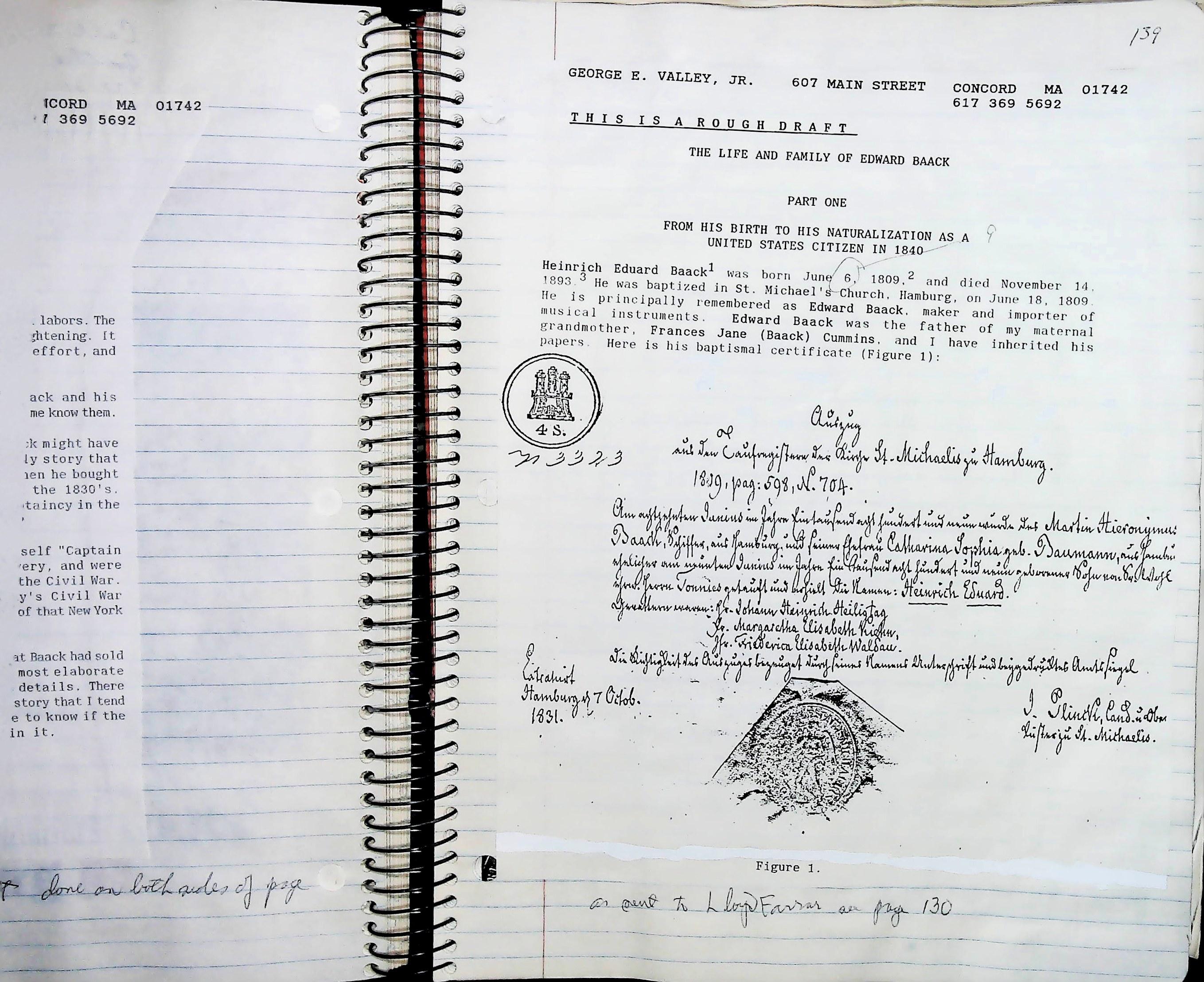
Notebook p. 139
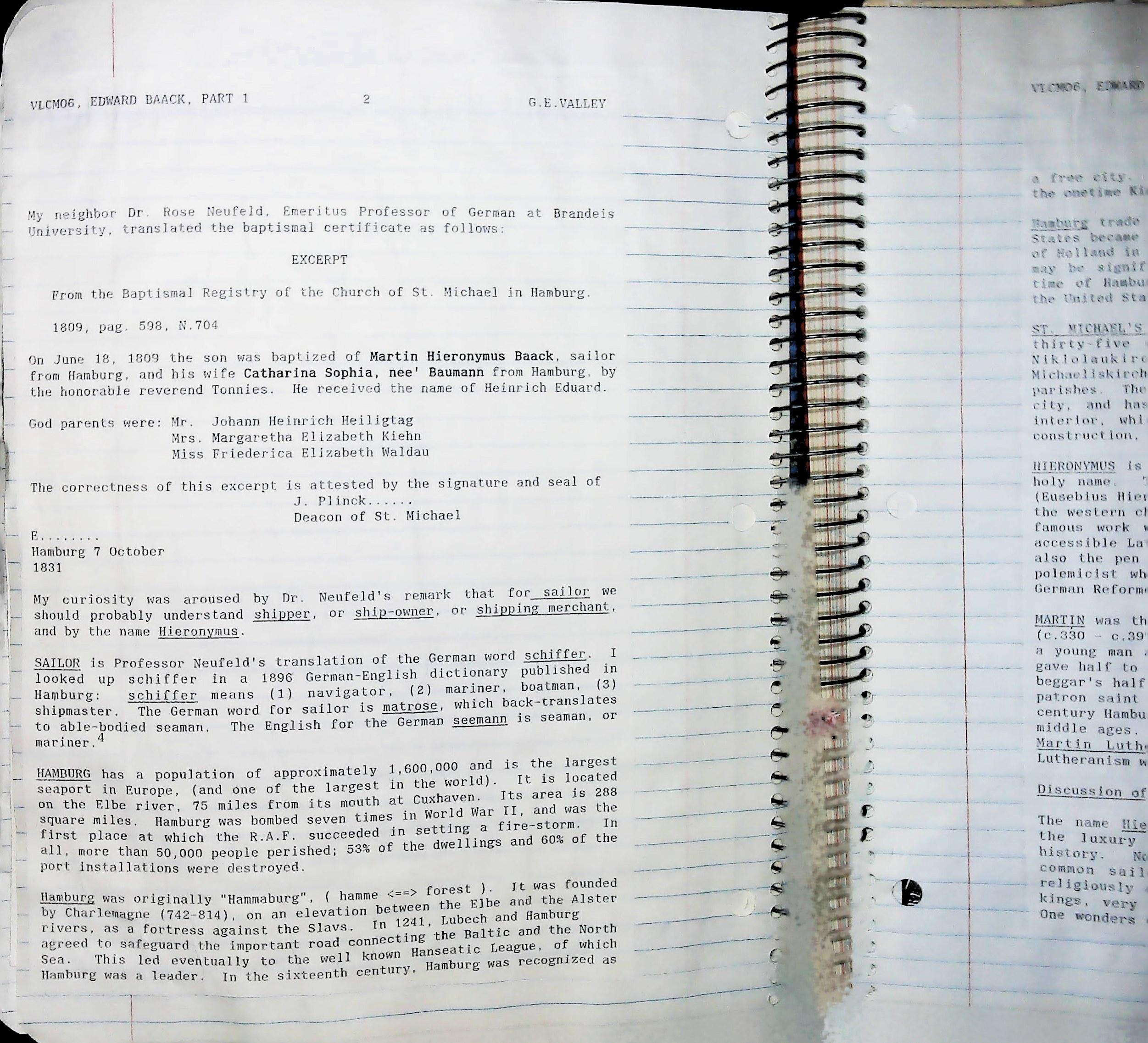
Notebook p. 140
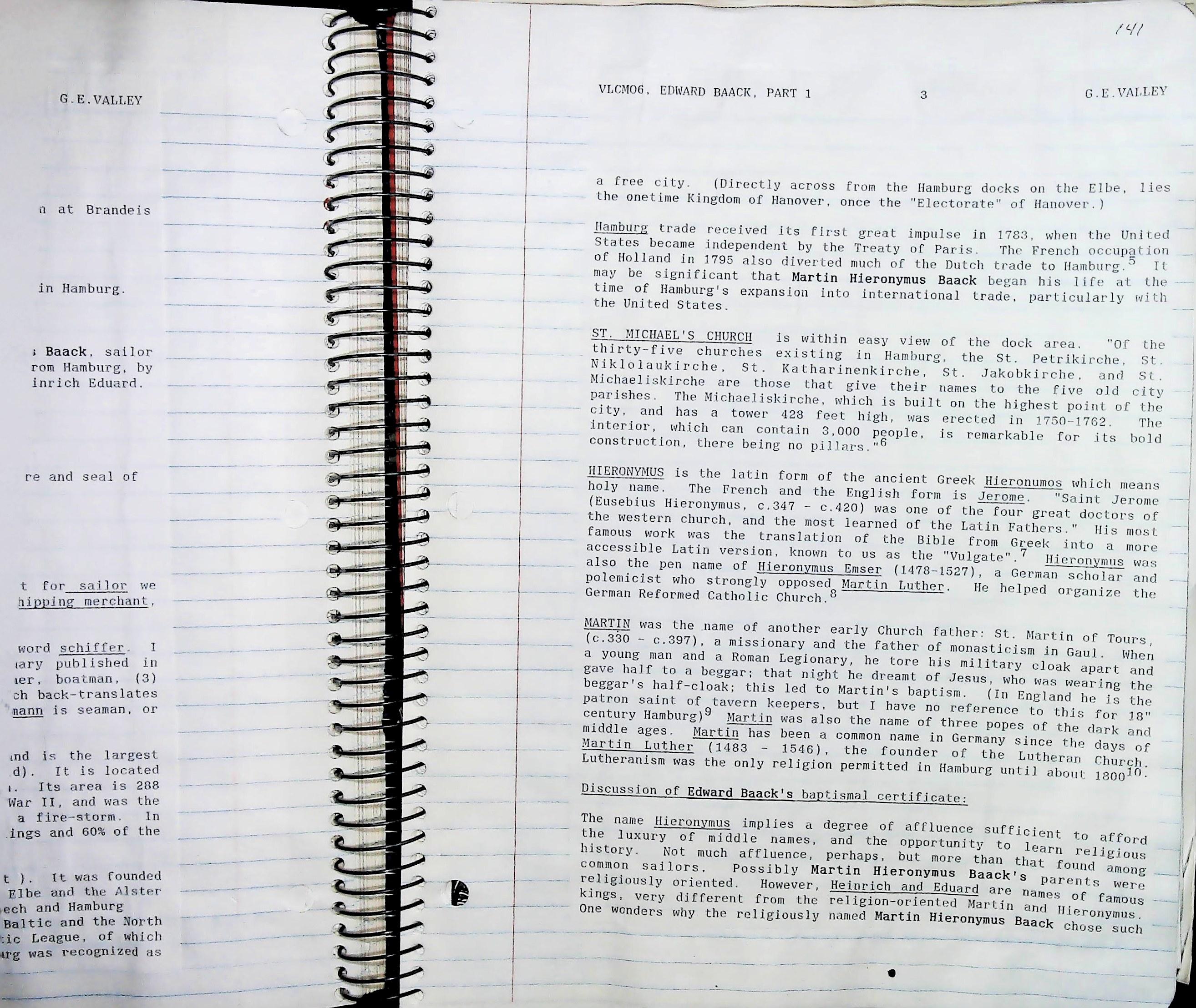
Notebook p. 141
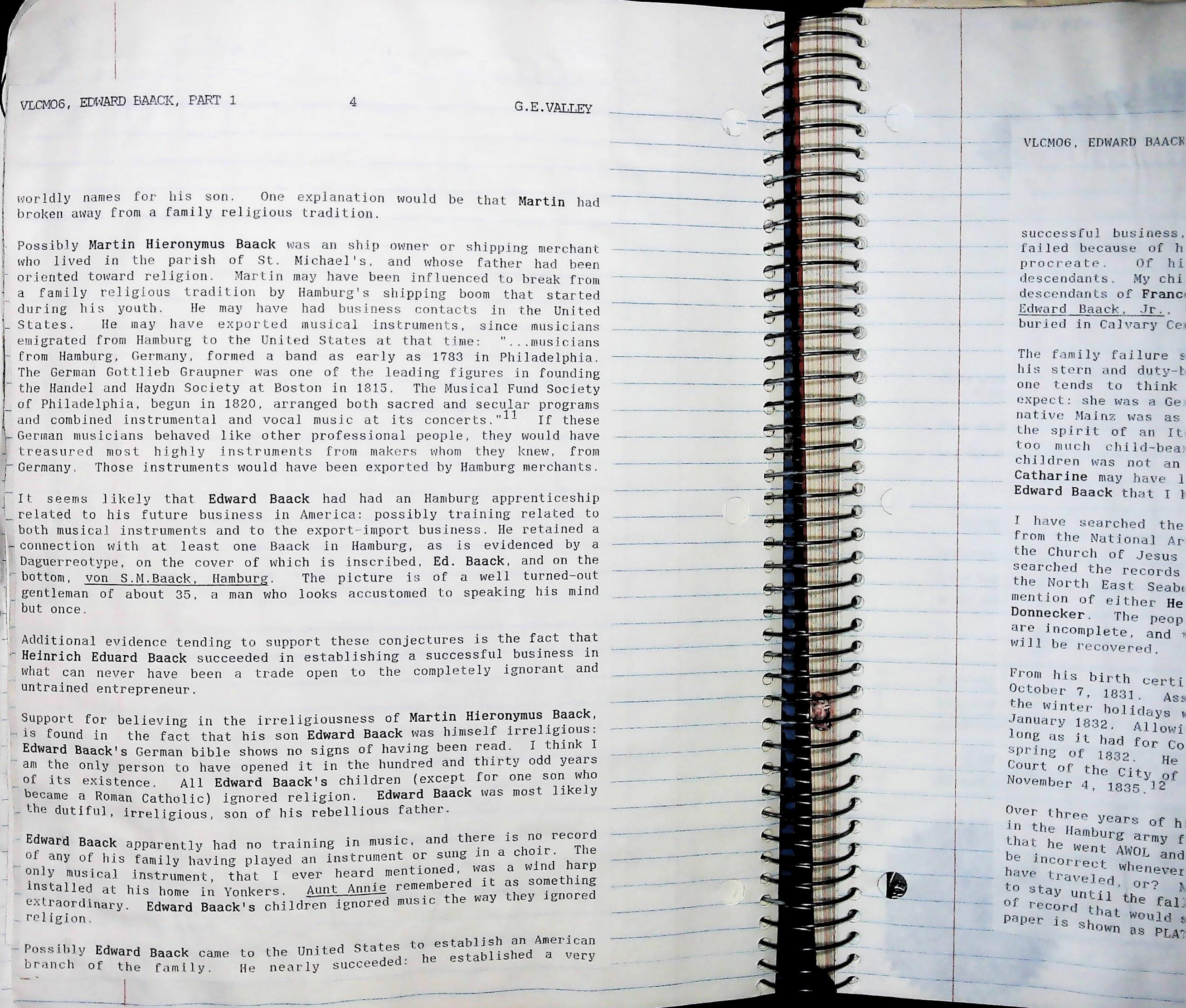
Notebook p. 142
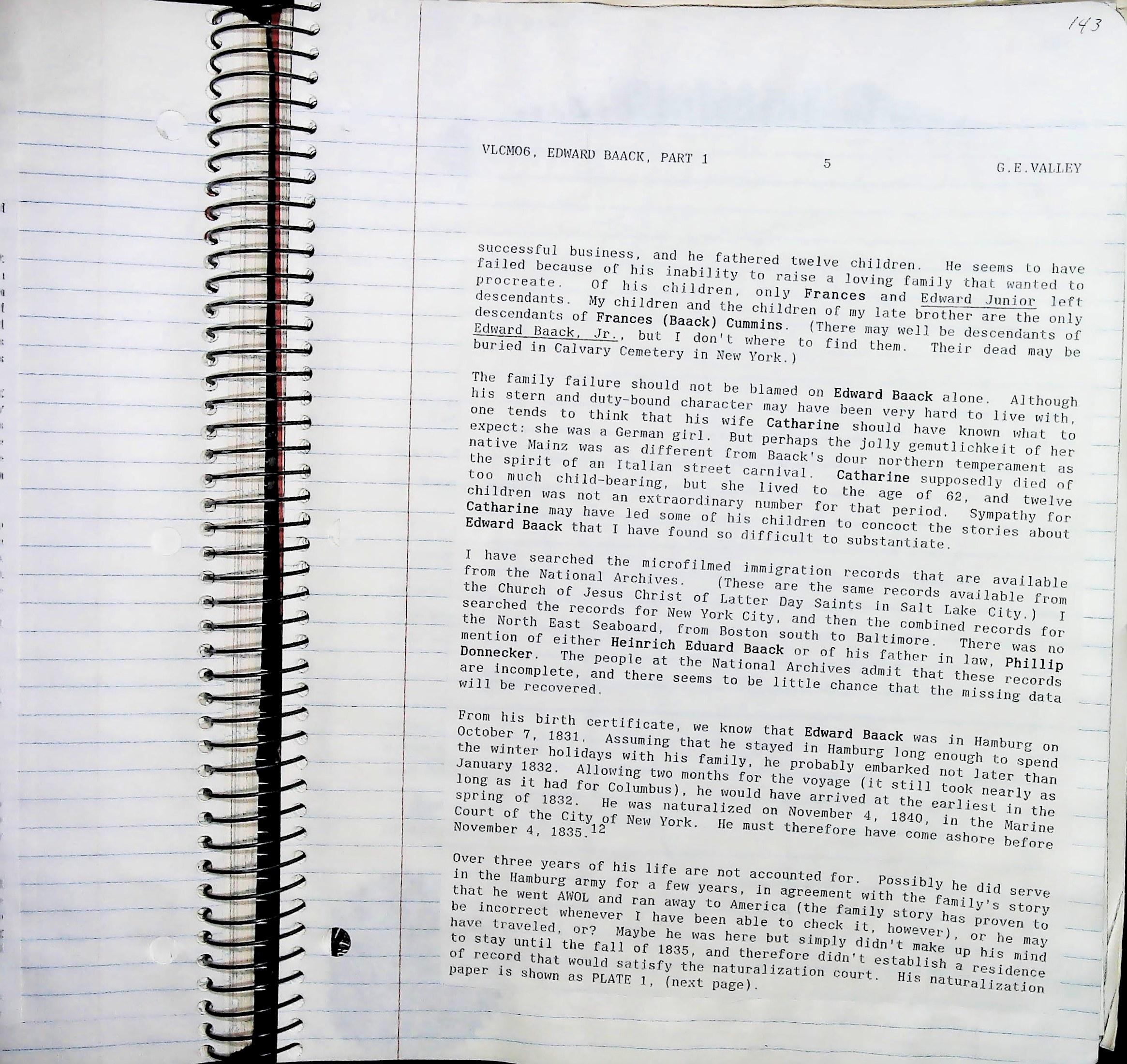
Notebook p. 143
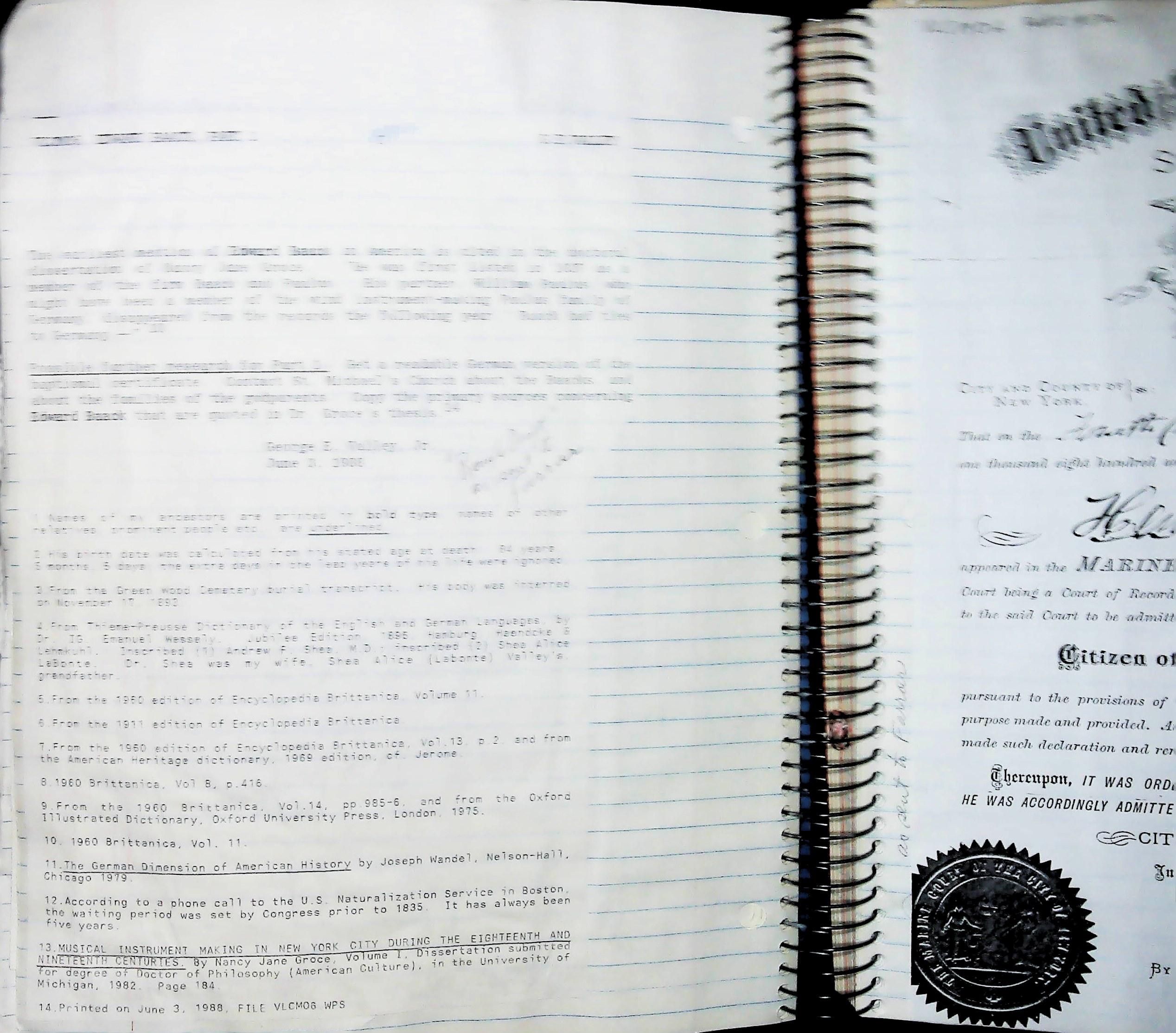
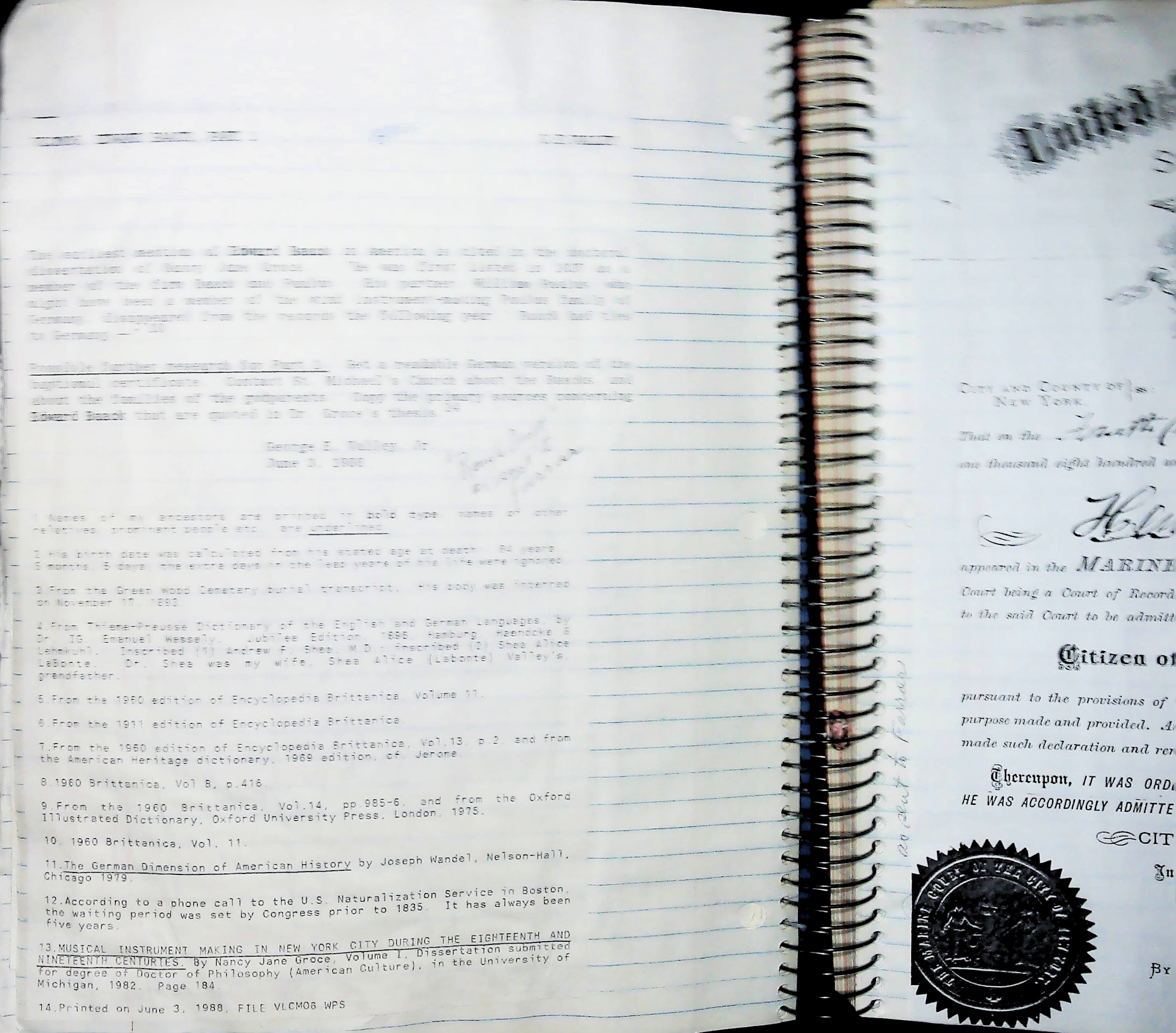
Notebook p. 144 (top half out of focus)
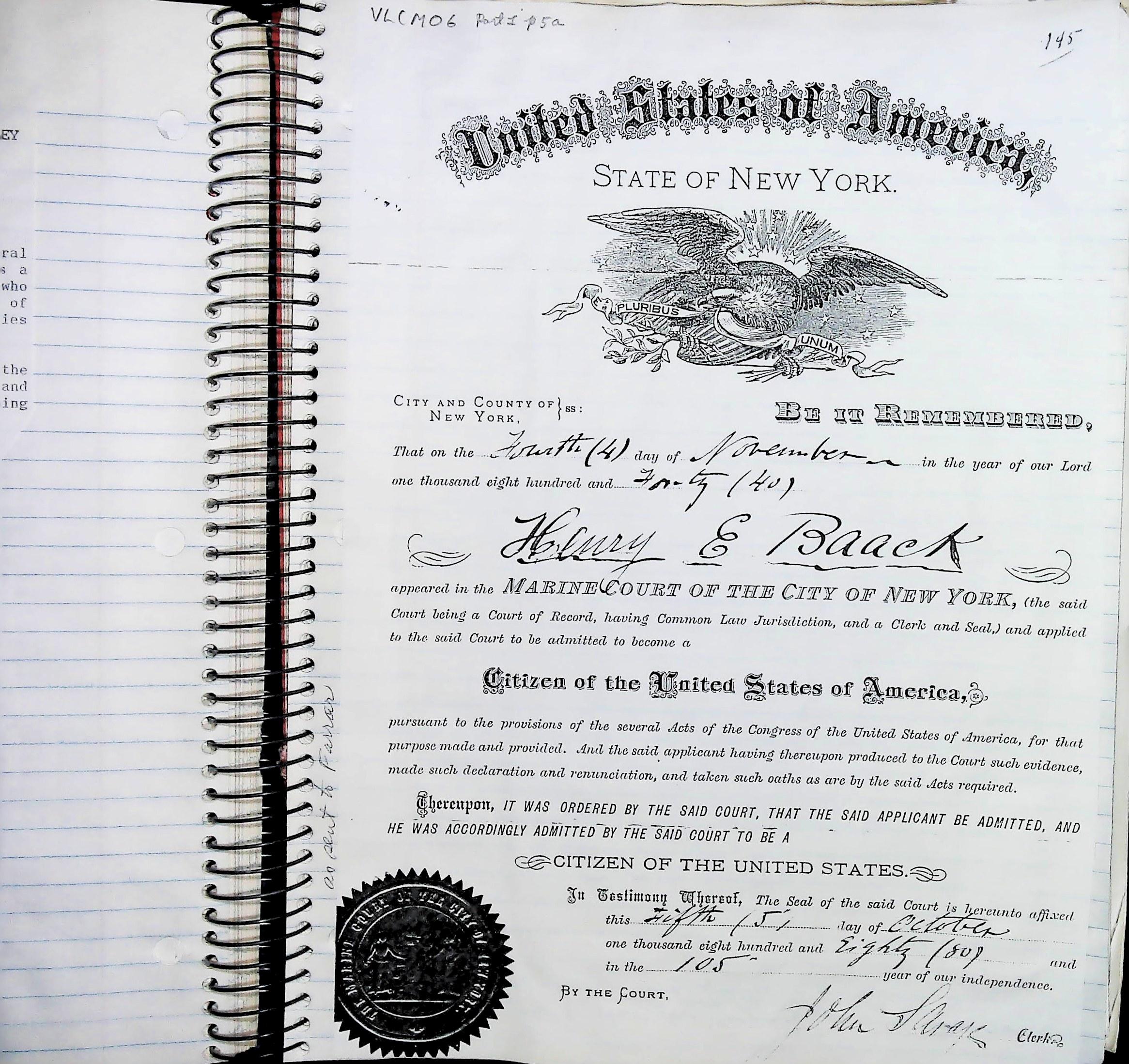
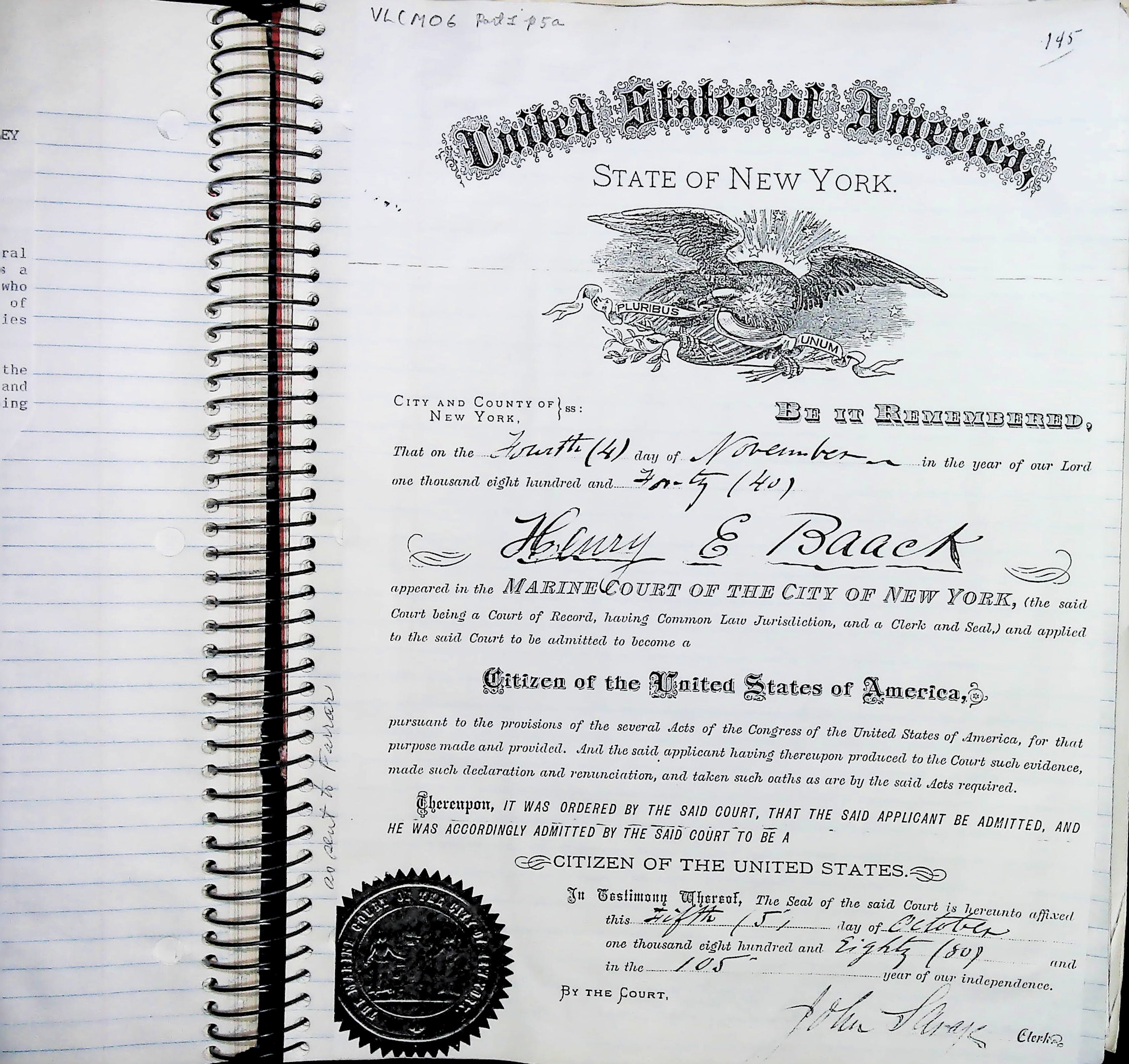
Notebook p. 145
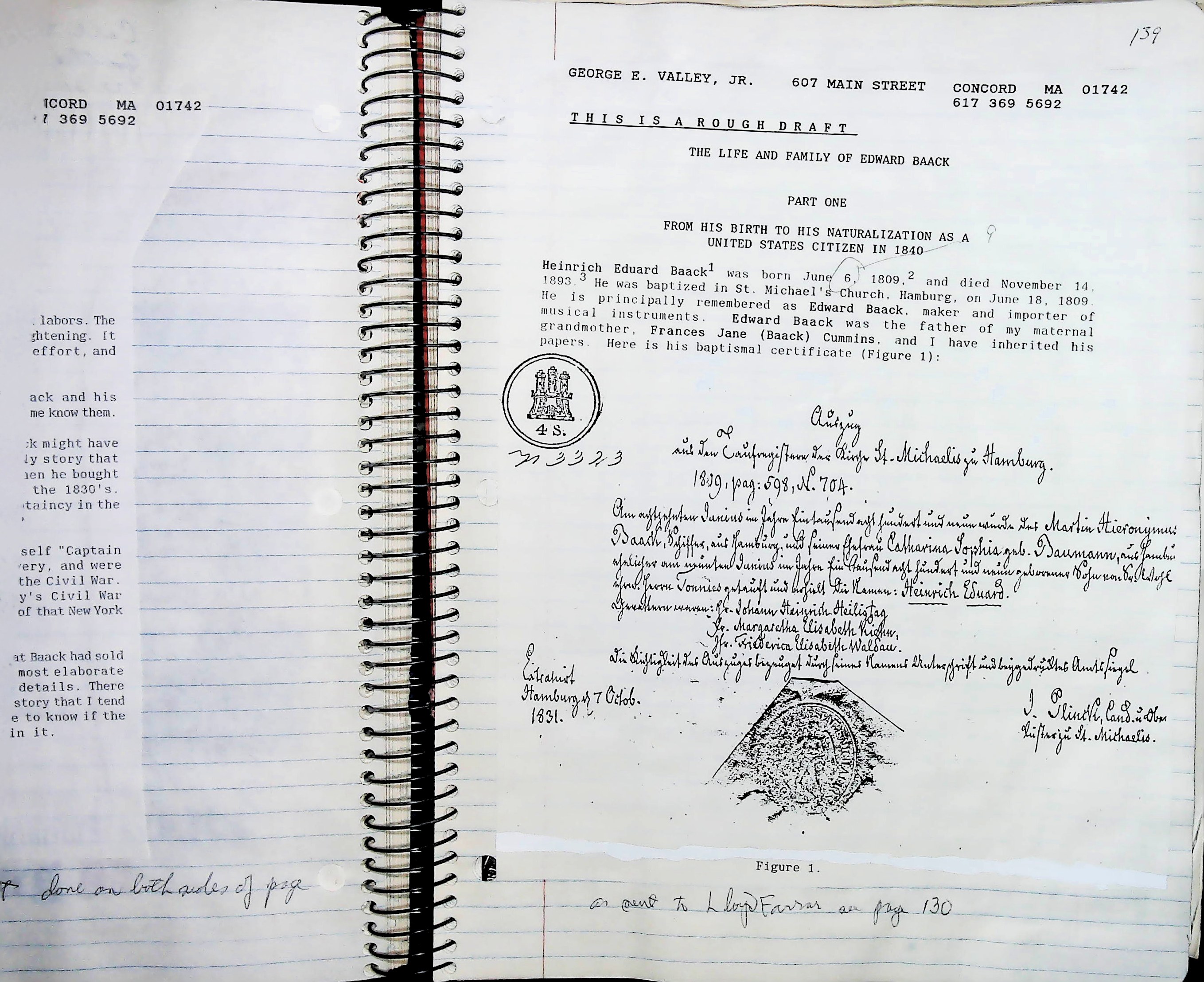
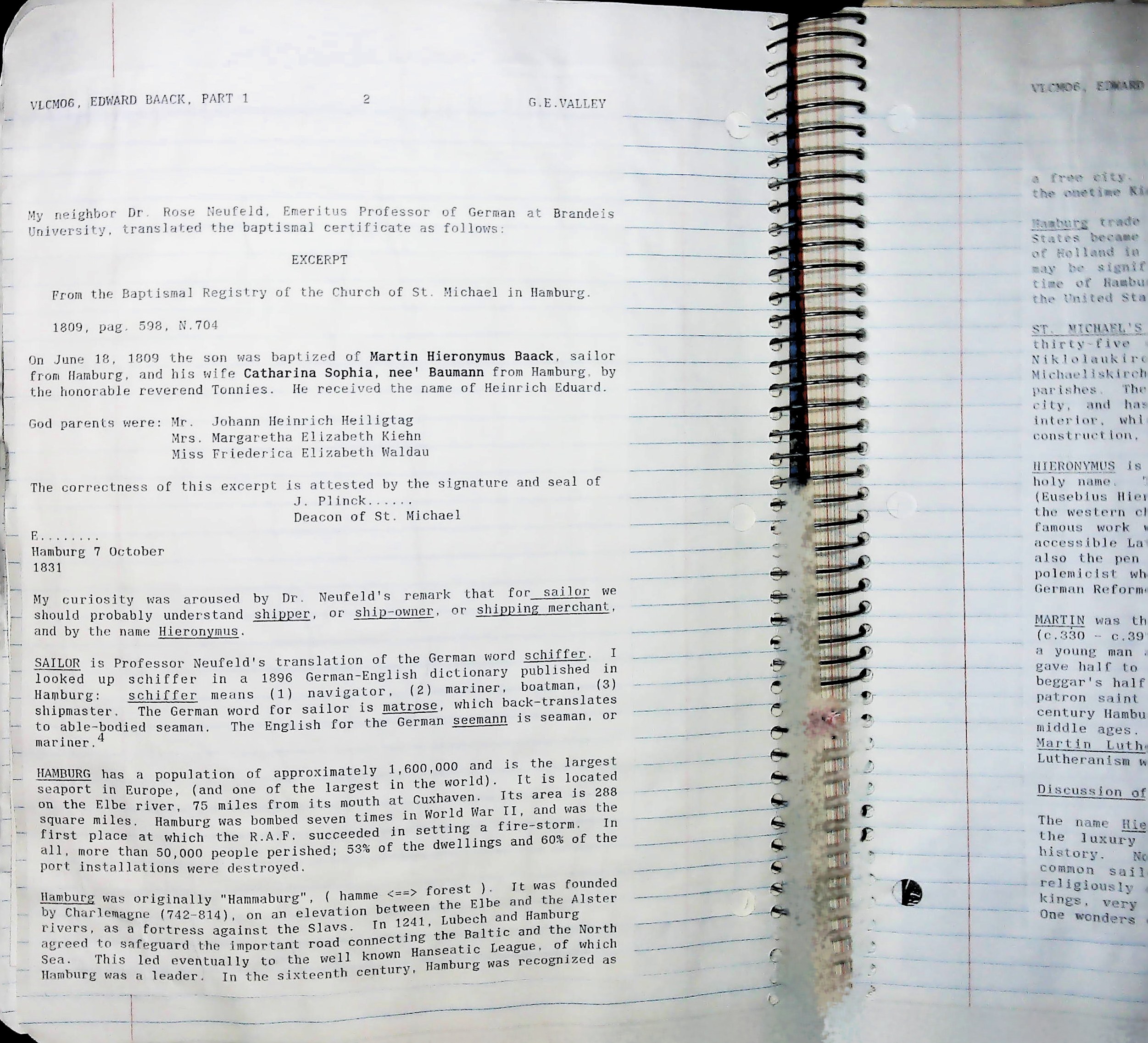
[Notebook p. 139: page 1 of GEV's typed paper pasted in, marked "as sent to Lloyd Farrar, see page 130". The phone number is left out.] GEORGE E. VALLEY, JR. 607 MAIN STREET CONCORD MA 01742 THIS IS A ROUGH DRAFT THE LIFE AND FAMILY OF EDWARD BAACK PART ONE FROM HIS BIRTH TO HIS NATURALIZATION AS A UNITED STATES CITIZEN IN 1840 Heinrich Eduard Baack(1) was born June 6 [corrected by hand to 9], 1809,(2) and died November 14, 1893.(3) He was baptized in St. Michael's Church, Hamburg, on June 18, 1809. He is principally remembered as Edward Baack, maker and importer of musical instruments. Edward Baack was the father of my maternal grandmother, Frances Jane (Baack) Cummins, and I have inherited his papers. Here is his baptismal certificate (Figure 1): [Figure 1: a reproduction of the 1831 extract of his baptism from the register of St. Michael's, Hamburg.]
[Page 2 of GEV's paper "Edward Baack, Part 1" (VLCM06).] My neighbor Dr. Rose Neufeld, Emeritus Professor of German at Brandeis University, translated the baptismal certificate as follows: [her translation, as in "Documented Facts About the Baacks", naming the godparents Mr. Johann Heinrich Heiligtag, Mrs. Margaretha Elizabeth Kiehn and Miss Friederica Elizabeth Waldau.] My curiosity was aroused by Dr. Neufeld's remark that for sailor we should probably understand shipper, or ship-owner, or shipping merchant, and by the name Hieronymus. SAILOR is Professor Neufeld's translation of the German word schiffer. I looked up schiffer in a 1896 German-English dictionary published in Hamburg: schiffer means (1) navigator, (2) mariner, boatman, (3) shipmaster. The German word for sailor is matrose, which back-translates to able-bodied seaman. [...] [He goes on to describe Hamburg: its size, its bombing in the Second World War, and its founding by Charlemagne and history in the Hanseatic League.]
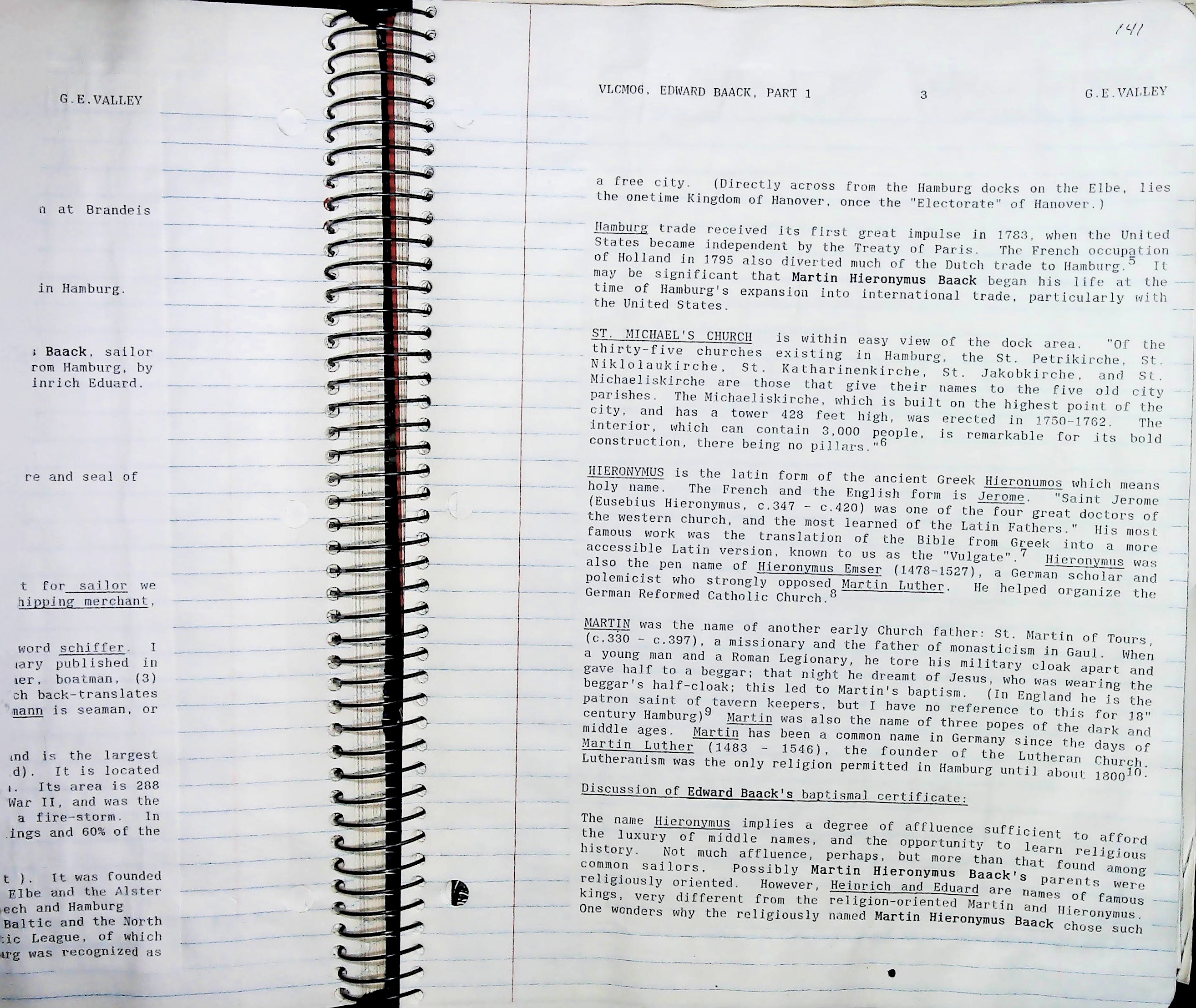
[Page 3 of GEV's paper "Edward Baack, Part 1" (VLCM06).] a free city. (Directly across from the Hamburg docks on the Elbe, lies the onetime Kingdom of Hanover, once the "Electorate" of Hanover.) Hamburg trade received its first great impulse in 1783, when the United States became independent by the Treaty of Paris. The French occupation of Holland in 1795 also diverted much of the Dutch trade to Hamburg.(5) It may be significant that Martin Hieronymus Baack began his life at the time of Hamburg's expansion into international trade, particularly with the United States. ST. MICHAEL'S CHURCH is within easy view of the dock area. [...] HIERONYMUS is the latin form of the ancient Greek Hieronumos which means holy name. The French and the English form is Jerome. [...] MARTIN was the name of another early Church father: St. Martin of Tours [...] Lutheranism was the only religion permitted in Hamburg until about 1800.(10) Discussion of Edward Baack's baptismal certificate: The name Hieronymus implies a degree of affluence sufficient to afford the luxury of middle names, and the opportunity to learn religious history. Not much affluence, perhaps, but more than that found among common sailors. Possibly Martin Hieronymus Baack's parents were religiously oriented. However, Heinrich and Eduard are names of famous kings, very different from the religion-oriented Martin and Hieronymus. One wonders why the religiously named Martin Hieronymus Baack chose such
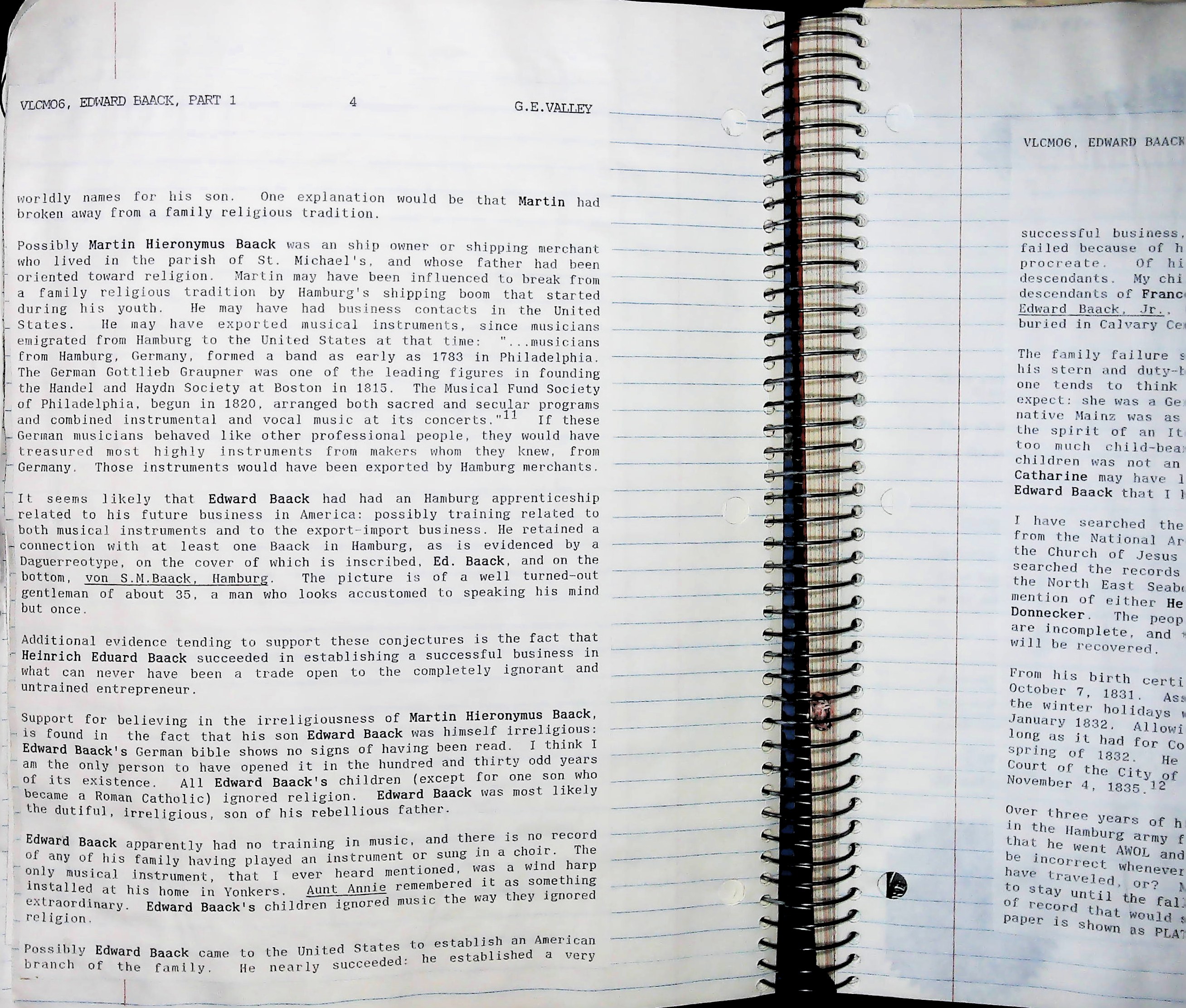
[Page 4 of GEV's paper "Edward Baack, Part 1" (VLCM06).] worldly names for his son. One explanation would be that Martin had broken away from a family religious tradition. Possibly Martin Hieronymus Baack was an ship owner or shipping merchant who lived in the parish of St. Michael's, and whose father had been oriented toward religion. Martin may have been influenced to break from a family religious tradition by Hamburg's shipping boom that started during his youth. He may have had business contacts in the United States. He may have exported musical instruments, since musicians emigrated from Hamburg to the United States at that time: [...] Those instruments would have been exported by Hamburg merchants. It seems likely that Edward Baack had had an Hamburg apprenticeship related to his future business in America: possibly training related to both musical instruments and to the export-import business. He retained a connection with at least one Baack in Hamburg, as is evidenced by a Daguerreotype, on the cover of which is inscribed, Ed. Baack, and on the bottom, von S.M.Baack, Hamburg. The picture is of a well turned-out gentleman of about 35, a man who looks accustomed to speaking his mind but once. Additional evidence tending to support these conjectures is the fact that Heinrich Eduard Baack succeeded in establishing a successful business in what can never have been a trade open to the completely ignorant and untrained entrepreneur. Support for believing in the irreligiousness of Martin Hieronymus Baack, is found in the fact that his son Edward Baack was himself irreligious: Edward Baack's German bible shows no signs of having been read. I think I am the only person to have opened it in the hundred and thirty odd years of its existence. All Edward Baack's children (except for one son who became a Roman Catholic) ignored religion. Edward Baack was most likely the dutiful, irreligious, son of his rebellious father. Edward Baack apparently had no training in music, and there is no record of any of his family having played an instrument or sung in a choir. The only musical instrument, that I ever heard mentioned, was a wind harp installed at his home in Yonkers. Aunt Annie remembered it as something extraordinary. Edward Baack's children ignored music the way they ignored religion. Possibly Edward Baack came to the United States to establish an American branch of the family. He nearly succeeded: he established a very
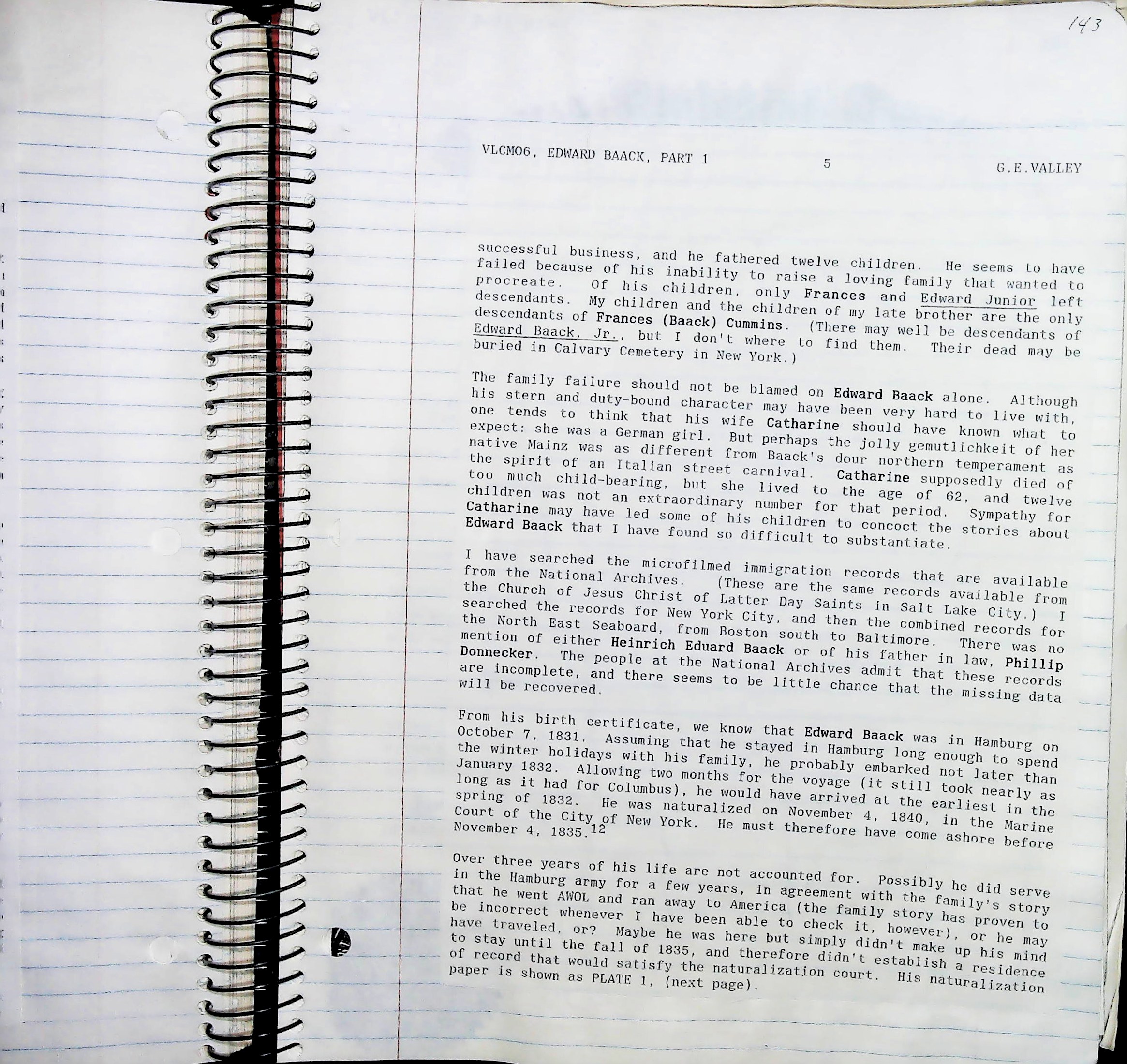
[Page 5 of GEV's paper "Edward Baack, Part 1" (VLCM06).] successful business, and he fathered twelve children. He seems to have failed because of his inability to raise a loving family that wanted to procreate. Of his children, only Frances and Edward Junior left descendants. My children and the children of my late brother are the only descendants of Frances (Baack) Cummins. (There may well be descendants of Edward Baack, Jr., but I don't where to find them. Their dead may be buried in Calvary Cemetery in New York.) The family failure should not be blamed on Edward Baack alone. Although his stern and duty-bound character may have been very hard to live with, one tends to think that his wife Catharine should have known what to expect: she was a German girl. But perhaps the jolly gemutlichkeit of her native Mainz was as different from Baack's dour northern temperament as the spirit of an Italian street carnival. Catharine supposedly died of too much child-bearing, but she lived to the age of 62, and twelve children was not an extraordinary number for that period. Sympathy for Catharine may have led some of his children to concoct the stories about Edward Baack that I have found so difficult to substantiate. I have searched the microfilmed immigration records that are available from the National Archives. (These are the same records available from the Church of Jesus Christ of Latter Day Saints in Salt Lake City.) I searched the records for New York City, and then the combined records for the North East Seaboard, from Boston south to Baltimore. There was no mention of either Heinrich Eduard Baack or of his father in law, Phillip Donnecker. The people at the National Archives admit that these records are incomplete, and there seems to be little chance that the missing data will be recovered. From his birth certificate, we know that Edward Baack was in Hamburg on October 7, 1831. Assuming that he stayed in Hamburg long enough to spend the winter holidays with his family, he probably embarked not later than January 1832. Allowing two months for the voyage (it still took nearly as long as it had for Columbus), he would have arrived at the earliest in the spring of 1832. He was naturalized on November 4, 1840, in the Marine Court of the City of New York. He must therefore have come ashore before November 4, 1835.(12) Over three years of his life are not accounted for. Possibly he did serve in the Hamburg army for a few years, in agreement with the family's story that he went AWOL and ran away to America (the family story has proven to be incorrect whenever I have been able to check it, however), or he may have traveled, or? Maybe he was here but simply didn't make up his mind to stay until the fall of 1835, and therefore didn't establish a residence of record that would satisfy the naturalization court. His naturalization paper is shown as PLATE 1, (next page).
[Page 6 of GEV's paper "Edward Baack, Part 1" (VLCM06). The top half of this shot is out of focus; it can be partly made out:] The earliest mention of Edward Baack in America is cited in the doctoral dissertation of Nancy Jane Groce. He was first listed in 1837 as a member of the firm Baack and Paulus. His partner, William Paulus, who might have been a member of the wind instrument-making Paulus family of Germany, disappeared from the records the following year. Baack had ties to Germany ...(13) Possible further research for Part 1. Get a readable German version of the baptismal certificate. Contact St. Michael's Church about the Baacks, and about the families of the godparents. Copy the primary sources concerning Edward Baack that are quoted in Dr. Groce's thesis. George E. Valley, Jr., June 3, 1988 [GEV: Revised [?] ... sent to Farrar] [Footnotes, readable:] 1 Names of my ancestors are printed in bold type. Names of other relatives, prominent people etc., are underlined. 2 His birth date was calculated from his stated age at death: 84 years, 5 months, 5 days; the extra days in the leap years of his life were ignored. 3 From the Green Wood Cemetery burial transcript. His body was interred on November 17, 1893. 4 From Thieme-Preusser Dictionary of the English and German Languages, by Dr. IG. Emanuel Wessely, Jubilee Edition 1896, Hamburg, Haendcke & Lehmkuhl. Inscribed (1) Andrew F. Shea, M.D., inscribed (2) Shea Alice LaBonte. Dr. Shea was my wife, Shea Alice (Labonte) Valley's, grandfather. 5-10 [Encyclopaedia Britannica, 1911 and 1960 editions; American Heritage Dictionary; Oxford Illustrated Dictionary.] 11 The German Dimension of American History by Joseph Wandel, Nelson-Hall, Chicago 1979. 12 According to a phone call to the U.S. Naturalization Service in Boston, the waiting period was set by Congress prior to 1835. It has always been five years. 13 MUSICAL INSTRUMENT MAKING IN NEW YORK CITY DURING THE EIGHTEENTH AND NINETEENTH CENTURIES, by Nancy Jane Groce, Volume 1, Dissertation submitted for degree of Doctor of Philosophy (American Culture), in the University of Michigan, 1982. Page 184. 14 Printed on June 3, 1988, FILE VLCM06.WPS [Facing page, edge of the naturalization certificate (Plate 1); GEV: "as sent to Farrar".]
[Notebook p. 145, marked "VLCM06 Part 1 p 5a", "as sent to Farrar": the photocopy of Henry E. Baack's naturalization certificate used as Plate 1 of GEV's paper. Marine Court of the City of New York, 4 November 1840; copy issued 5 October 1880, signed by the clerk. The full text is given with Plate 4 of "Documented Facts About the Baacks".]
Notes
Source: G. E. Valley Jr., "The Life and Family of Edward Baack, Part One" (VLCM06), rough draft of 3 Jun 1988, as sent to Lloyd Farrar Location: G. E. Valley Jr.'s research notebook VLCM #5 (begun 14 Sep 1987), part 4, pp. 139-145; Valley family papers, storage bin Found by: Claude research assistant