Correspondence of January-February 1988 between G. E. Valley Jr. and Chauncey B. Jessup, the National Archives archivist who had helped him find the tax lists: Jessup asks about the big bang and the size of the universe, and Valley, an emeritus MIT physics professor, answers with Einstein's velocity addition, a balloon covered in dots, and a canoe trip to the Grand Canyon, then recommends books and Sky and Telescope; Jessup's last letter jokes about a time machine.
History · 16 Feb 1988 · Concord, Middlesex, Massachusetts, United States
Linked to George Edward Valley Jr
8 pages. Open one to read it full size.

Notebook p. 60

Notebook p. 61

Notebook p. 62

Notebook p. 63

Notebook p. 66

Notebook p. 67

Notebook p. 68

Notebook p. 72
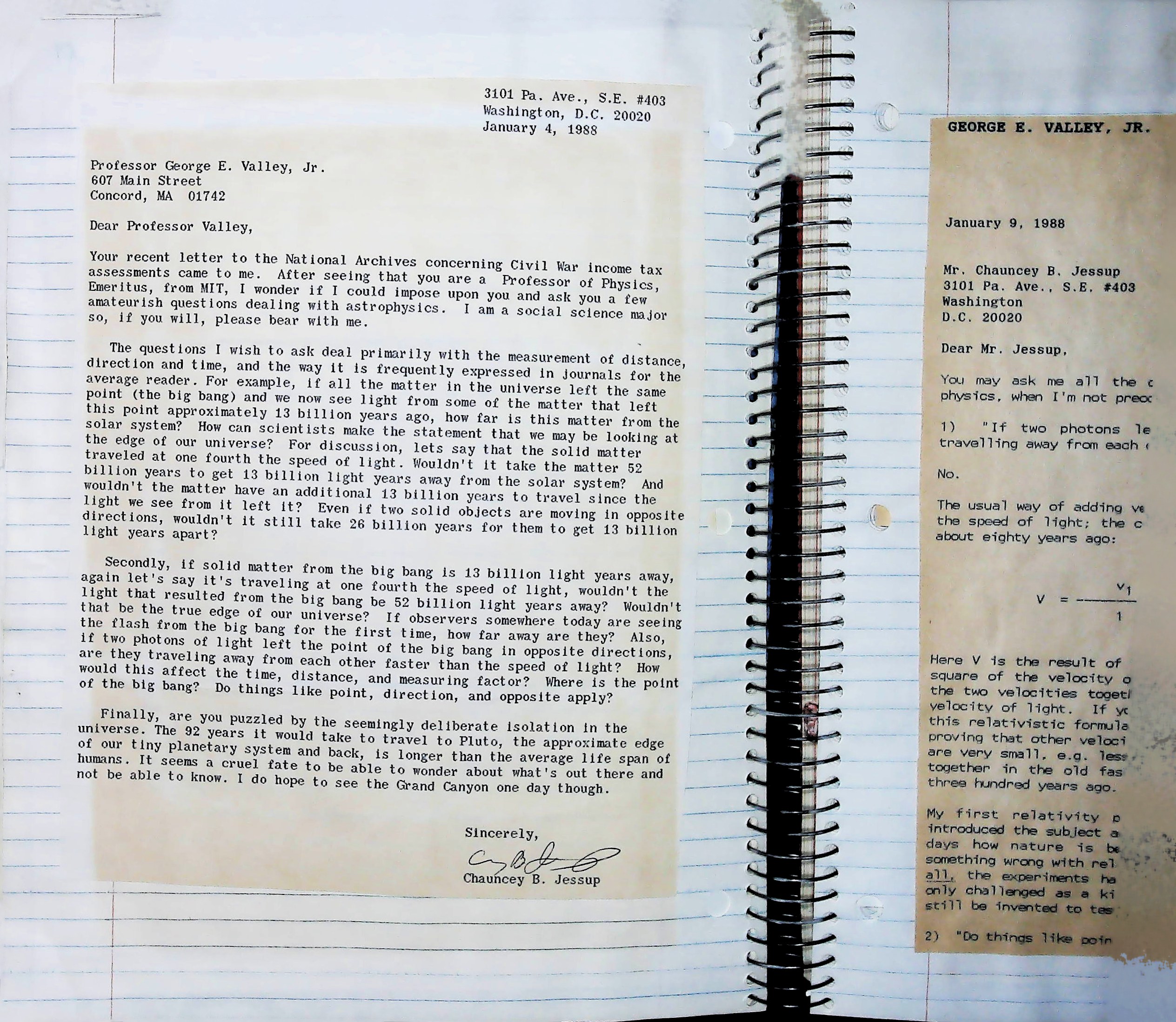
[Notebook p. 60: a typed personal letter pasted in, from the National Archives archivist who had answered GEV's query, written from his home (the address is left out), with the start of GEV's reply on the facing page.] January 4, 1988 Professor George E. Valley, Jr. 607 Main Street Concord, MA 01742 Dear Professor Valley, Your recent letter to the National Archives concerning Civil War income tax assessments came to me. After seeing that you are a Professor of Physics, Emeritus, from MIT, I wonder if I could impose upon you and ask you a few amateurish questions dealing with astrophysics. I am a social science major so, if you will, please bear with me. [Summarized: he asks how far away the matter from the big bang can be if its light left it 13 billion years ago, whether two photons leaving in opposite directions recede from each other faster than light, and where the point of the big bang is; and closes:] It seems a cruel fate to be able to wonder about what's out there and not be able to know. I do hope to see the Grand Canyon one day though. Sincerely, [signed] Chauncey B. Jessup
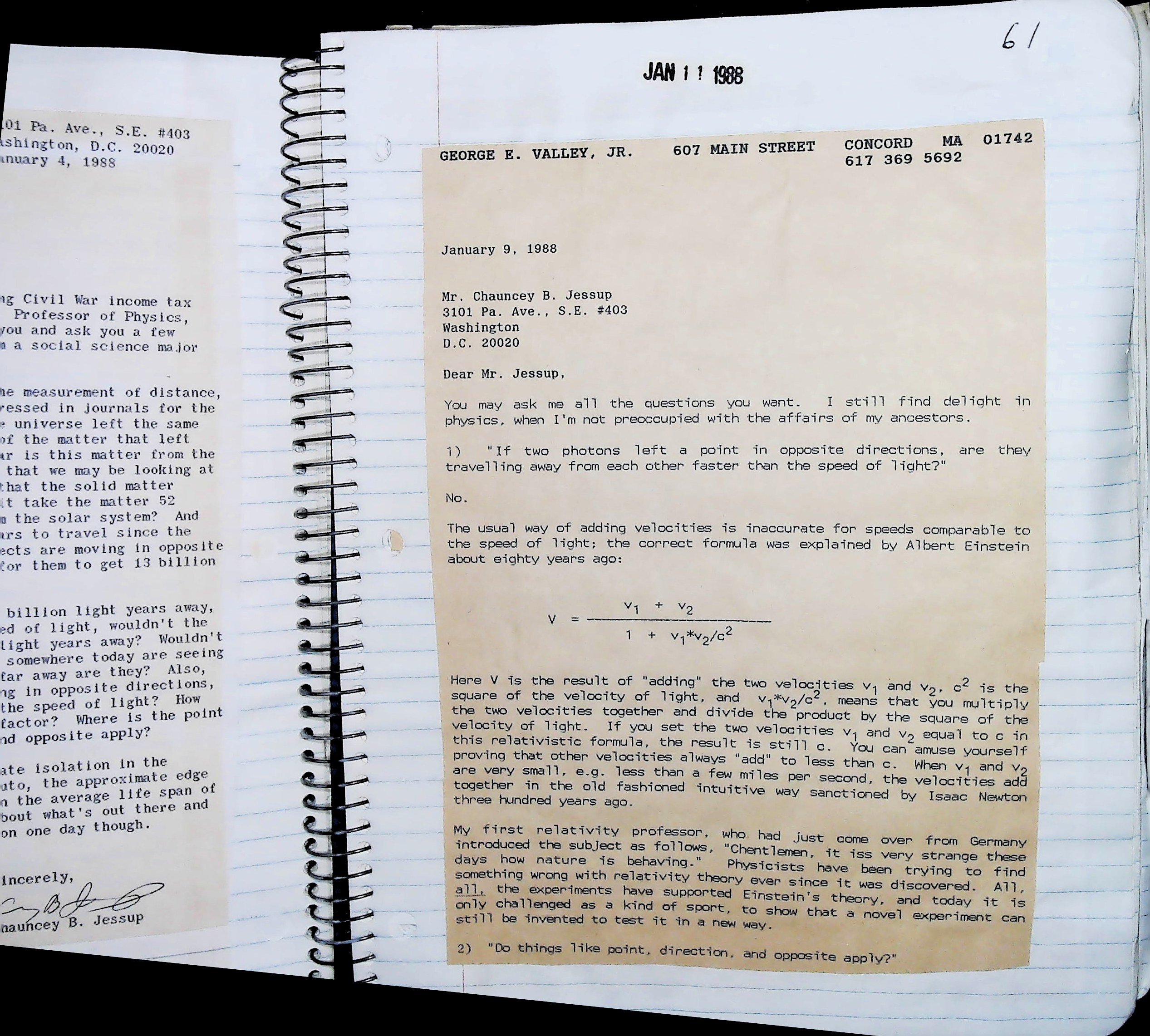
[Notebook p. 61, date stamp JAN 11 1988: GEV's typed reply, page 1, pasted in. Jessup's home address and GEV's phone number are left out.] GEORGE E. VALLEY, JR. 607 MAIN STREET CONCORD MA 01742 January 9, 1988 Mr. Chauncey B. Jessup Washington, D.C. Dear Mr. Jessup, You may ask me all the questions you want. I still find delight in physics, when I'm not preoccupied with the affairs of my ancestors. 1) "If two photons left a point in opposite directions, are they travelling away from each other faster than the speed of light?" No. The usual way of adding velocities is inaccurate for speeds comparable to the speed of light; the correct formula was explained by Albert Einstein about eighty years ago: V = (v1 + v2) / (1 + v1*v2/c^2). [He explains the formula, then:] My first relativity professor, who had just come over from Germany introduced the subject as follows, "Chentlemen, it iss very strange these days how nature is behaving." Physicists have been trying to find something wrong with relativity theory ever since it was discovered. All, all, the experiments have supported Einstein's theory, and today it is only challenged as a kind of sport, to show that a novel experiment can still be invented to test it in a new way. 2) "Do things like point, direction, and opposite apply?"
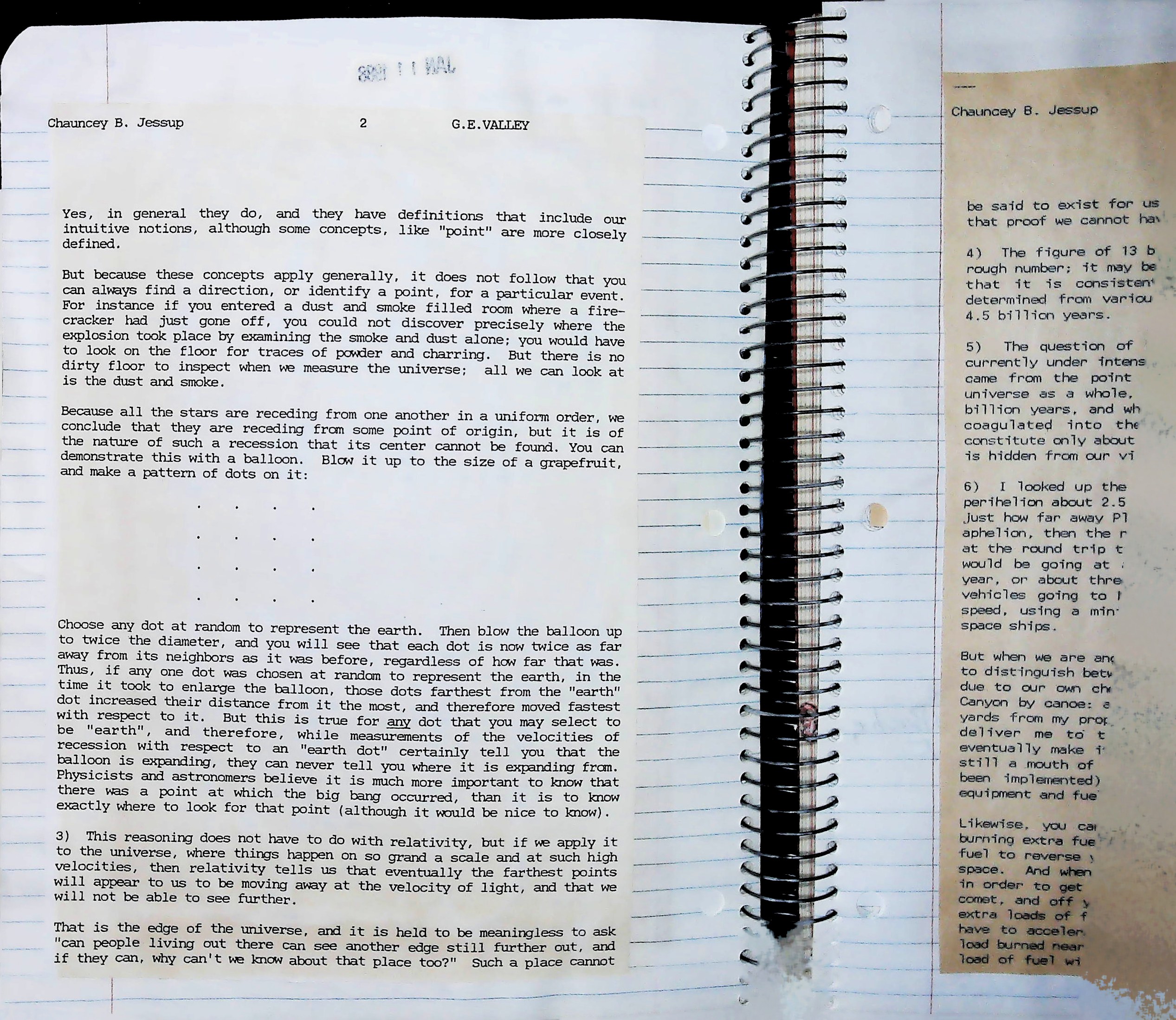
[Notebook p. 62: page 2 of GEV's reply to Chauncey B. Jessup, with page 3 on the facing page (p. 63). Summarized: he answers that "point" and "direction" apply in general but that the centre of the universe's expansion cannot be found, illustrating with a balloon covered in dots that is blown up to twice its size; that relativity sets the edge of what can be seen where the farthest points recede at the speed of light; that 13 billion years is a rough figure; and that a round trip to Pluto would be slow but not impossible.]
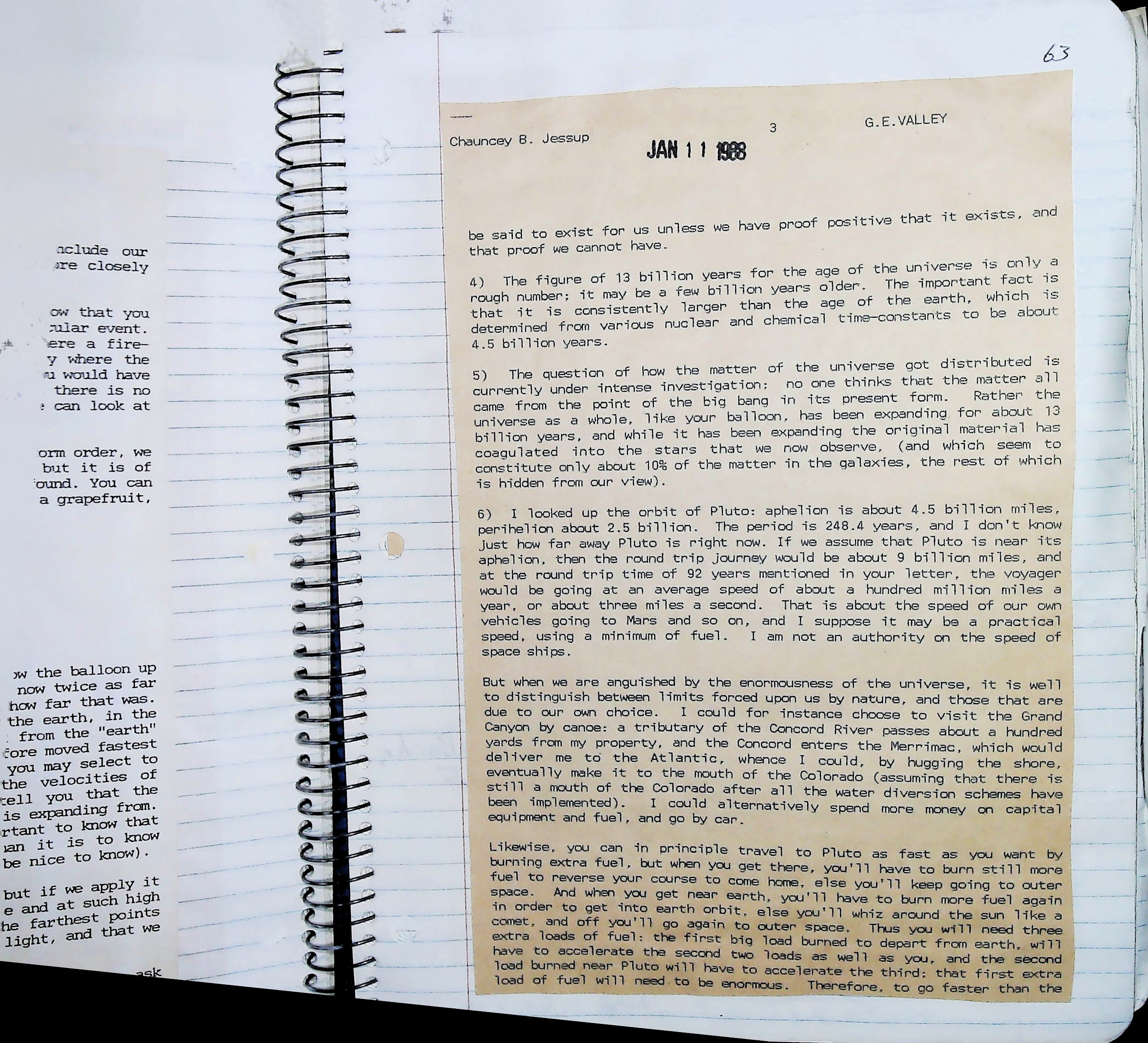
[Notebook p. 63, date stamp JAN 11 1988: page 3 of GEV's reply to Chauncey B. Jessup.] ...be said to exist for us unless we have proof positive that it exists, and that proof we cannot have. 4) The figure of 13 billion years for the age of the universe is only a rough number; it may be a few billion years older. The important fact is that it is consistently larger than the age of the earth, which is determined from various nuclear and chemical time-constants to be about 4.5 billion years. 5) The question of how the matter of the universe got distributed is currently under intense investigation; no one thinks that the matter all came from the point of the big bang in its present form. [...] 6) I looked up the orbit of Pluto [...] the voyager would be going at an average speed of about a hundred million miles a year, or about three miles a second. That is about the speed of our own vehicles going to Mars and so on [...] But when we are anguished by the enormousness of the universe, it is well to distinguish between limits forced upon us by nature, and those that are due to our own choice. I could for instance choose to visit the Grand Canyon by canoe: a tributary of the Concord River passes about a hundred yards from my property, and the Concord enters the Merrimac, which would deliver me to the Atlantic, whence I could, by hugging the shore, eventually make it to the mouth of the Colorado (assuming that there is still a mouth of the Colorado after all the water diversion schemes have been implemented). I could alternatively spend more money on capital equipment and fuel, and go by car. [He goes on to explain why a fast trip to Pluto and back needs enormous loads of fuel.]
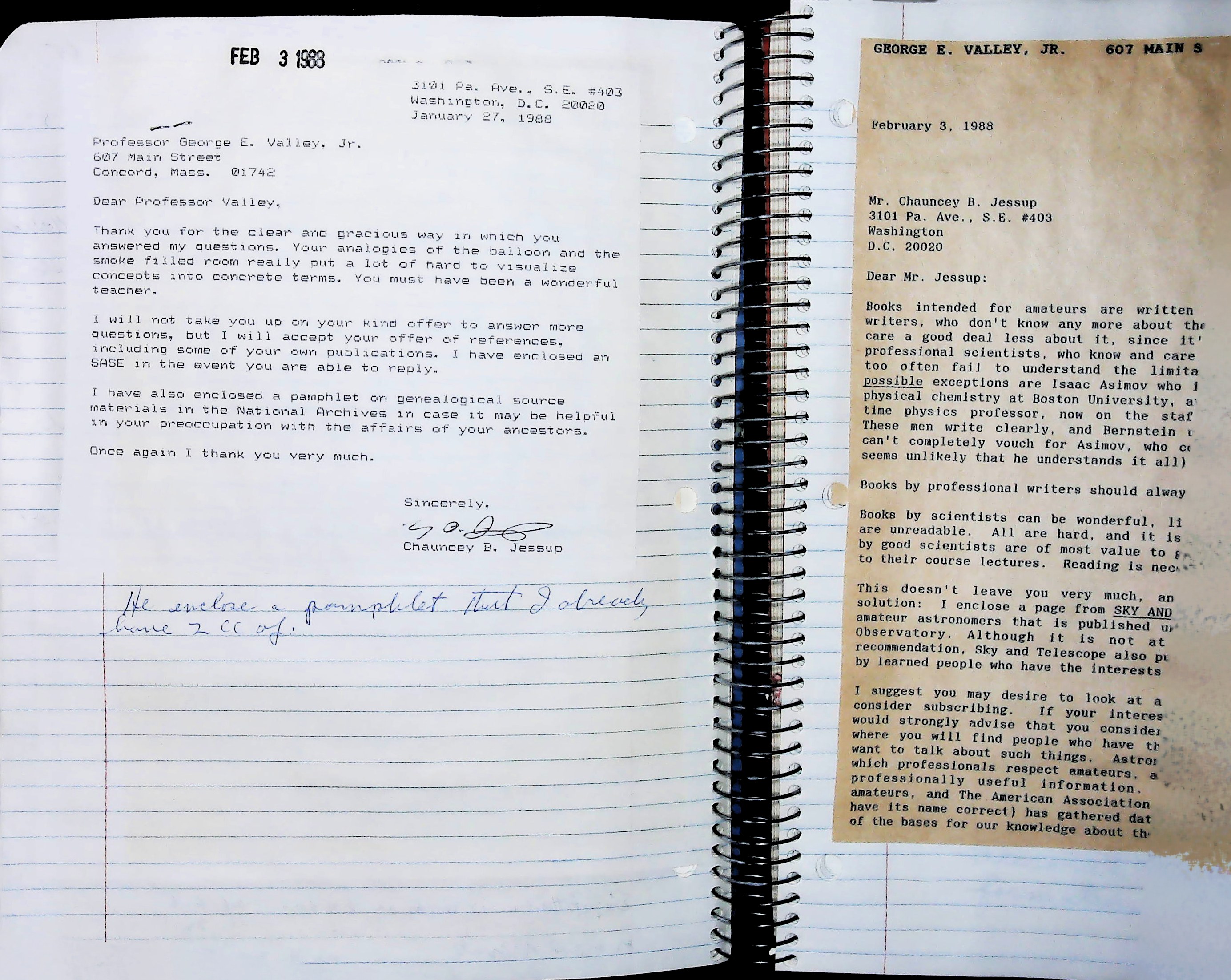
[Notebook p. 66, date stamp FEB 3 1988: a typed letter from Chauncey B. Jessup pasted in (his home address is left out).] January 27, 1988 Professor George E. Valley, Jr. 607 Main Street Concord, Mass. 01742 Dear Professor Valley, Thank you for the clear and gracious way in which you answered my questions. Your analogies of the balloon and the smoke filled room really put a lot of hard to visualize concepts into concrete terms. You must have been a wonderful teacher. I will not take you up on your kind offer to answer more questions, but I will accept your offer of references, including some of your own publications. I have enclosed an SASE in the event you are able to reply. I have also enclosed a pamphlet on genealogical source materials in the National Archives in case it may be helpful in your preoccupation with the affairs of your ancestors. Once again I thank you very much. Sincerely, [signed] Chauncey B. Jessup [GEV:] He enclosed a pamphlet that I already have 2 cc of.
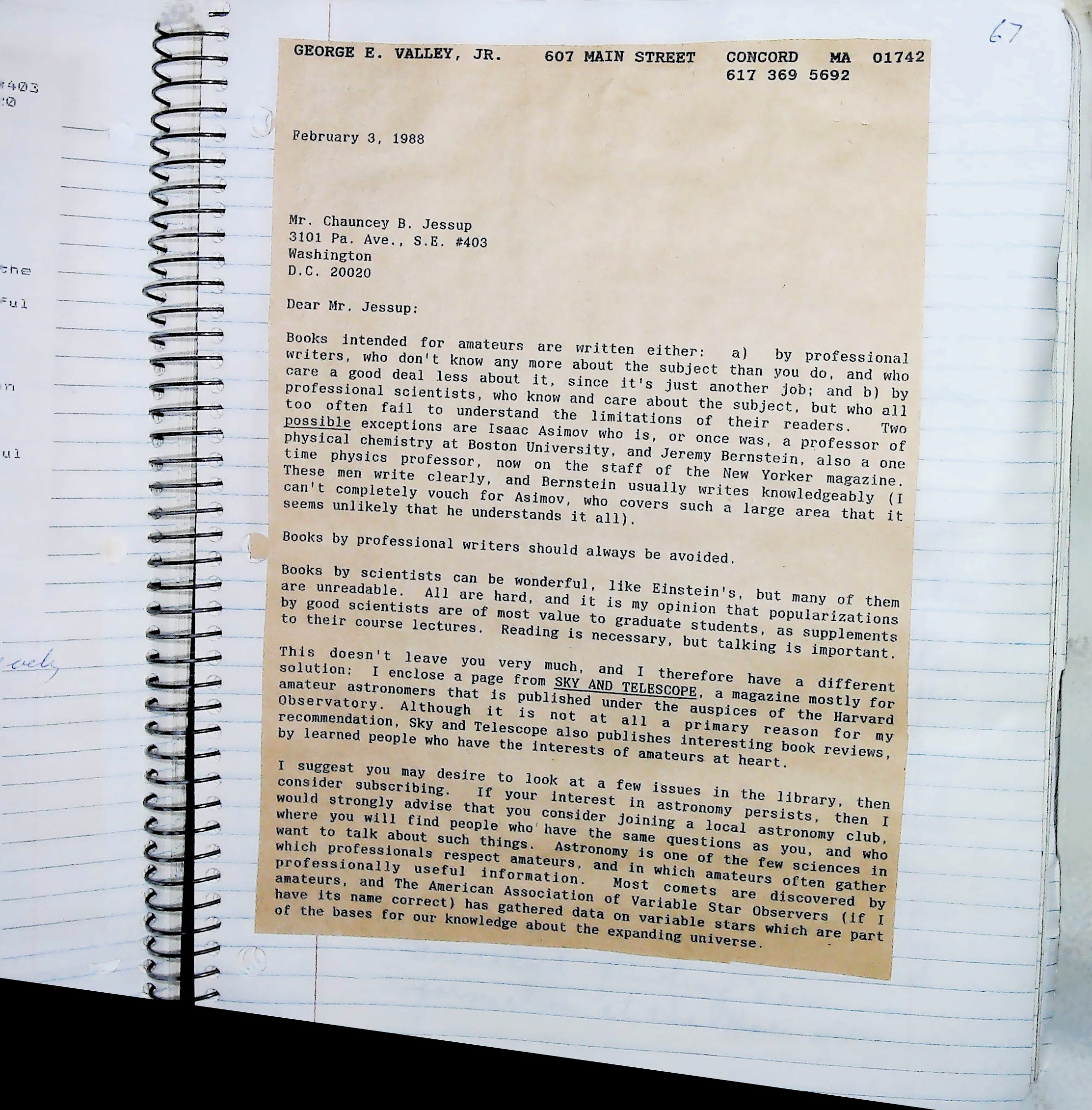
[Notebook p. 67: GEV's typed reply pasted in. Jessup's home address and GEV's phone number are left out.] GEORGE E. VALLEY, JR. 607 MAIN STREET CONCORD MA 01742 February 3, 1988 Mr. Chauncey B. Jessup Washington, D.C. Dear Mr. Jessup: Books intended for amateurs are written either: a) by professional writers, who don't know any more about the subject than you do, and who care a good deal less about it, since it's just another job; and b) by professional scientists, who know and care about the subject, but who all too often fail to understand the limitations of their readers. Two possible exceptions are Isaac Asimov who is, or once was, a professor of physical chemistry at Boston University, and Jeremy Bernstein, also a one time physics professor, now on the staff of the New Yorker magazine. These men write clearly, and Bernstein usually writes knowledgeably (I can't completely vouch for Asimov, who covers such a large area that it seems unlikely that he understands it all). Books by professional writers should always be avoided. Books by scientists can be wonderful, like Einstein's, but many of them are unreadable. All are hard, and it is my opinion that popularizations by good scientists are of most value to graduate students, as supplements to their course lectures. Reading is necessary, but talking is important. This doesn't leave you very much, and I therefore have a different solution: I enclose a page from SKY AND TELESCOPE, a magazine mostly for amateur astronomers that is published under the auspices of the Harvard Observatory. [...] I suggest you may desire to look at a few issues in the library, then consider subscribing. If your interest in astronomy persists, then I would strongly advise that you consider joining a local astronomy club, where you will find people who have the same questions as you, and who want to talk about such things. Astronomy is one of the few sciences in which professionals respect amateurs, and in which amateurs often gather professionally useful information. Most comets are discovered by amateurs, and The American Association of Variable Star Observers (if I have its name correct) has gathered data on variable stars which are part of the bases for our knowledge about the expanding universe.
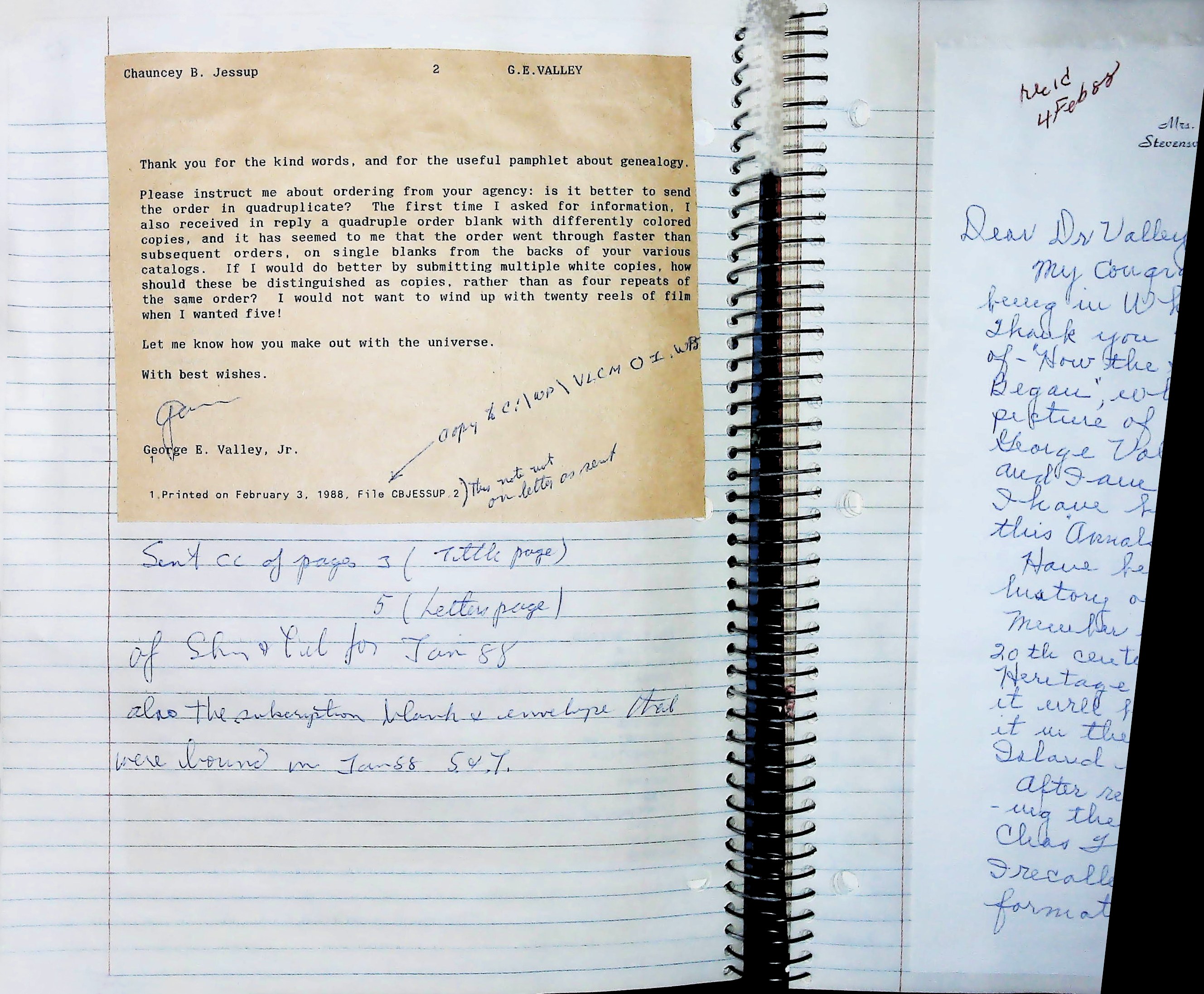
[Notebook p. 68: page 2 of GEV's letter of 3 Feb 1988 to Chauncey B. Jessup, pasted in, with his notes.] Thank you for the kind words, and for the useful pamphlet about genealogy. Please instruct me about ordering from your agency: is it better to send the order in quadruplicate? The first time I asked for information, I also received in reply a quadruple order blank with differently colored copies, and it has seemed to me that the order went through faster than subsequent orders, on single blanks from the backs of your various catalogs. If I would do better by submitting multiple white copies, how should these be distinguished as copies, rather than as four repeats of the same order? I would not want to wind up with twenty reels of film when I wanted five! Let me know how you make out with the universe. With best wishes, [signed] George George E. Valley, Jr. 1.Printed on February 3, 1988, File CBJESSUP.2 [GEV: copy to C:\WP\VLCMO1.WPS; this not on letter as sent] [GEV:] Sent cc of pages 3 (Title page), 5 (Letter page) of Sky & Tel for Jan 88, also the subscription blank & envelope that were bound in Jan 88 S & T.
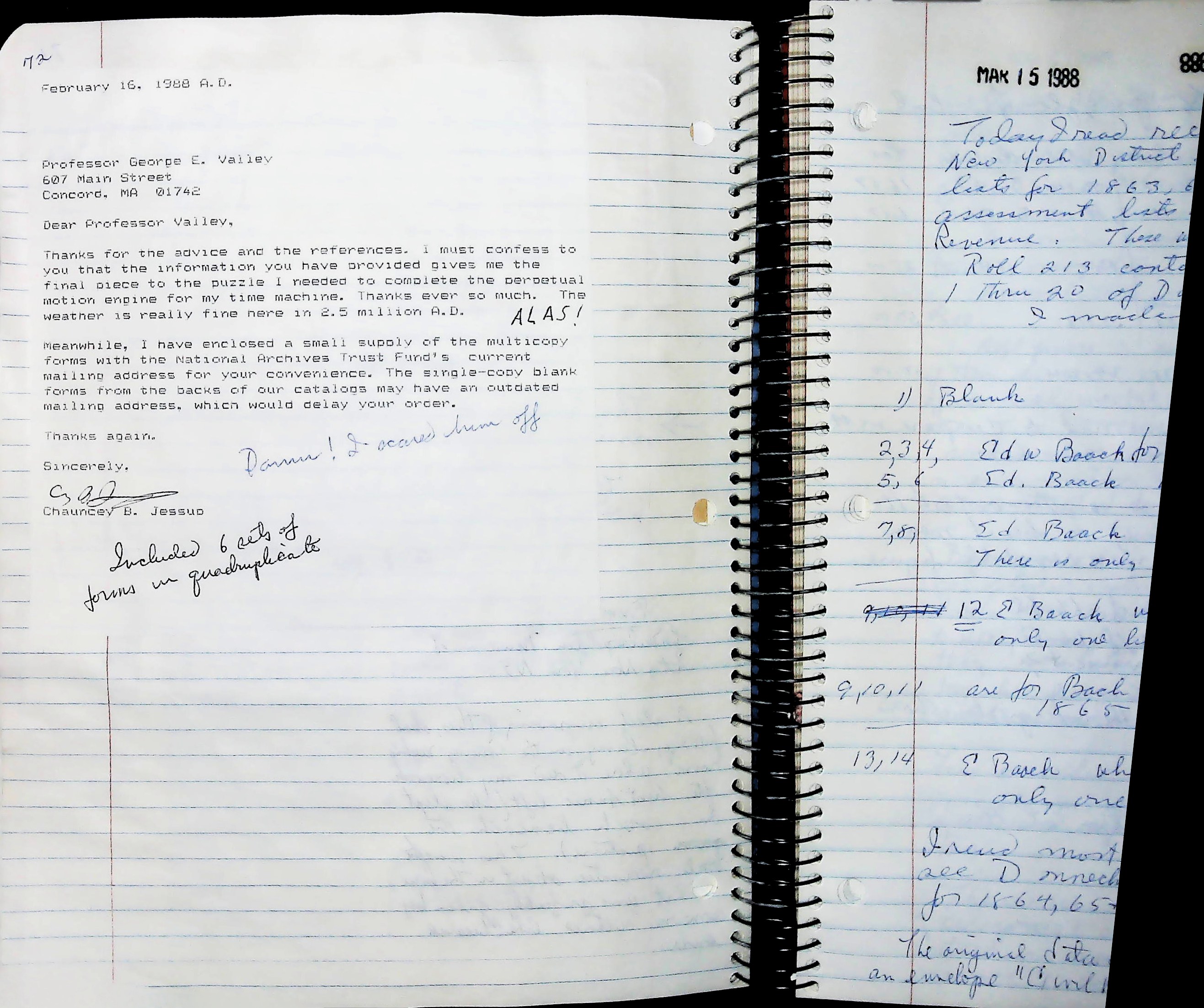
[Notebook p. 72: a typed letter from Chauncey B. Jessup pasted in, with GEV's notes. On the facing page, the first lines of p. 73 (in part 3 of these scans).] February 16, 1988 A.D. Professor George E. Valley 607 Main Street Concord, MA 01742 Dear Professor Valley, Thanks for the advice and the references. I must confess to you that the information you have provided gives me the final piece to the puzzle I needed to complete the perpetual motion engine for my time machine. Thanks ever so much. The weather is really fine here in 2.5 million A.D. [GEV: ALAS!] Meanwhile, I have enclosed a small supply of the multicopy forms with the National Archives Trust Fund's current mailing address for your convenience. The single-copy blank forms from the backs of our catalogs may have an outdated mailing address, which would delay your order. Thanks again. Sincerely, [signed] Chauncey B. Jessup [GEV:] Damn! I scared him off. Included 6 sets of forms in quadruplicate
Notes
Source: Correspondence between G. E. Valley Jr. and Chauncey B. Jessup about the big bang and the size of the universe, Jan-Feb 1988 Location: G. E. Valley Jr.'s research notebook VLCM #5 (begun 14 Sep 1987), part 2, pp. 60-63 and 66-68, 72; Valley family papers, storage bin Found by: Claude research assistant