G. E. Valley Jr.'s notebook account of reading the National Archives microfilms of the Civil War federal tax assessment lists for New York's 32nd collection district (Wards 1, 2 and 4) on 15 and 16 March 1988: Edward Baack appears in division 9 as a wholesale dealer (and on a retail list in 1863) in the annual lists for 1863-1866, but not in the monthly lists, though his neighbours do; with the National Archives' introduction to the records pasted in, and Valley's notes on the 1862-1864 tax rates, licences and 1869 prices drawn from Cynthia G. Fox's article in "Prologue" (Winter 1986).
History · 16 Mar 1988 · Concord, Middlesex, Massachusetts, United States
Linked to Katharina Donnecker, Heinrich Eduard Baack, Sr. and George Edward Valley Jr
9 pages. Open one to read it full size.

Notebook p. 73

Notebook p. 74 (edge of p. 77)

Notebook p. 77 (p. 74 facing)

Notebook pp. 78-79 (pasted National Archives text)

Notebook p. 79
Notebook p. 80

Notebook p. 81

Notebook p. 82

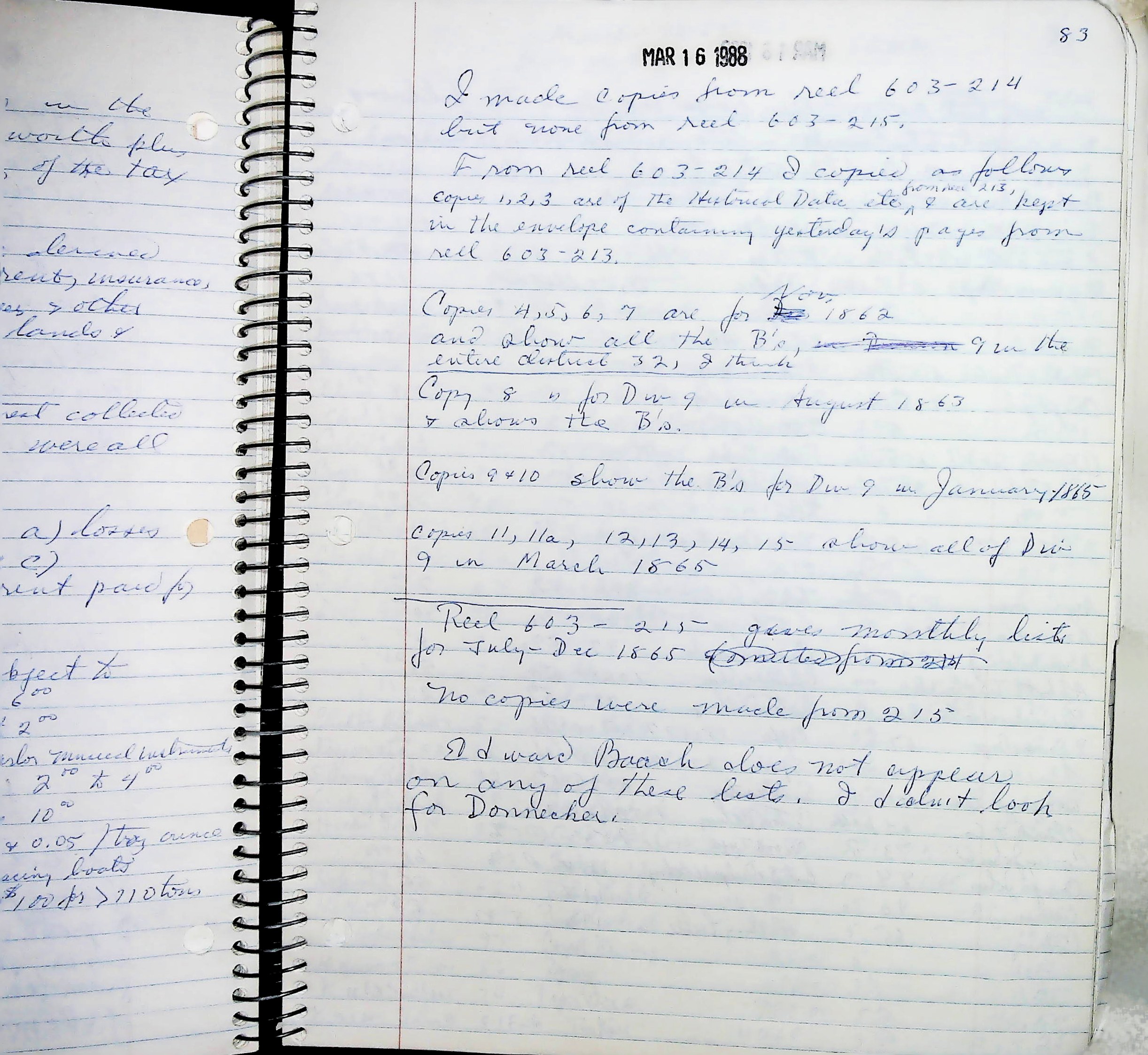
Notebook p. 83
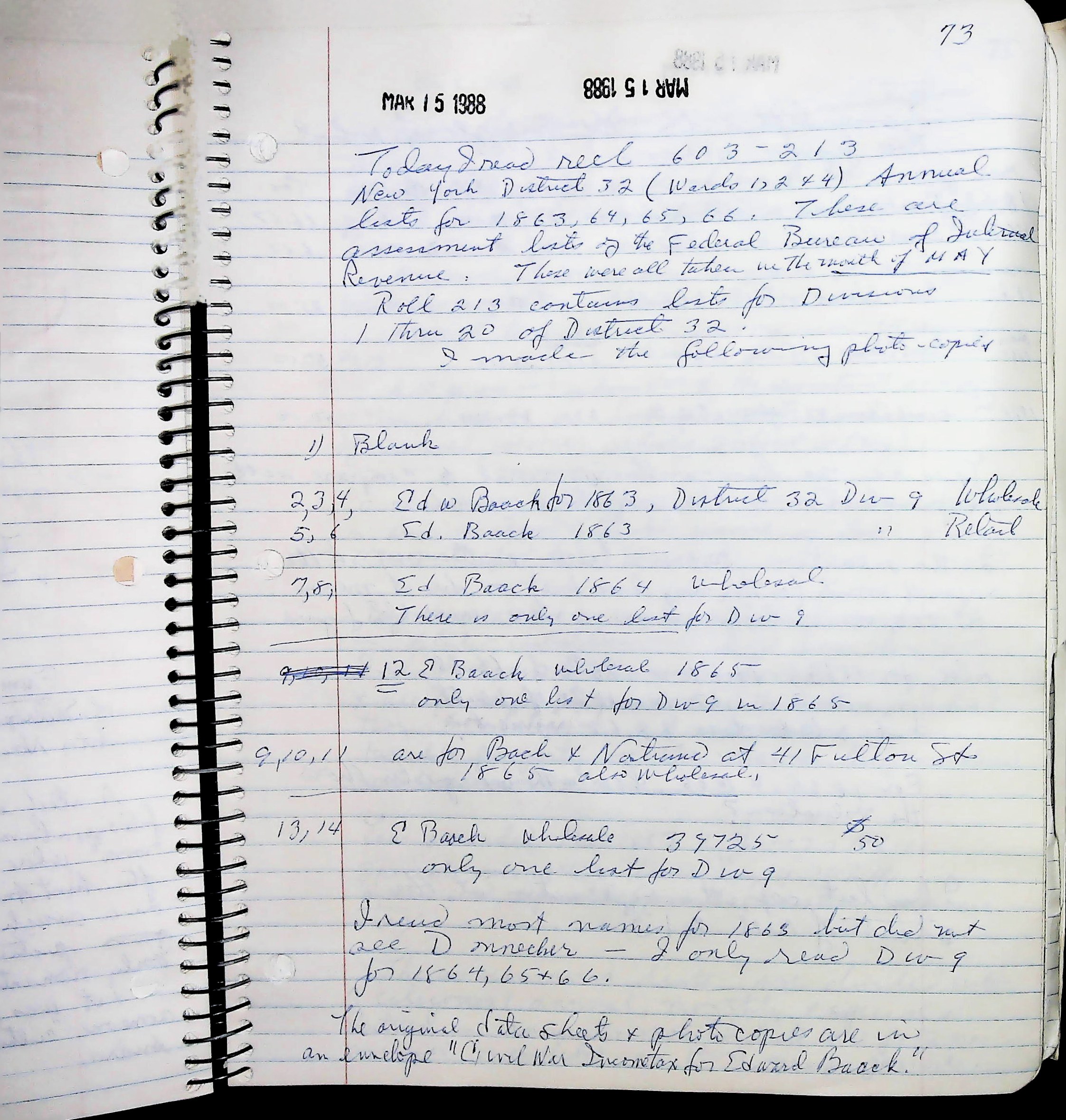
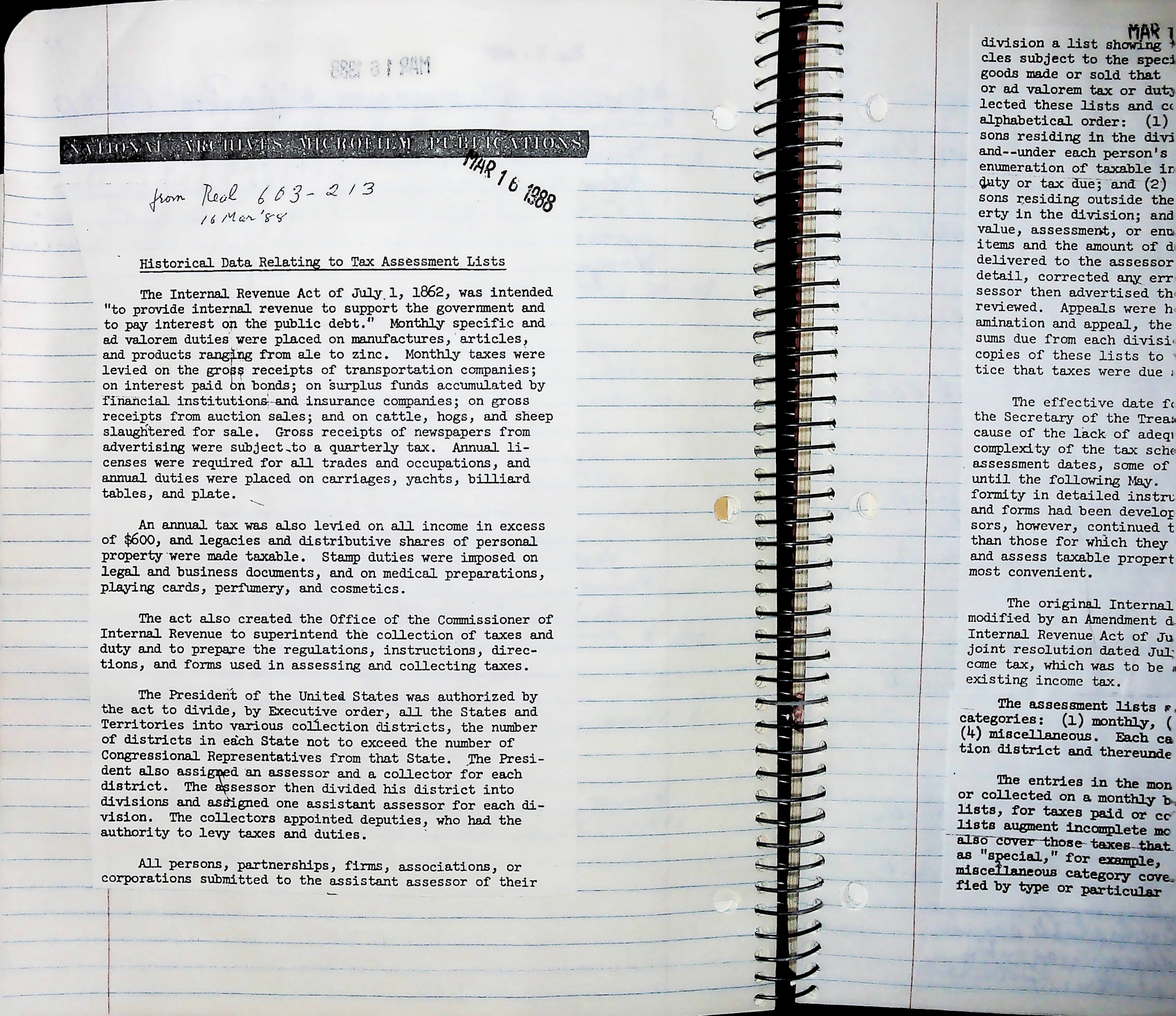
[Notebook p. 73, date stamps MAR 15 1988.] Today I read reel 603-213 New York District 32 (Wards 1, 2 & 4) Annual lists for 1863, 64, 65, 66. These are assessment lists of the Federal Bureau of Internal Revenue. These were all taken in the month of MAY. Roll 213 contains lists for Divisions 1 thru 20 of District 32. I made the following photo-copies: 1) Blank 2, 3, 4, Edw Baack for 1863, District 32 Div 9 Wholesale 5, 6 Ed. Baack 1863 " Retail 7, 8, Ed Baack 1864 wholesale. There is only one list for Div 9 12 E Baack wholesale 1865 - only one list for Div 9 in 1865 9, 10, 11 are for Bach & Nathans [?] at 41 Fulton St. 1865 also wholesale. 13, 14 E Baach wholesale 39725 $.50 only one list for Div 9 I read most names for 1863 but did not see Donnecker - I only read Div 9 for 1864, 65 & 66. The original data sheets & photo copies are in an envelope "Civil War Income tax for Edward Baack."
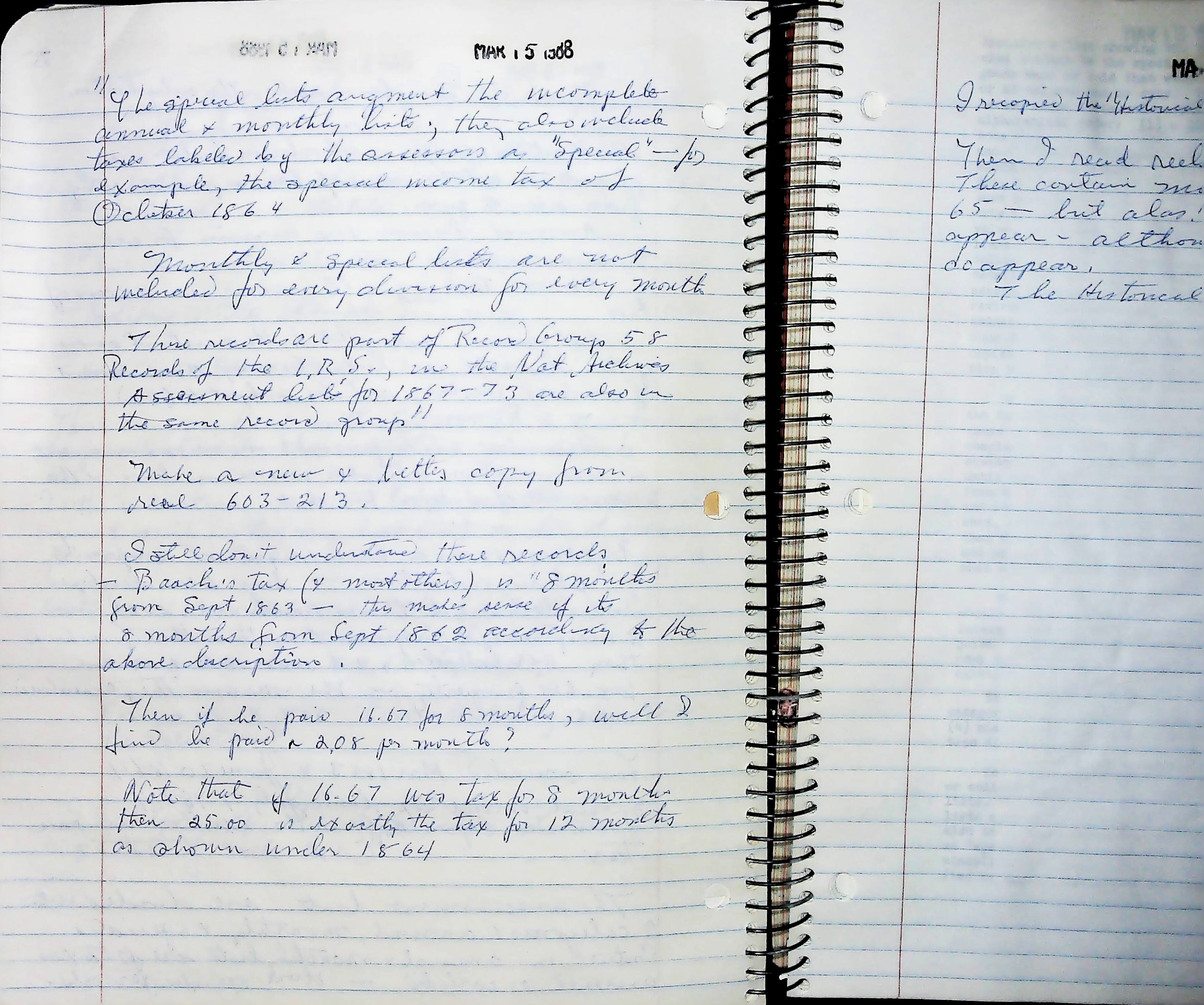
[Notebook p. 74, date stamp MAR 15 1988. GEV copies a description of the records, then his own notes. The facing page (p. 75) shows only its left edge.] "The special lists augment the incomplete annual & monthly lists; they also include taxes labeled by the assessors as "Special" - for example, the special income tax of October 1864. Monthly & special lists are not included for every division for every month. These records are part of Record Group 58 Records of the I.R.S., in the Nat Archives. Assessment lists for 1867-73 are also in the same record group." Make a new & better copy from reel 603-213. I still don't understand these records - Baack's tax (& most others) is "8 months from Sept 1863" - this makes sense if it's 8 months from Sept 1862 according to the above description. Then if he paid 16.67 for 8 months, will I find he paid 2.08 per month? Note that if 16.67 was tax for 8 months then 25.00 is exactly the tax for 12 months as shown under 1864.
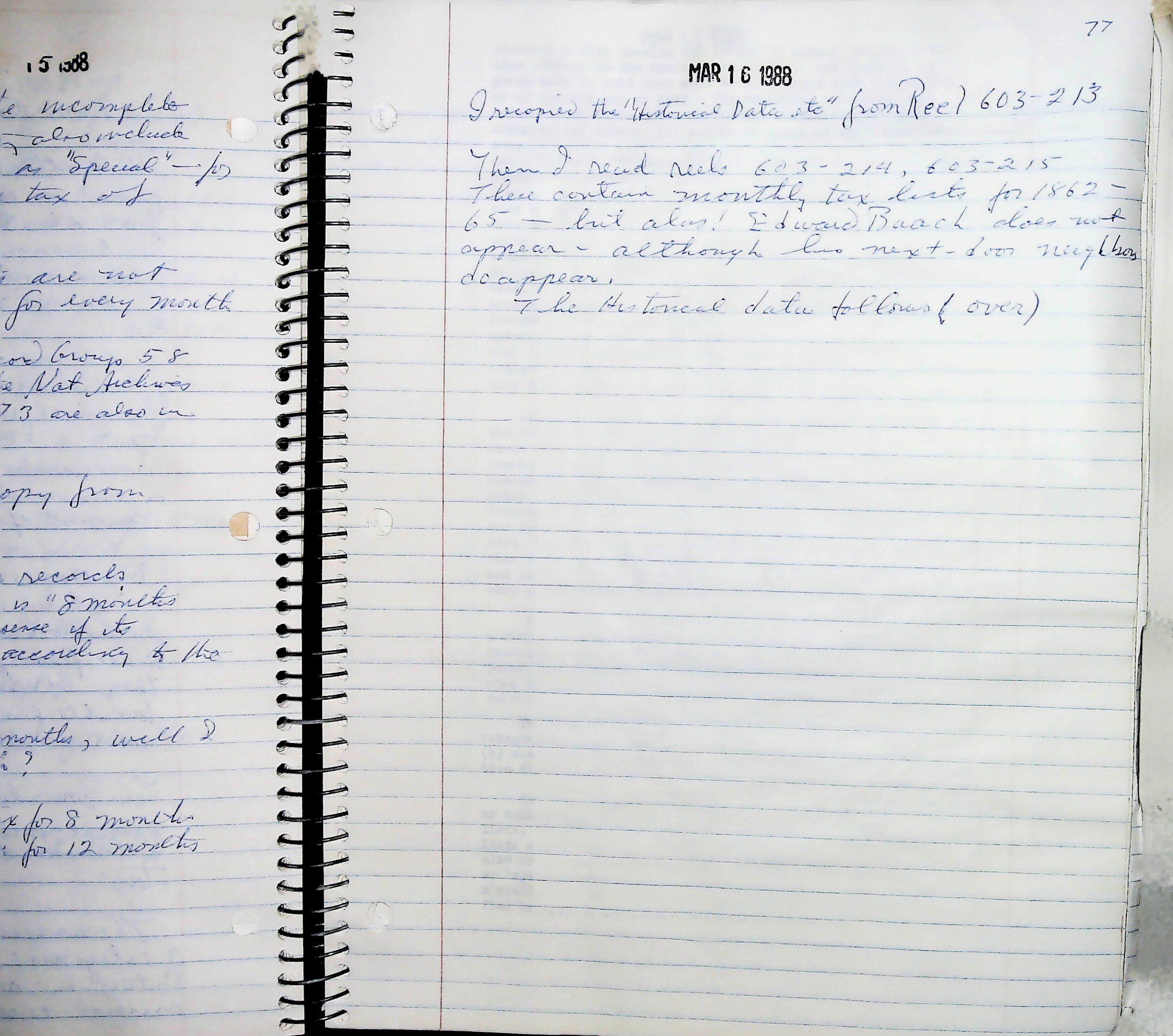
[Notebook p. 77, date stamp MAR 16 1988; p. 74 faces it on the left. (No pages numbered 75-76 appear between them.)] I recopied the "Historical Data etc" from Reel 603-213. Then I read reels 603-214, 603-215. These contain monthly tax lists for 1862-65 - but alas! Edward Baack does not appear - although his next-door neighbors do appear. The Historical data follows (over).
[Notebook p. 78, with p. 79 at the right: GEV's photocopy of the National Archives microfilm publication's introduction, pasted in, marked "from Reel 603-213, 16 Mar '88" and stamped MAR 16 1988. Summarized: "Historical Data Relating to Tax Assessment Lists" explains that the Internal Revenue Act of 1 July 1862 placed monthly duties on manufactures and products, annual licenses on all trades and occupations, an annual tax on incomes over $600, and stamp duties; that the President divided the states into collection districts, each with an assessor, and the assessor divided his district into divisions with an assistant assessor for each; that everyone in a division submitted a list of their taxable income, articles and goods; and that the assessment lists fall into monthly, annual, special and miscellaneous categories, arranged by collection district and division.]
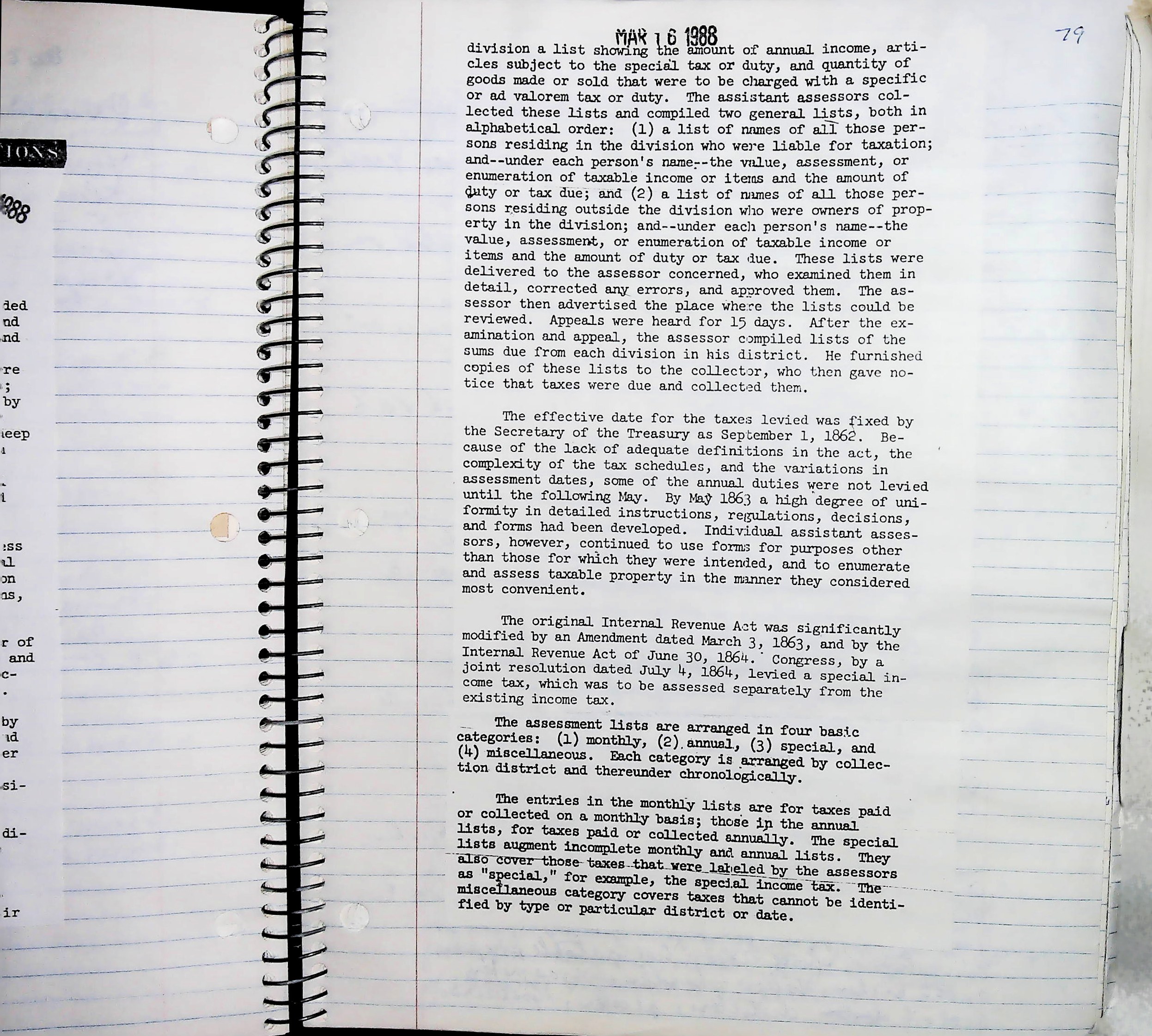
[Notebook p. 79: the second page of the pasted National Archives introduction, stamped MAR 16 1988. Summarized: the assistant assessors compiled alphabetical lists of everyone in the division liable for tax, with the value assessed and the duty due, and of owners of property in the division who lived elsewhere; the assessor heard appeals for 15 days and passed the lists to the collector. The Secretary of the Treasury fixed 1 September 1862 as the effective date of the taxes, though some annual duties were not levied until the following May; the act was amended on 3 March 1863 and by the Internal Revenue Act of 30 June 1864, and a joint resolution of 4 July 1864 levied a special income tax. The special lists augment incomplete monthly and annual lists and cover taxes labelled "special".]
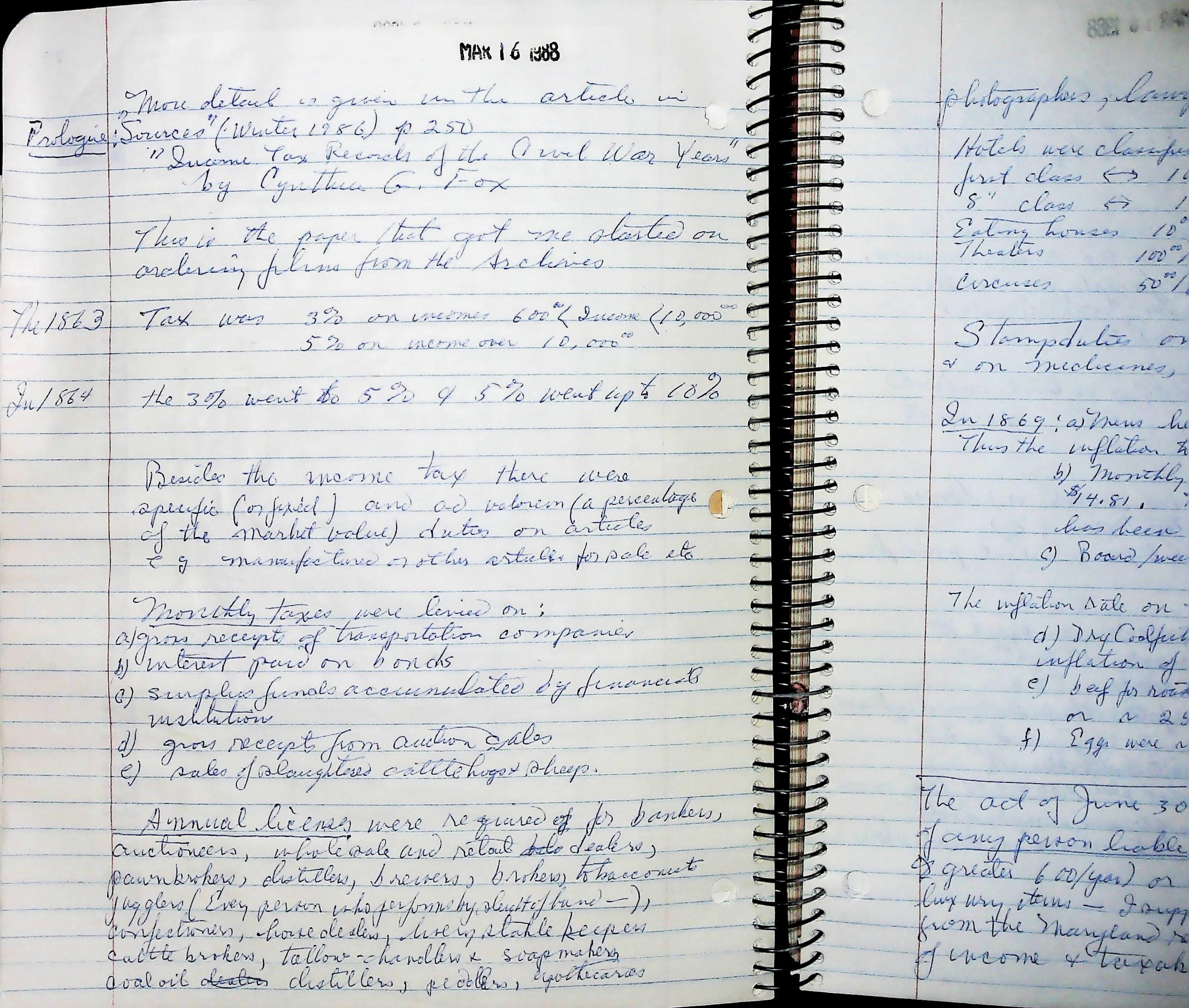
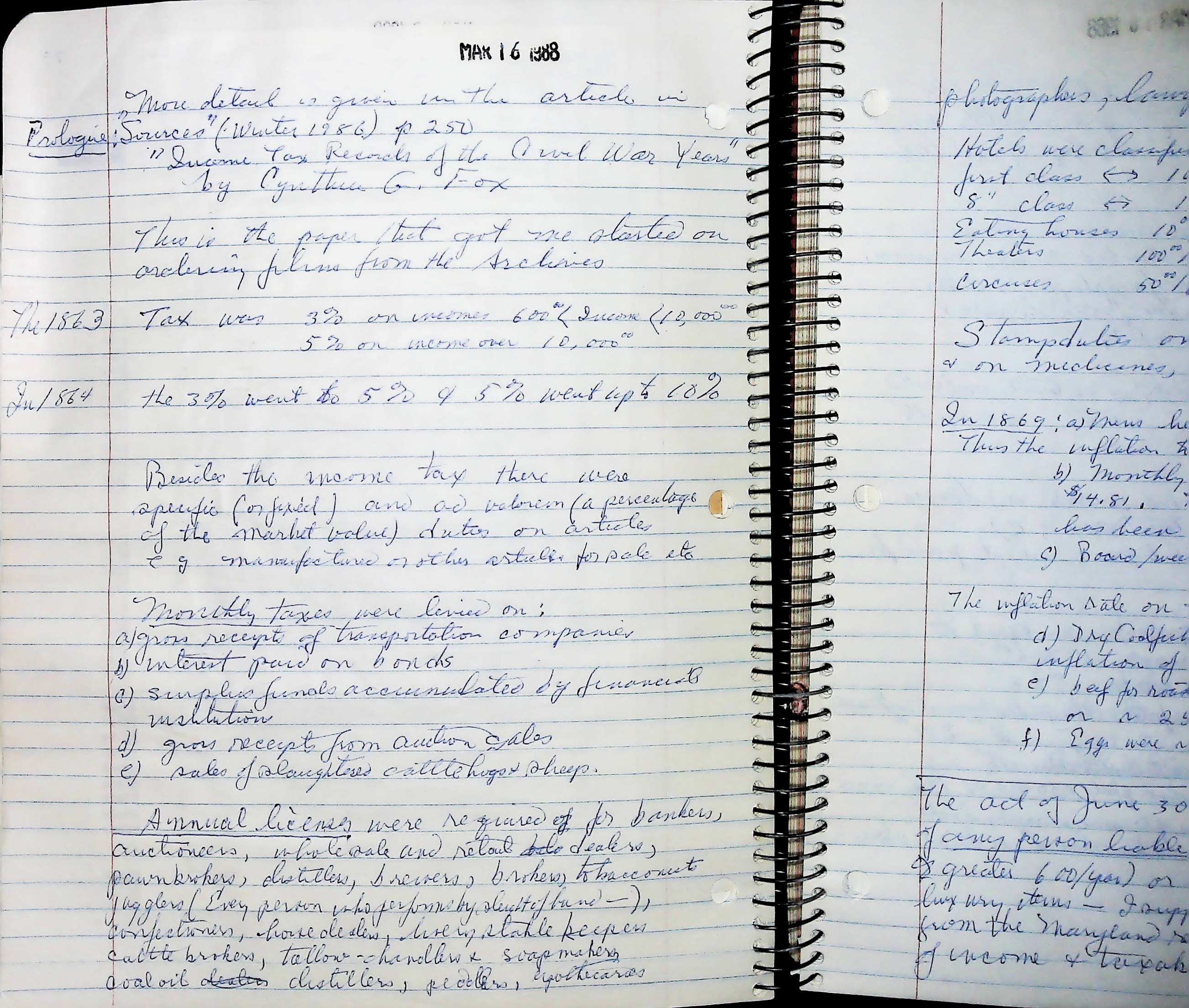
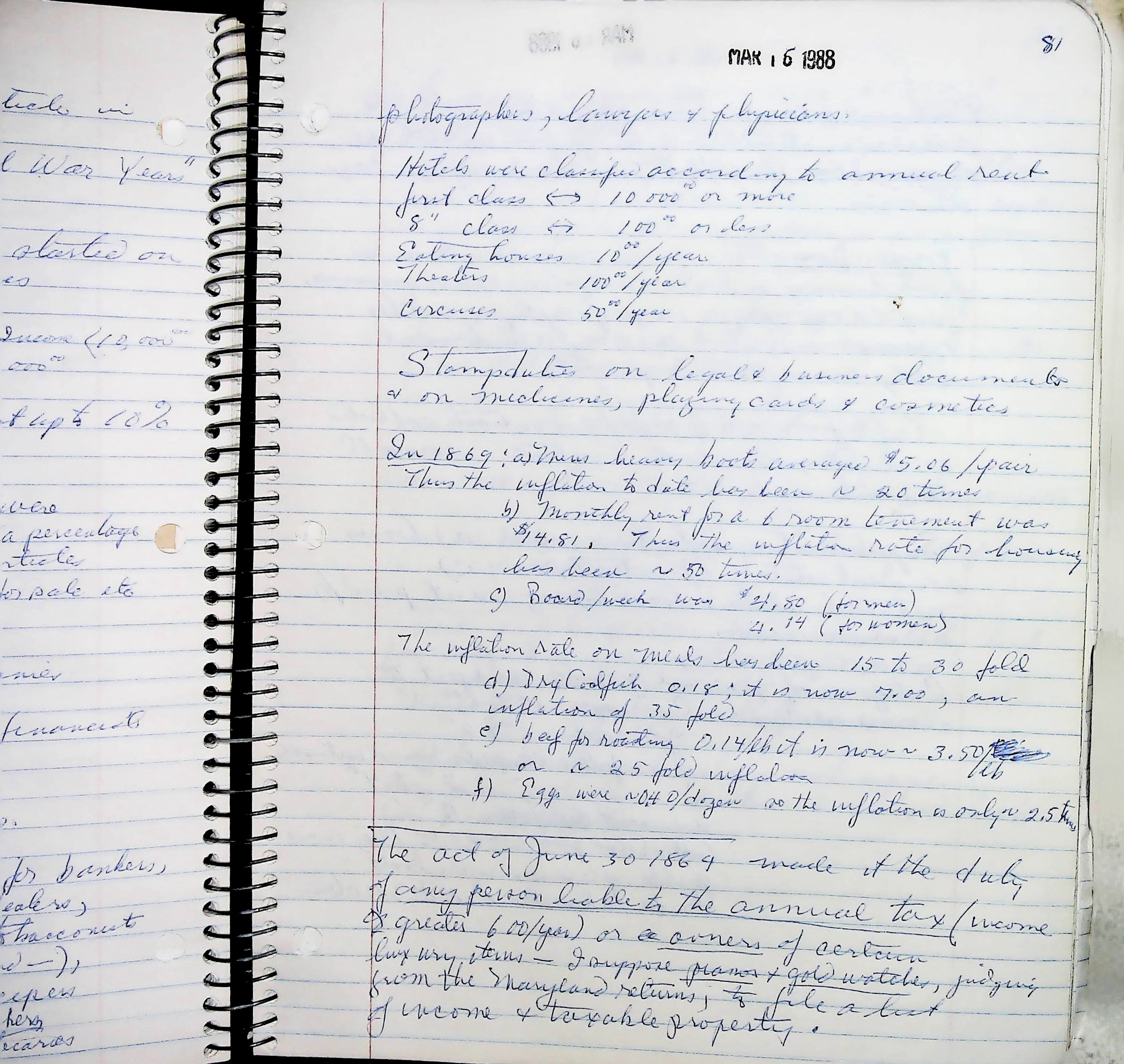
[Notebook p. 80, date stamp MAR 16 1988. Margin headings in brackets.] [Prologue:] More detail is given in the article in "Sources" (Winter 1986) p 250 "Income Tax Records of the Civil War Years" by Cynthia G. Fox. This is the paper that got me started on ordering films from the Archives. [In 1863] Tax was 3% on incomes 600.00 < income < 10,000.00; 5% on income over 10,000.00 [In 1864] the 3% went to 5% & 5% went up to 10% Besides the income tax there were specific (or fixed) and ad valorem (a percentage of the market value) duties on articles e.g. manufactured or other articles for sale etc. Monthly taxes were levied on: a) gross receipts of transportation companies b) interest paid on bonds c) surplus funds accumulated by financial institution d) gross receipts from auction sales e) sales of slaughtered cattle hogs & sheep. Annual licenses were required of [for] bankers, auctioneers, wholesale and retail dealers, pawnbrokers, distillers, brewers, brokers, tobacconists, jugglers (Every person who performs by sleight of hand -), confectioners, horse dealers, livery stable keepers, cattle brokers, tallow-chandlers & soap makers, coal oil distillers, peddlers, apothecaries,
[Notebook p. 81, date stamp MAR 16 1988.] photographers, lawyers & physicians. Hotels were classified according to annual rent: first class <-> 10,000.00 or more; 8th class <-> 100.00 or less. Eating houses 10.00/year; Theaters 100.00/year; Circuses 50.00/year. Stamp duties on legal & business documents & on medicines, playing cards & cosmetics. In 1869: a) Mens heavy boots averaged $5.06/pair. Thus the inflation to date has been ~20 times. b) Monthly rent for a 6 room tenement was $14.81. Thus the inflation rate for housing has been ~50 times. c) Board/week was $2.80 (for men), 4.14 (for women). The inflation rate on meals has been 15 to 30 fold. d) Dry Codfish 0.18; it is now 7.00, an inflation of 35 fold. e) beef for roasting 0.14/lb; it is now ~3.50/lb or ~25 fold inflation. f) Eggs were ~0.40/dozen so the inflation is only ~2.5 times. The act of June 30 1864 made it the duty of any person liable to the annual tax (income greater 600/year) or owners of certain luxury items - I suppose pianos & gold watches, judging from the Maryland returns, to file a list of income & taxable property.
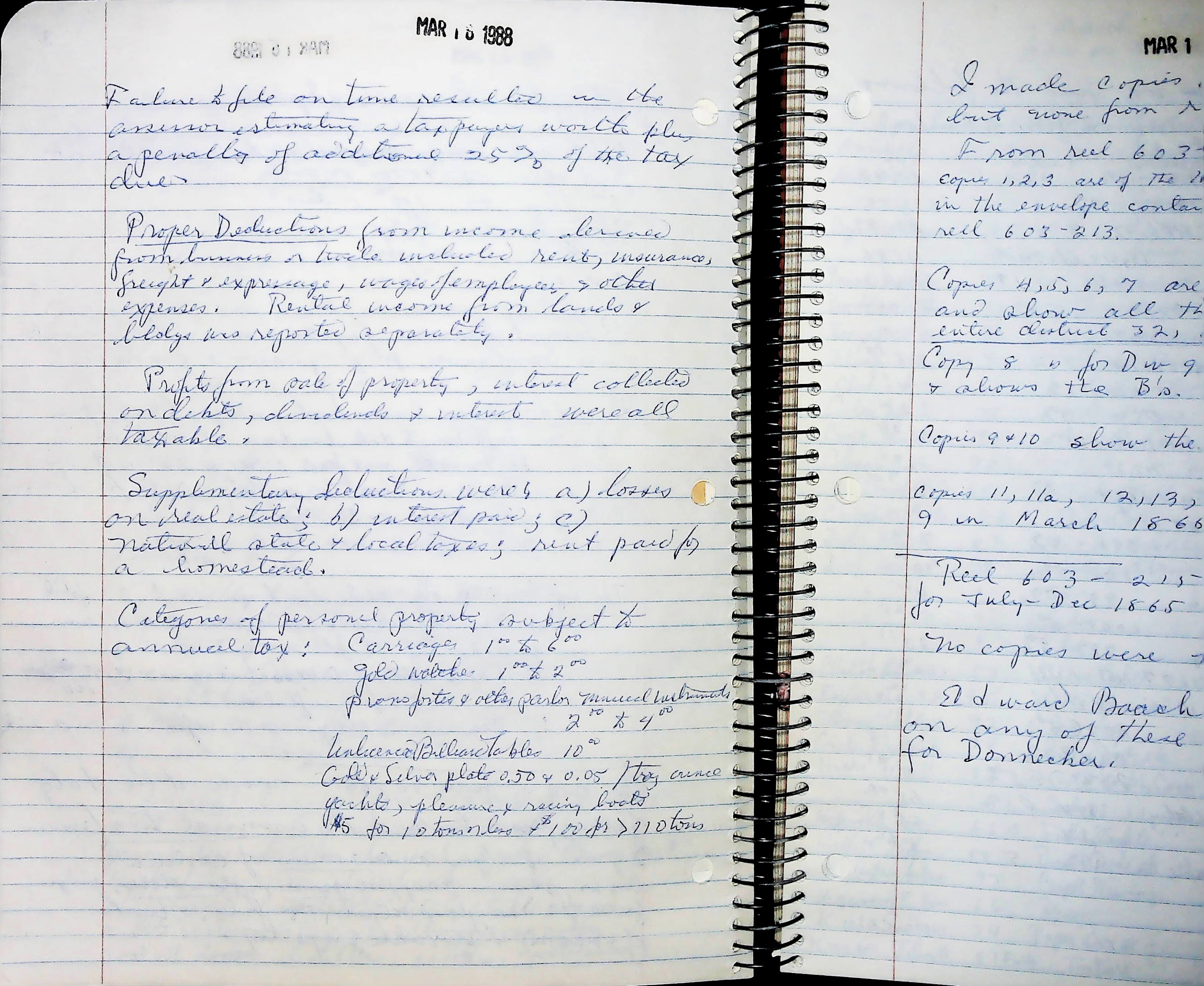
[Notebook p. 82, date stamp MAR 16 1988.] Failure to file on time resulted in the assessor estimating a taxpayer's worth plus a penalty of additional 25% of the tax due. Proper Deductions from income derived from business or trade included rent, insurance, freight & expressage, wages of employees & other expenses. Rental income from lands & bldgs was reported separately. Profits from sale of property, interest collected on debts, dividends & interest were all taxable. Supplementary deductions were: a) losses on real estate; b) interest paid; c) national state & local taxes; rent paid for a homestead. Categories of personal property subject to annual tax: Carriages 1.00 to 6.00; Gold watches 1.00 to 2.00; pianofortes & other parlor musical instruments 2.00 to 4.00; Unlicensed Billiard Tables 10.00; Gold & Silver plate 0.50 & 0.05 / troy ounce; yachts, pleasure & racing boats $5 for 10 tons or less, $100 for > 110 tons.
[Notebook p. 83, date stamp MAR 16 1988.] I made copies from reel 603-214 but none from reel 603-215. From reel 603-214 I copied as follows: copies 1, 2, 3 are of the Historical Data etc from reel 213, & are kept in the envelope containing yesterday's pages from reel 603-213. Copies 4, 5, 6, 7 are for Nov 1862 and show all the B's, in the entire district 32, I think. Copy 8 is for Div 9 in August 1863 & shows the B's. Copies 9 & 10 show the B's for Div 9 in January 1865. Copies 11, 11a, 12, 13, 14, 15 show all of Div 9 in March 1865. Reel 603-215 gives monthly lists for July-Dec 1865. No copies were made from 215. Edward Baach does not appear on any of these lists. I didn't look for Donnecker.
Notes
Source: G. E. Valley Jr., notes on the Civil War federal tax assessment lists for Edward Baack, 15-16 Mar 1988 (notebook VLCM #5, pp. 73-83) Location: G. E. Valley Jr.'s research notebook VLCM #5 (begun 14 Sep 1987), part 3, pp. 73-83; Valley family papers, storage bin Found by: Claude research assistant