G. E. Valley Jr.'s letter to Chris Abell, a flute maker in Concord, with his chronology of Edward Baack's life, and his account of visiting Abell's shop on 3 September 1987 to learn how wooden fifes and flutes are made and how long Baack's would have taken.
History · 3 Sep 1987 · Concord, Middlesex, Massachusetts, United States
Linked to Christina Franzeska Mohr, Catharina Sophie Baumann, Mary C. C. Baack, Martin Hieronymus Baack, Philipp Jakob Donnecker, Edward Baack, Jr., Katharina Donnecker, Heinrich Eduard Baack, Sr. and George Edward Valley Jr
5 pages. Open one to read it full size.

Notebook p. 232
Notebook p. 233

Notebook p. 234
Notebook p. 235

Notebook p. 236
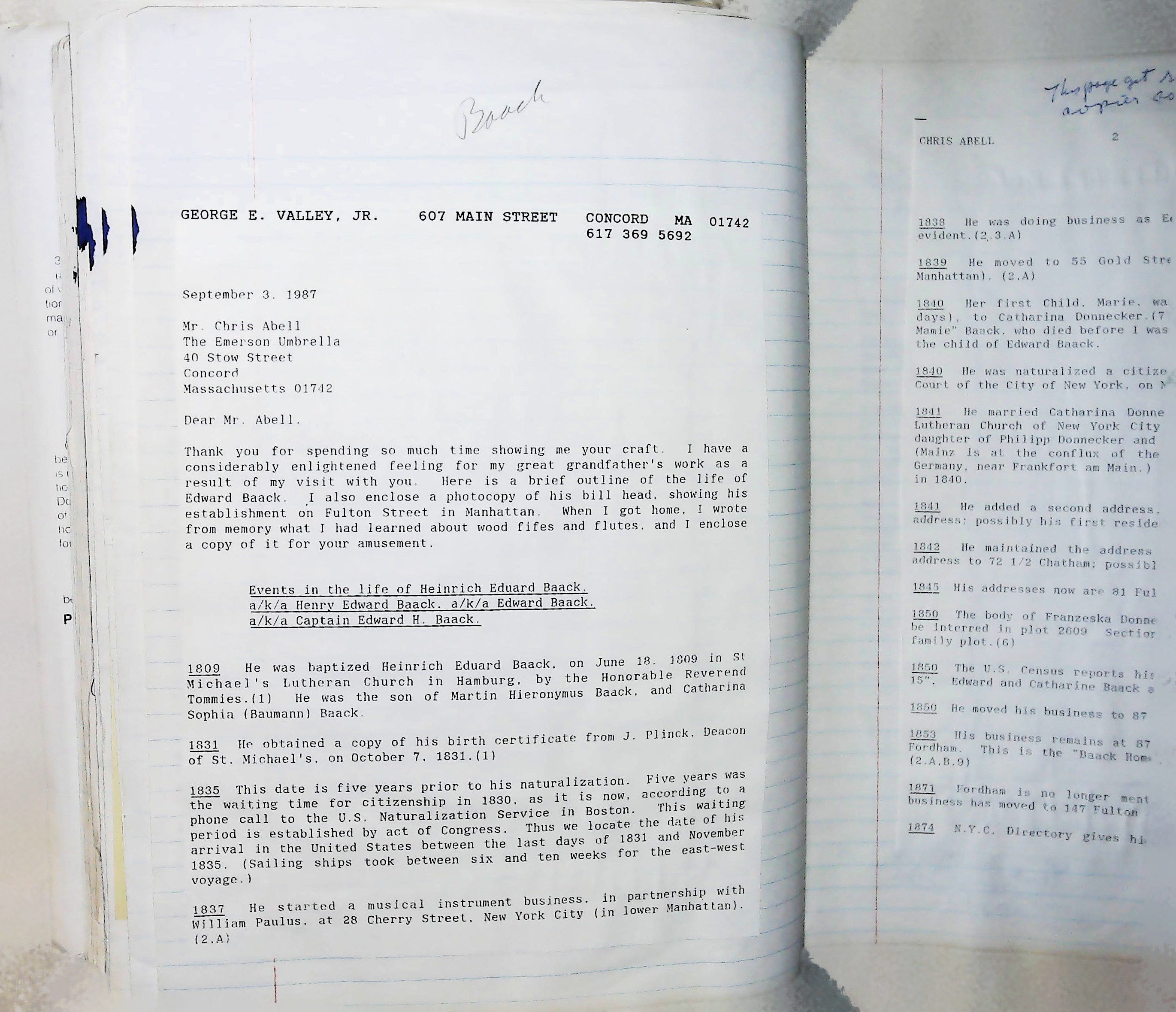
[Notebook p. 232. Copy of GEV's typed letter to Chris Abell, flute maker, page 1, pasted in. GEV's note: "Baach".] GEORGE E. VALLEY, JR. 607 MAIN STREET CONCORD MA 01742 617 369 5692
September 3, 1987
Mr. Chris Abell The Emerson Umbrella 40 Stow Street Concord Massachusetts 01742
Dear Mr. Abell,
Thank you for spending so much time showing me your craft. I have a considerably enlightened feeling for my great grandfather's work as a result of my visit with you. Here is a brief outline of the life of Edward Baack. I also enclose a photocopy of his bill head, showing his establishment on Fulton Street in Manhattan. When I got home, I wrote from memory what I had learned about wood fifes and flutes, and I enclose a copy of it for your amusement.
[The chronology "Events in the life of Heinrich Eduard Baack, a/k/a Henry Edward Baack, a/k/a Edward Baack, a/k/a Captain Edward H. Baack" follows, 1809-1837, as in the letter to Lehman.]
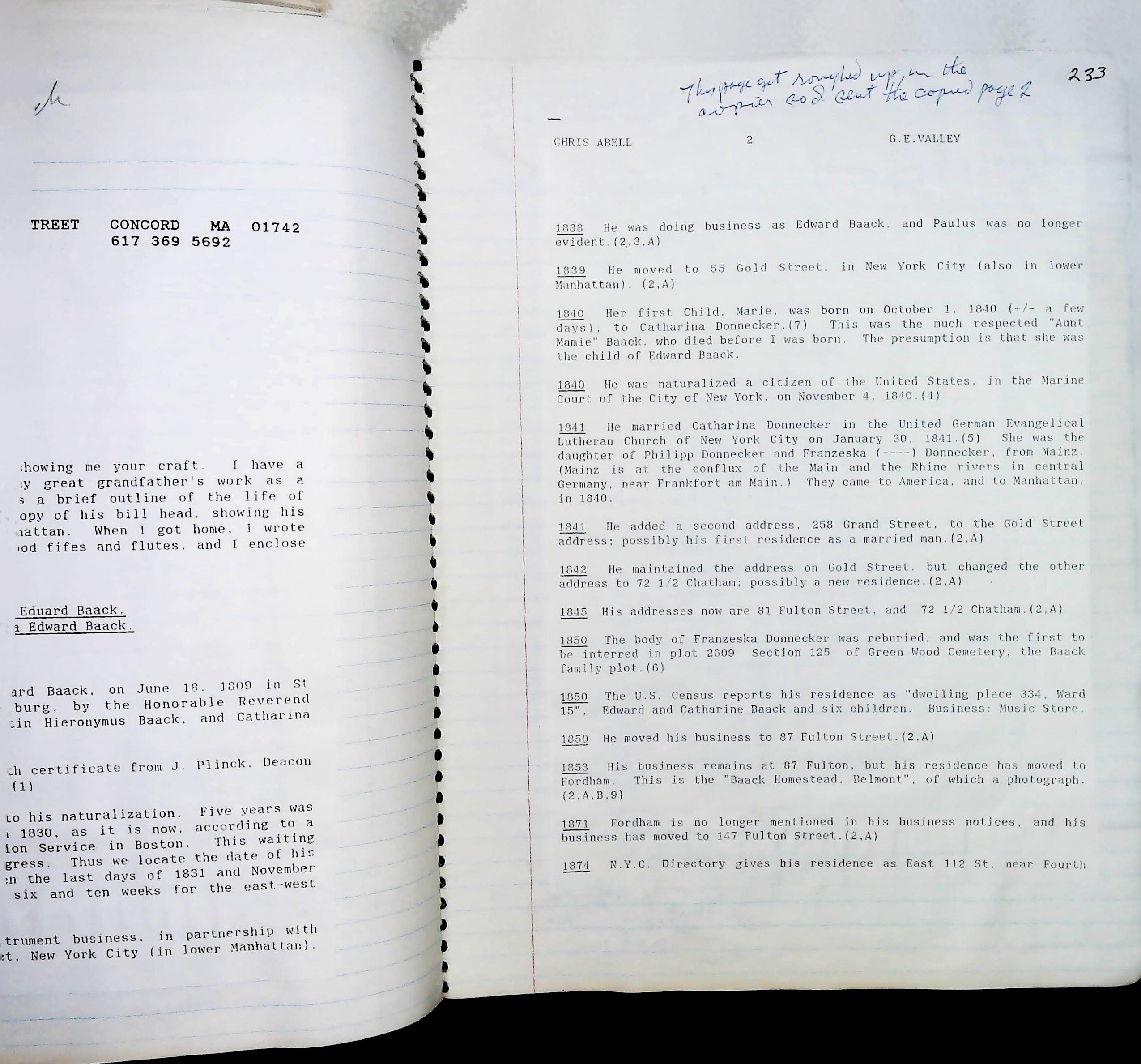
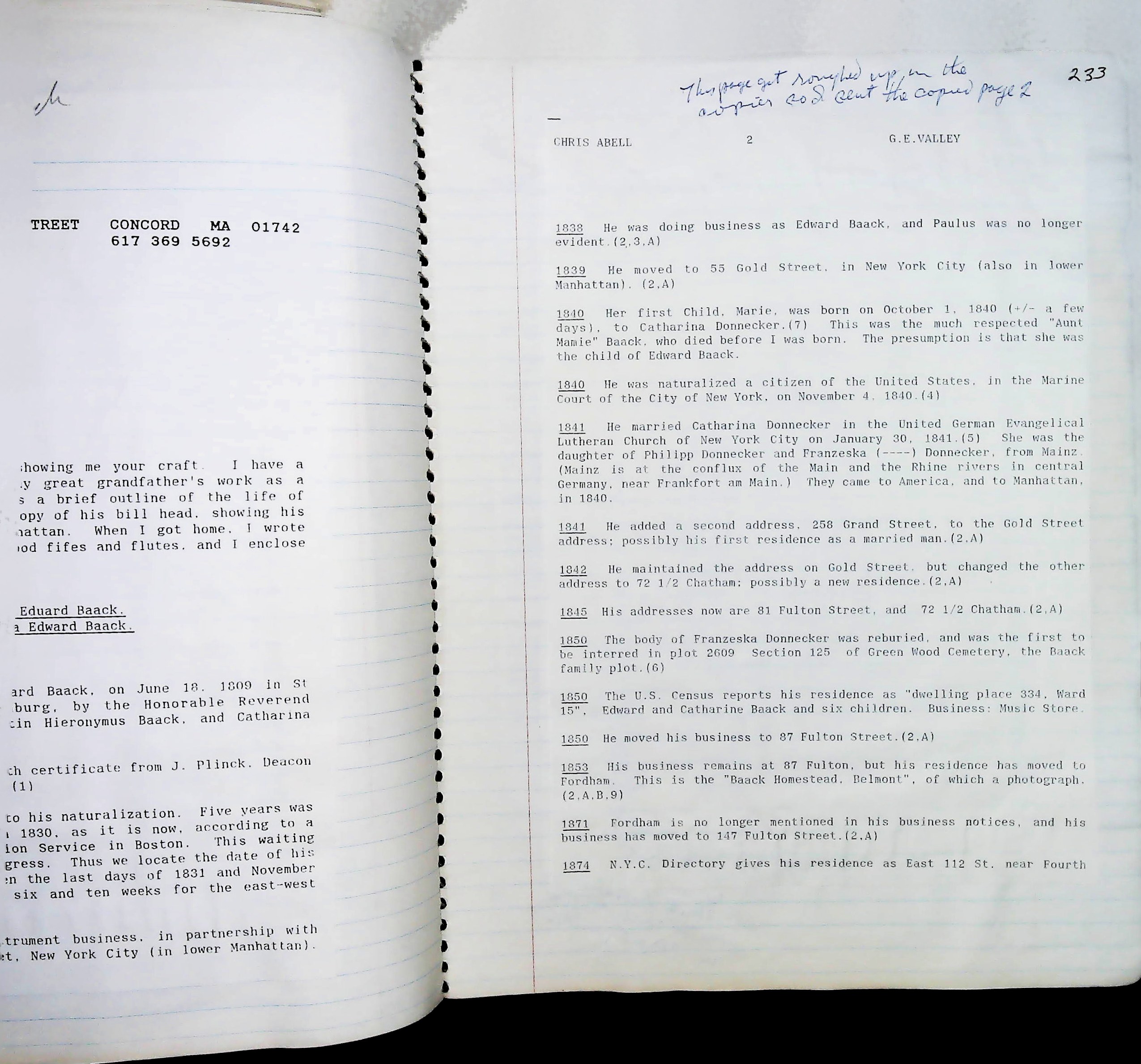
[Notebook p. 233. Page 2 of the letter to Abell: the chronology 1838-1874, as in the letter to Lehman, with this addition. GEV's note at top: "This page got rumpled up in the copier so I sent the copied page 2".] 1840 Her first Child, Marie, was born on October 1, 1840 (+/- a few days), to Catharina Donnecker.(7) This was the much respected "Aunt Mamie" Baack, who died before I was born. The presumption is that she was the child of Edward Baack.
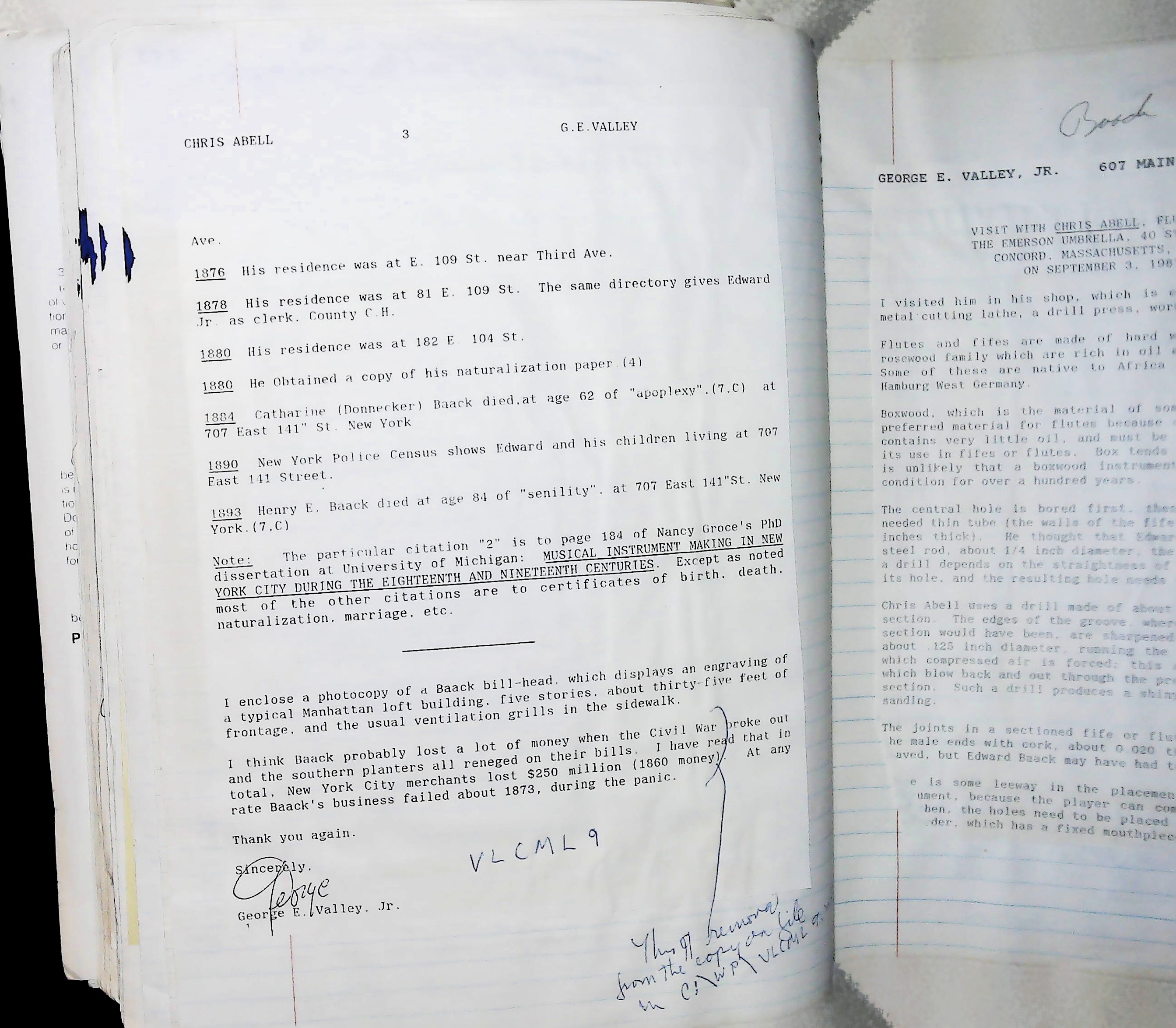
[Notebook p. 234. Page 3 of the letter to Abell: the chronology 1876-1893 and note on citations, as in the letter to Lehman, then:] I enclose a photocopy of a Baack bill-head, which displays an engraving of a typical Manhattan loft building, five stories, about thirty-five feet of frontage, and the usual ventilation grills in the sidewalk.
I think Baack probably lost a lot of money when the Civil War broke out and the southern planters all reneged on their bills. I have read that in total, New York City merchants lost $250 million (1860 money). At any rate Baack's business failed about 1873, during the panic.
Thank you again. Sincerely, [signed] George George E. Valley, Jr. [handwritten:] VLCML9. [Beside the last paragraph:] This [paragraph] removed from the copy on file in C:\WP\VLCML9
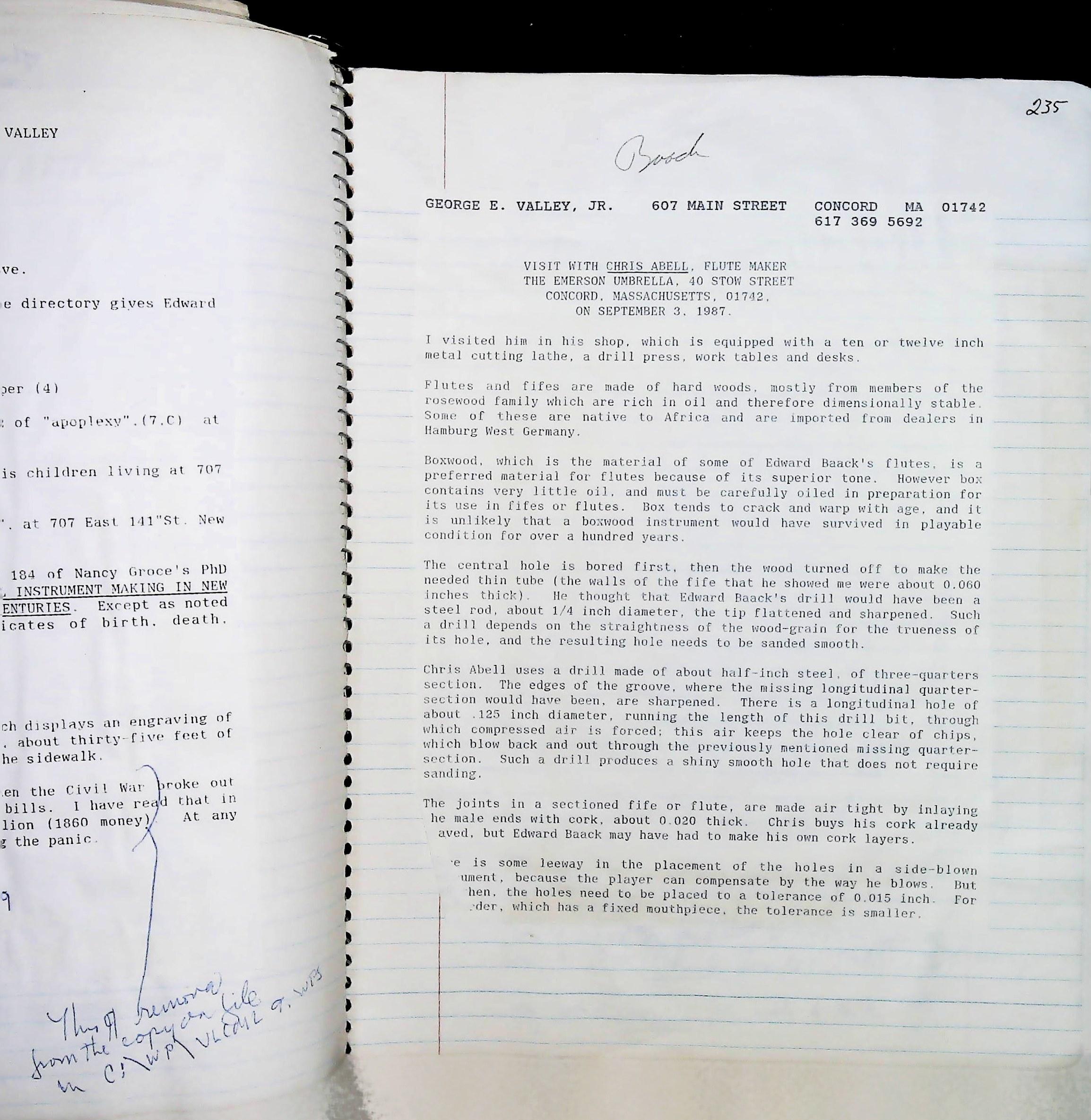
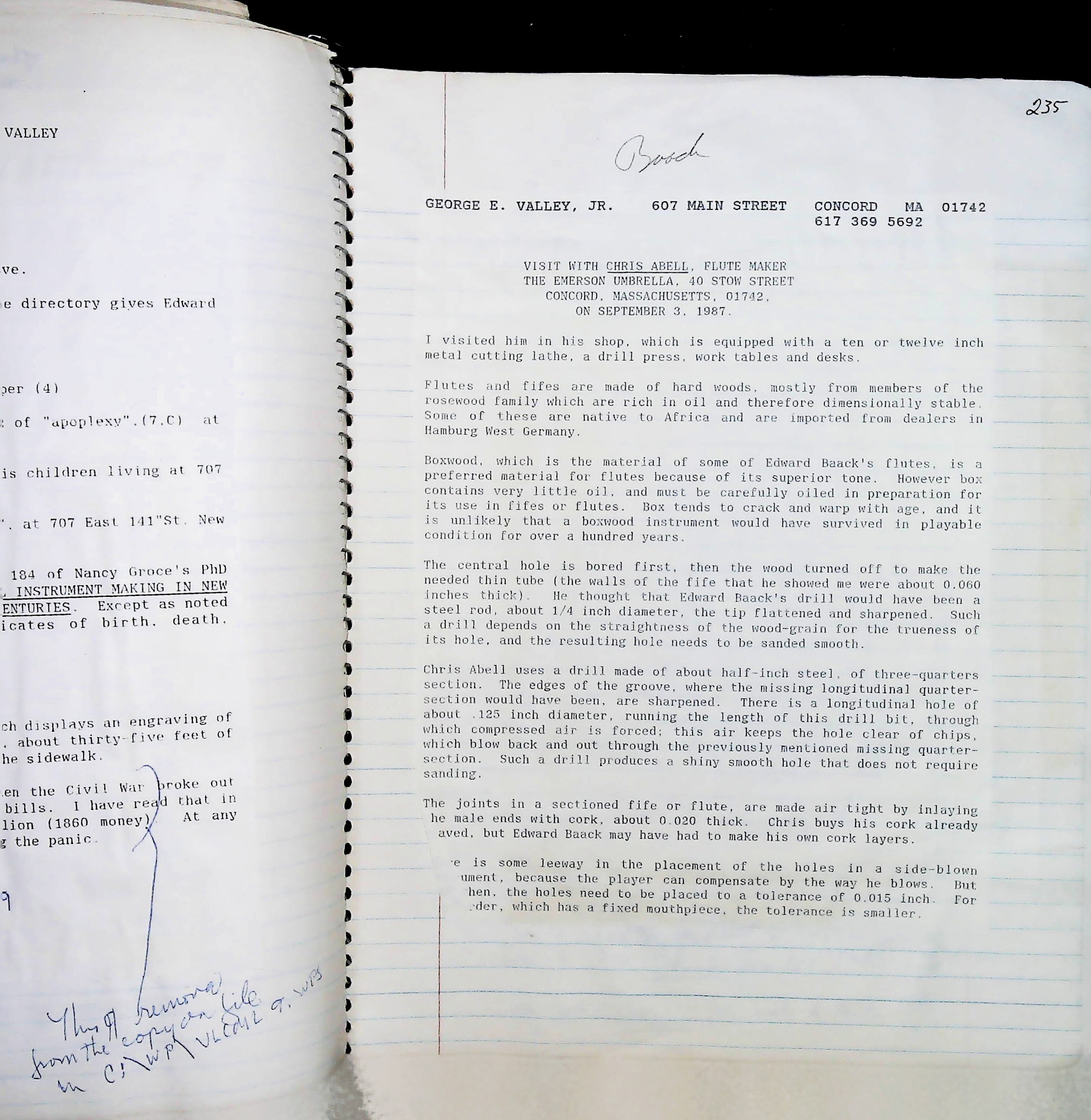
[Notebook p. 235. GEV's typed account of his visit to a flute maker, page 1, pasted in. GEV's note: "Baach". The left edge of the last paragraph is torn.] GEORGE E. VALLEY, JR. 607 MAIN STREET CONCORD MA 01742 617 369 5692
VISIT WITH CHRIS ABELL, FLUTE MAKER THE EMERSON UMBRELLA, 40 STOW STREET CONCORD, MASSACHUSETTS, 01742, ON SEPTEMBER 3, 1987.
I visited him in his shop, which is equipped with a ten or twelve inch metal cutting lathe, a drill press, work tables and desks.
Flutes and fifes are made of hard woods, mostly from members of the rosewood family which are rich in oil and therefore dimensionally stable. Some of these are native to Africa and are imported from dealers in Hamburg West Germany.
Boxwood, which is the material of some of Edward Baack's flutes, is a preferred material for flutes because of its superior tone. However box contains very little oil, and must be carefully oiled in preparation for its use in fifes or flutes. Box tends to crack and warp with age, and it is unlikely that a boxwood instrument would have survived in playable condition for over a hundred years.
The central hole is bored first, then the wood turned off to make the needed thin tube (the walls of the fife that he showed me were about 0.060 inches thick). He thought that Edward Baack's drill would have been a steel rod, about 1/4 inch diameter, the tip flattened and sharpened. Such a drill depends on the straightness of the wood-grain for the trueness of its hole, and the resulting hole needs to be sanded smooth.
Chris Abell uses a drill made of about half-inch steel, of three-quarters section. The edges of the groove, where the missing longitudinal quarter-section would have been, are sharpened. There is a longitudinal hole of about .125 inch diameter, running the length of this drill bit, through which compressed air is forced; this air keeps the hole clear of chips, which blow back and out through the previously mentioned missing quarter-section. Such a drill produces a shiny smooth hole that does not require sanding.
The joints in a sectioned fife or flute, are made air tight by inlaying the male ends with cork, about 0.020 thick. Chris buys his cork already [sh]aved, but Edward Baack may have had to make his own cork layers.
[Ther]e is some leeway in the placement of the holes in a side-blown [instr]ument, because the player can compensate by the way he blows. But [even t]hen, the holes need to be placed to a tolerance of 0.015 inch. For [a reco]rder, which has a fixed mouthpiece, the tolerance is smaller.
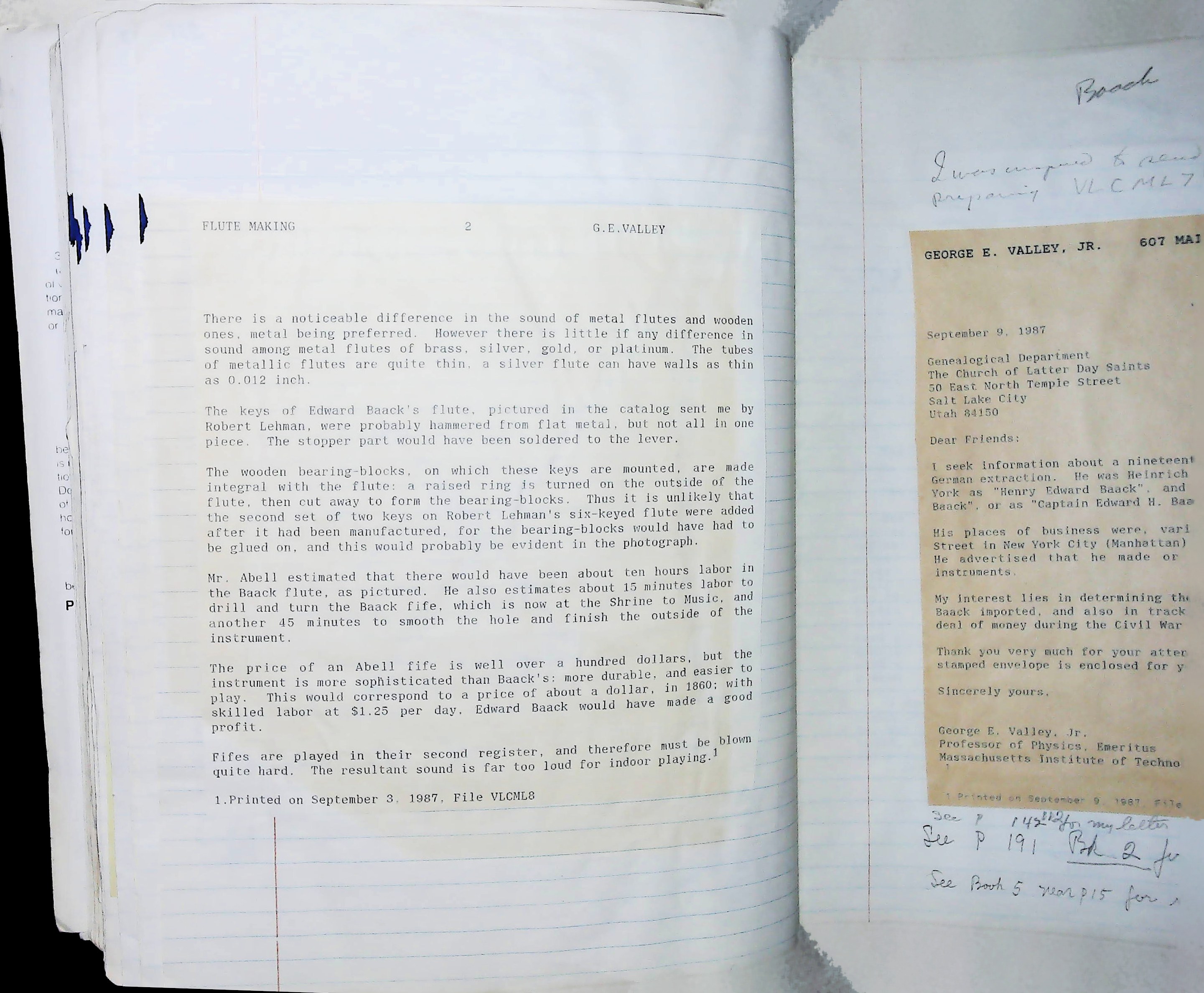
[Notebook p. 236. Page 2 of GEV's account of the visit to Chris Abell.] FLUTE MAKING 2 G.E.VALLEY
There is a noticeable difference in the sound of metal flutes and wooden ones, metal being preferred. However there is little if any difference in sound among metal flutes of brass, silver, gold, or platinum. The tubes of metallic flutes are quite thin, a silver flute can have walls as thin as 0.012 inch.
The keys of Edward Baack's flute, pictured in the catalog sent me by Robert Lehman, were probably hammered from flat metal, but not all in one piece. The stopper part would have been soldered to the lever.
The wooden bearing-blocks, on which these keys are mounted, are made integral with the flute: a raised ring is turned on the outside of the flute, then cut away to form the bearing-blocks. Thus it is unlikely that the second set of two keys on Robert Lehman's six-keyed flute were added after it had been manufactured, for the bearing-blocks would have had to be glued on, and this would probably be evident in the photograph.
Mr. Abell estimated that there would have been about ten hours labor in the Baack flute, as pictured. He also estimates about 15 minutes labor to drill and turn the Baack fife, which is now at the Shrine to Music, and another 45 minutes to smooth the hole and finish the outside of the instrument.
The price of an Abell fife is well over a hundred dollars, but the instrument is more sophisticated than Baack's: more durable, and easier to play. This would correspond to a price of about a dollar, in 1860; with skilled labor at $1.25 per day. Edward Baack would have made a good profit.
Fifes are played in their second register, and therefore must be blown quite hard. The resultant sound is far too loud for indoor playing.
1.Printed on September 3, 1987, File VLCML8
Notes
Source: G. E. Valley Jr., letter to and account of a visit with Chris Abell, flute maker, Concord, 3 Sep 1987 (notebook VLCM 4, pp. 232-236) Location: G. E. Valley Jr.'s research notebook VLCM #4 (1 Jul 1986 - 14 Sep 1987), part 3, pp. 232, 233, 234, 235, 236; Valley family papers, storage bin Found by: Claude research assistant