Correspondence between G. E. Valley Jr. and Robert A. Lehman, secretary of the American Musical Instrument Society and owner of two boxwood flutes by Edward Baack, June to September 1987: GEV's chronology of Baack's life, the family stories he set out to correct (bugles for the Confederacy, desertion from the Hamburg army, the honorary captaincy), his reasons for thinking Baack manufactured woodwinds, and Lehman's answers and exhibition catalogs. Ends with the notebook's rear cover.
History · Jun-Sep 1987 · Concord, Middlesex, Massachusetts, United States
Linked to Christina Franzeska Mohr, Catharina Sophie Baumann, Martin Hieronymus Baack, Philipp Jakob Donnecker, Katharina Donnecker, Edward Baack, Jr., Frances Jane Baack, Heinrich Eduard Baack, Sr. and George Edward Valley Jr
13 pages. Open one to read it full size.

Notebook p. 191

Notebook p. 204

Notebook p. 205
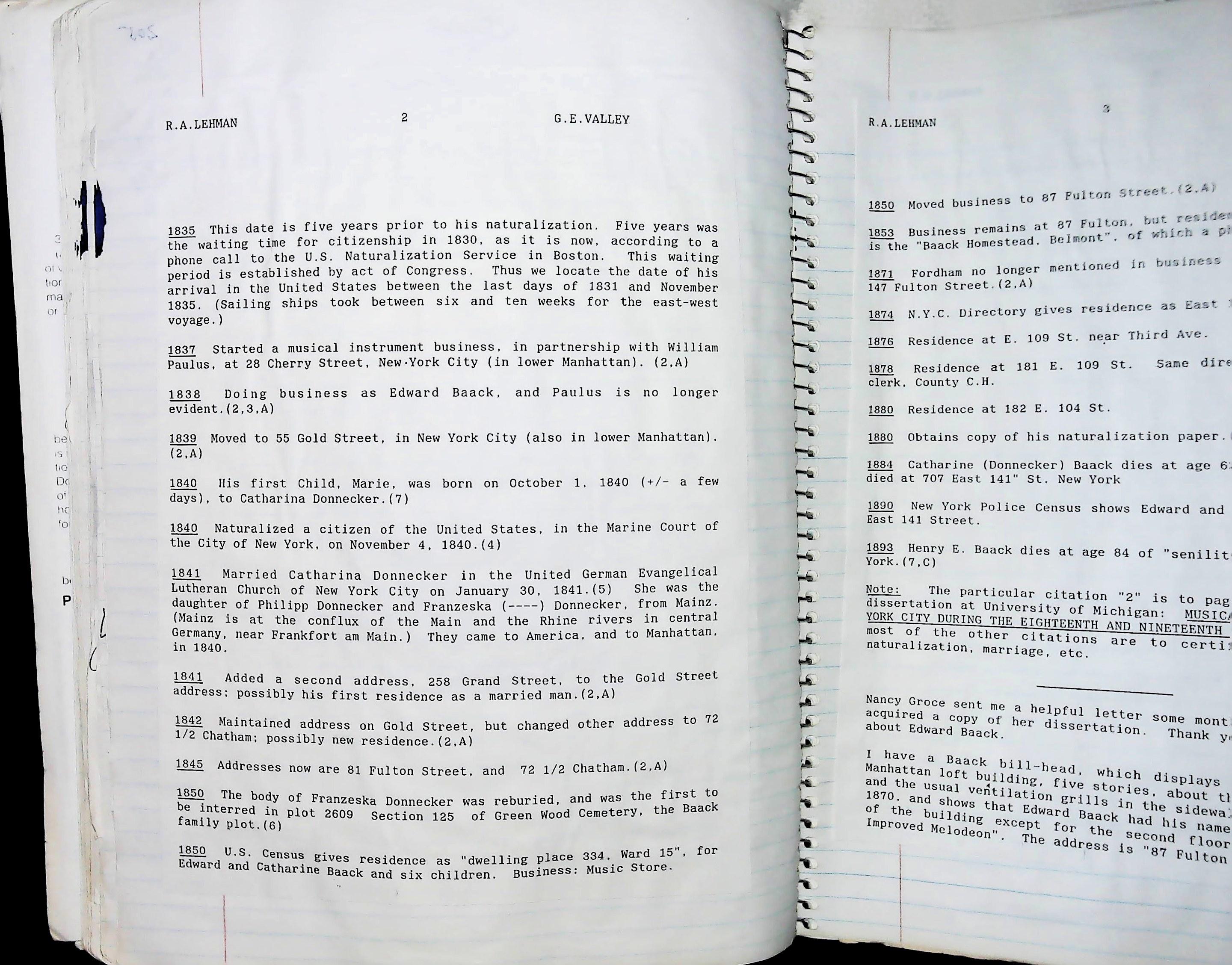
Notebook p. 206
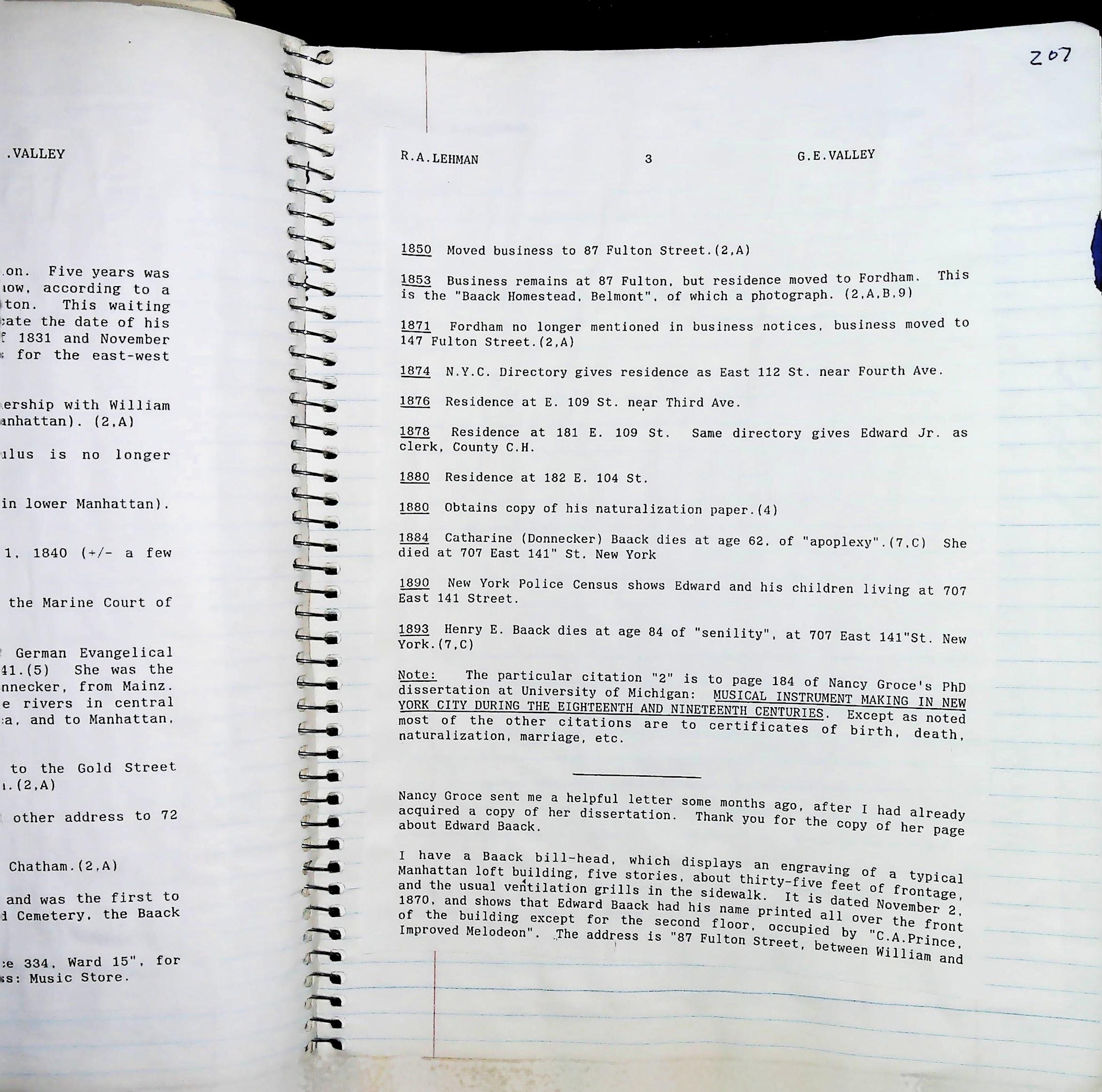
Notebook p. 207
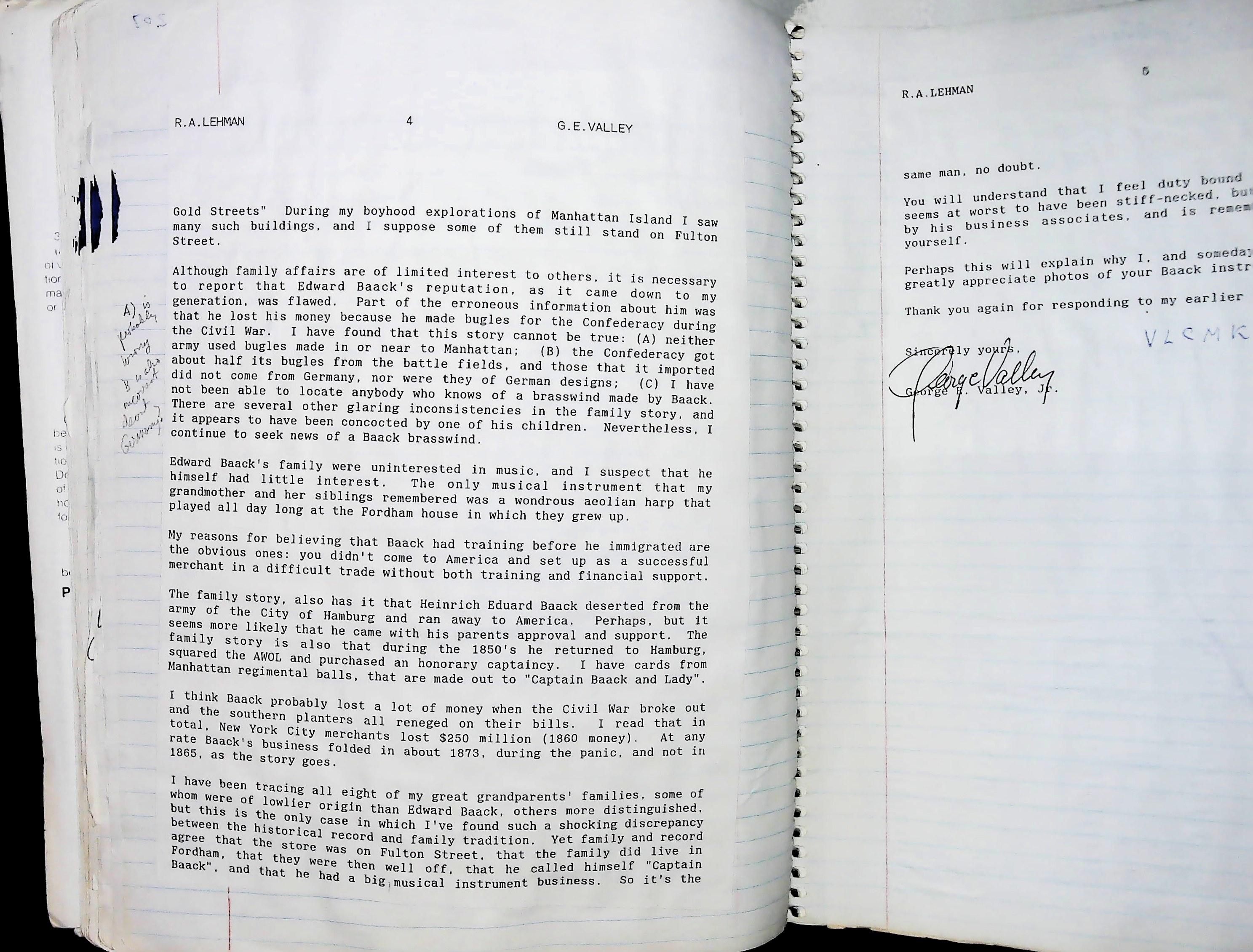
Notebook p. 208
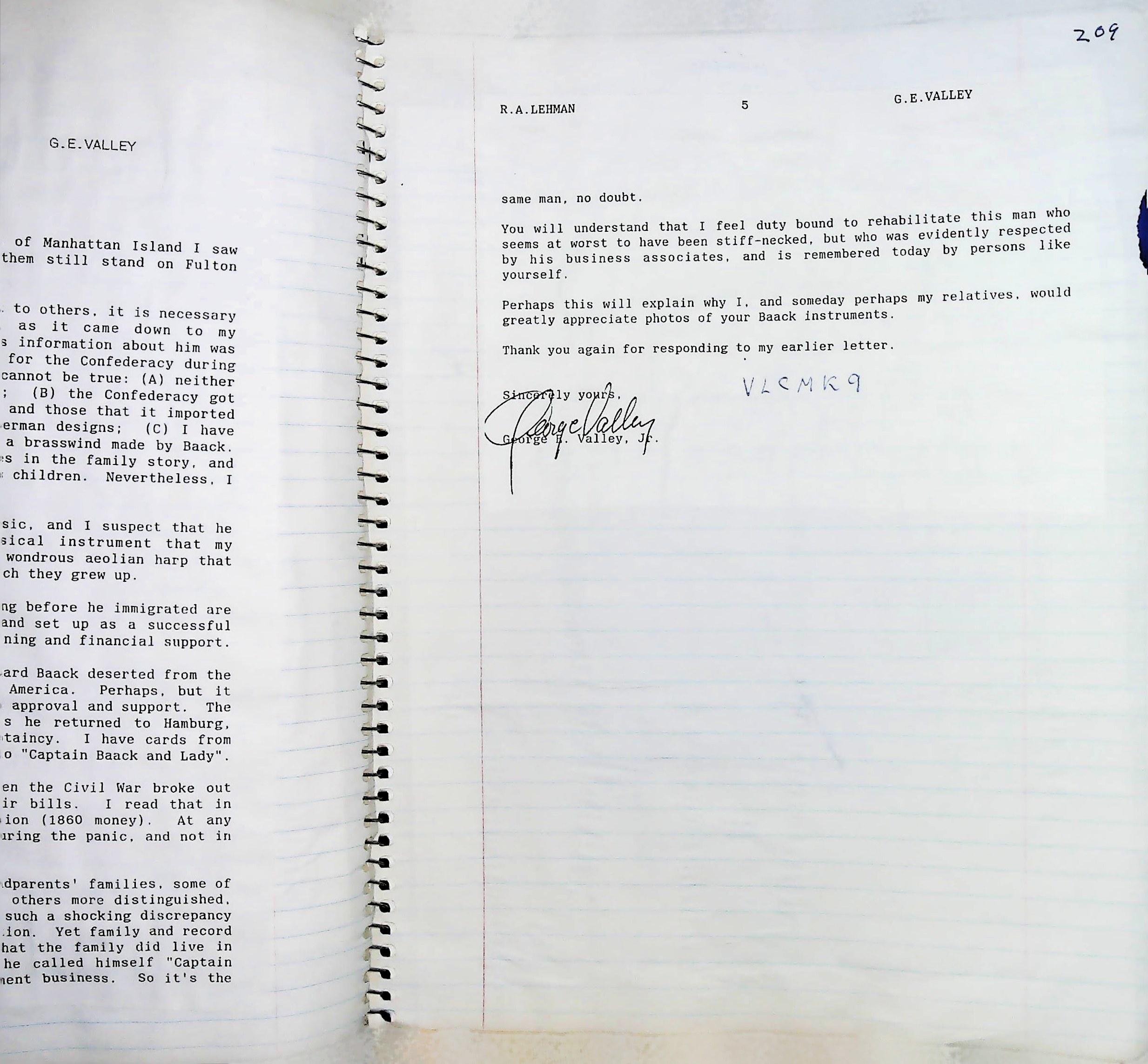
Notebook p. 209
Notebook p. 228

Notebook p. 229
Notebook p. 230
Notebook p. 231

Notebook p. 239

Rear cover of the notebook
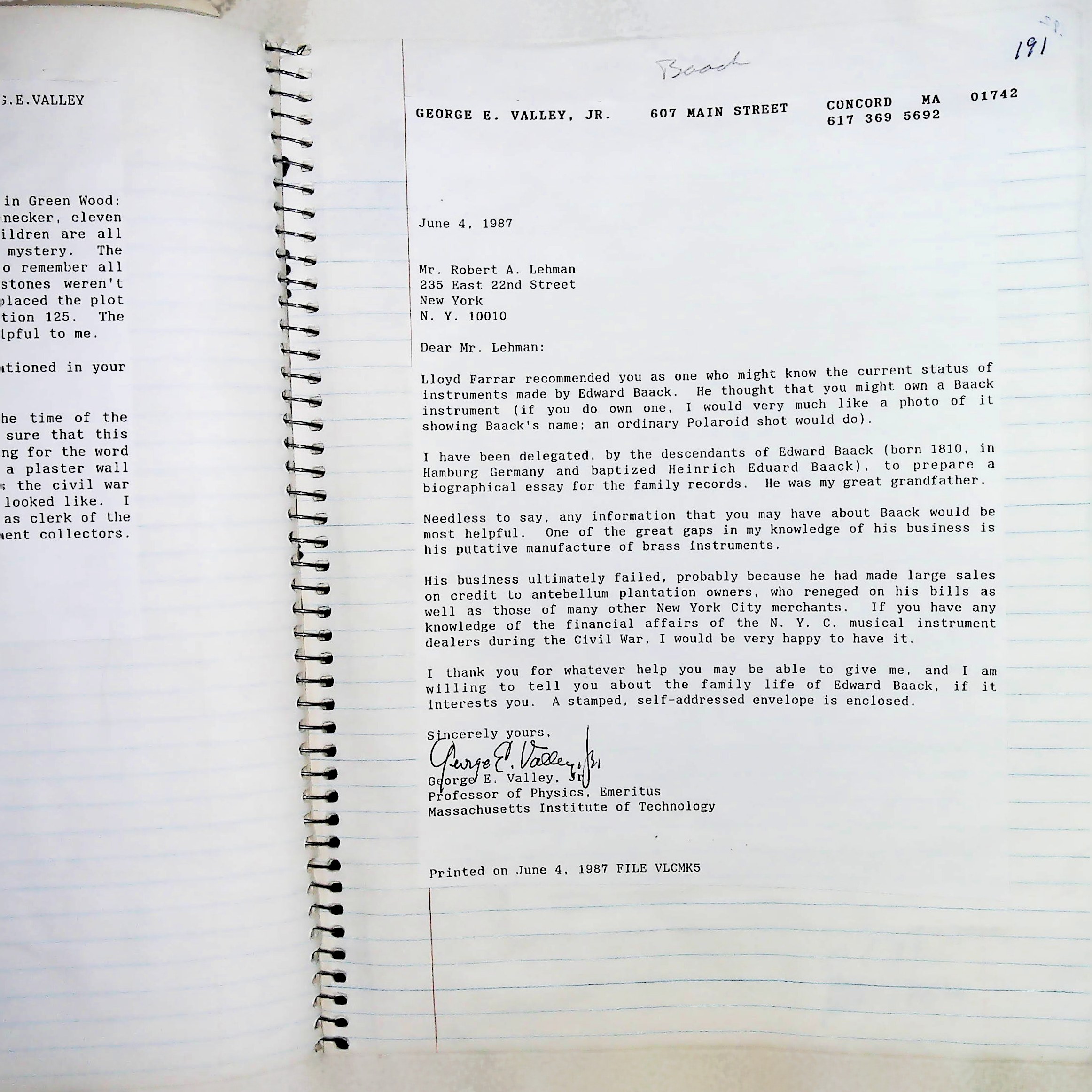
[Notebook p. 191. Copy of GEV's typed letter to Robert A. Lehman, pasted in. GEV's note: "Baach".] GEORGE E. VALLEY, JR. 607 MAIN STREET CONCORD MA 01742 617 369 5692
June 4, 1987
Mr. Robert A. Lehman 235 East 22nd Street New York N. Y. 10010
Dear Mr. Lehman:
Lloyd Farrar recommended you as one who might know the current status of instruments made by Edward Baack. He thought that you might own a Baack instrument (if you do own one, I would very much like a photo of it showing Baack's name; an ordinary Polaroid shot would do).
I have been delegated, by the descendants of Edward Baack (born 1810, in Hamburg Germany and baptized Heinrich Eduard Baack), to prepare a biographical essay for the family records. He was my great grandfather.
Needless to say, any information that you may have about Baack would be most helpful. One of the great gaps in my knowledge of his business is his putative manufacture of brass instruments.
His business ultimately failed, probably because he had made large sales on credit to antebellum plantation owners, who reneged on his bills as well as those of many other New York City merchants. If you have any knowledge of the financial affairs of the N. Y. C. musical instrument dealers during the Civil War, I would be very happy to have it.
I thank you for whatever help you may be able to give me, and I am willing to tell you about the family life of Edward Baack, if it interests you. A stamped, self-addressed envelope is enclosed.
Sincerely yours, [signed] George E. Valley, Jr. George E. Valley, Jr. Professor of Physics, Emeritus Massachusetts Institute of Technology
Printed on June 4, 1987 FILE VLCMK5
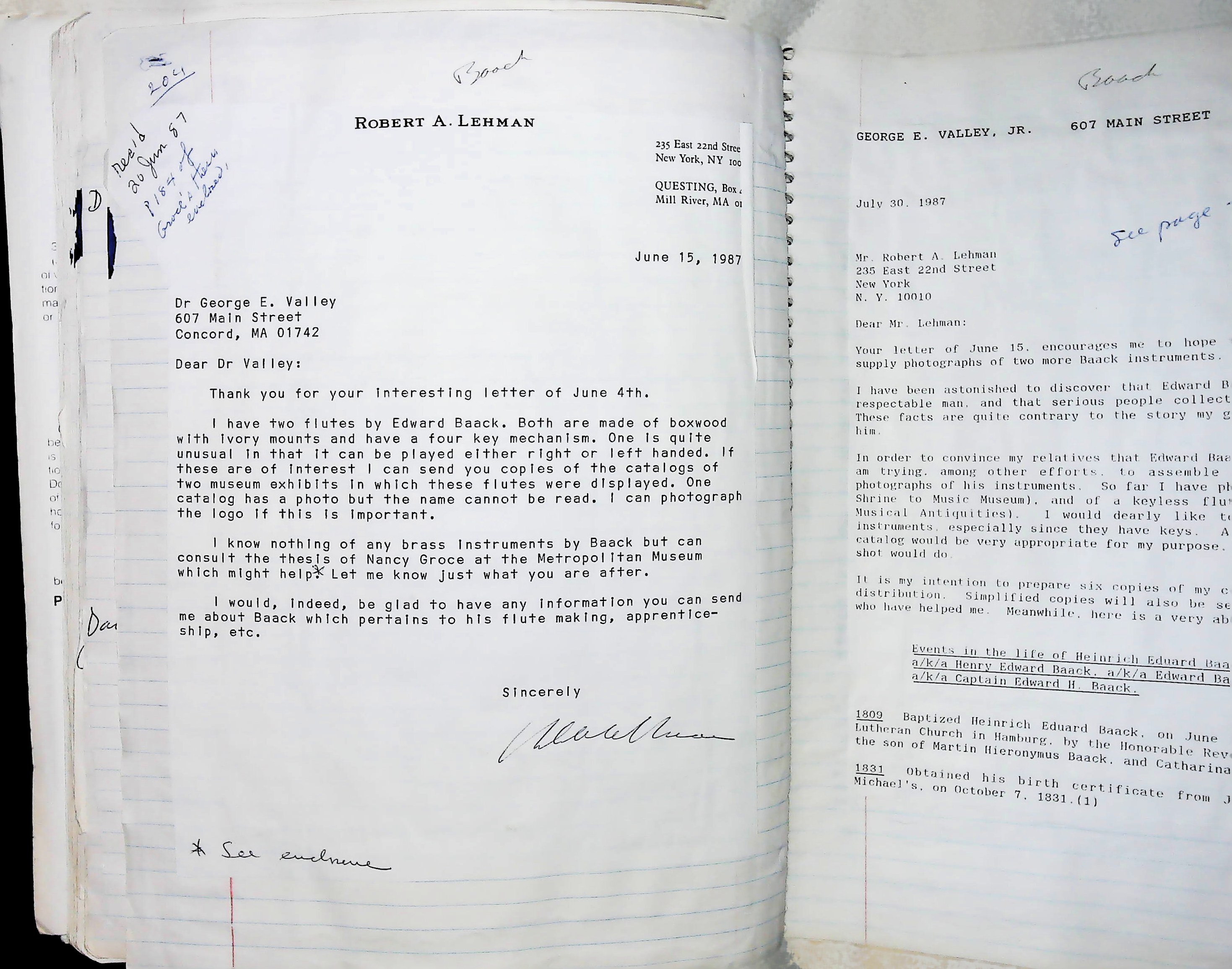
[Notebook p. 204 (the page number is overwritten). Typed letter from Robert A. Lehman to GEV, pasted in. GEV's notes: "Baach"; "rec'd 20 Jun 87, p 184 of Groce's thesis enclosed"; "* See enclosure".] ROBERT A. LEHMAN 235 East 22nd Street, New York, NY 10010 QUESTING, Box [...], Mill River, MA
June 15, 1987
Dr George E. Valley 607 Main Street Concord, MA 01742
Dear Dr Valley:
Thank you for your interesting letter of June 4th.
I have two flutes by Edward Baack. Both are made of boxwood with ivory mounts and have a four key mechanism. One is quite unusual in that it can be played either right or left handed. If these are of interest I can send you copies of the catalogs of two museum exhibits in which these flutes were displayed. One catalog has a photo but the name cannot be read. I can photograph the logo if this is important.
I know nothing of any brass instruments by Baack but can consult the thesis of Nancy Groce at the Metropolitan Museum which might help.* Let me know just what you are after.
I would, indeed, be glad to have any information you can send me about Baack which pertains to his flute making, apprenticeship, etc.
Sincerely [signed] R. A. Lehman
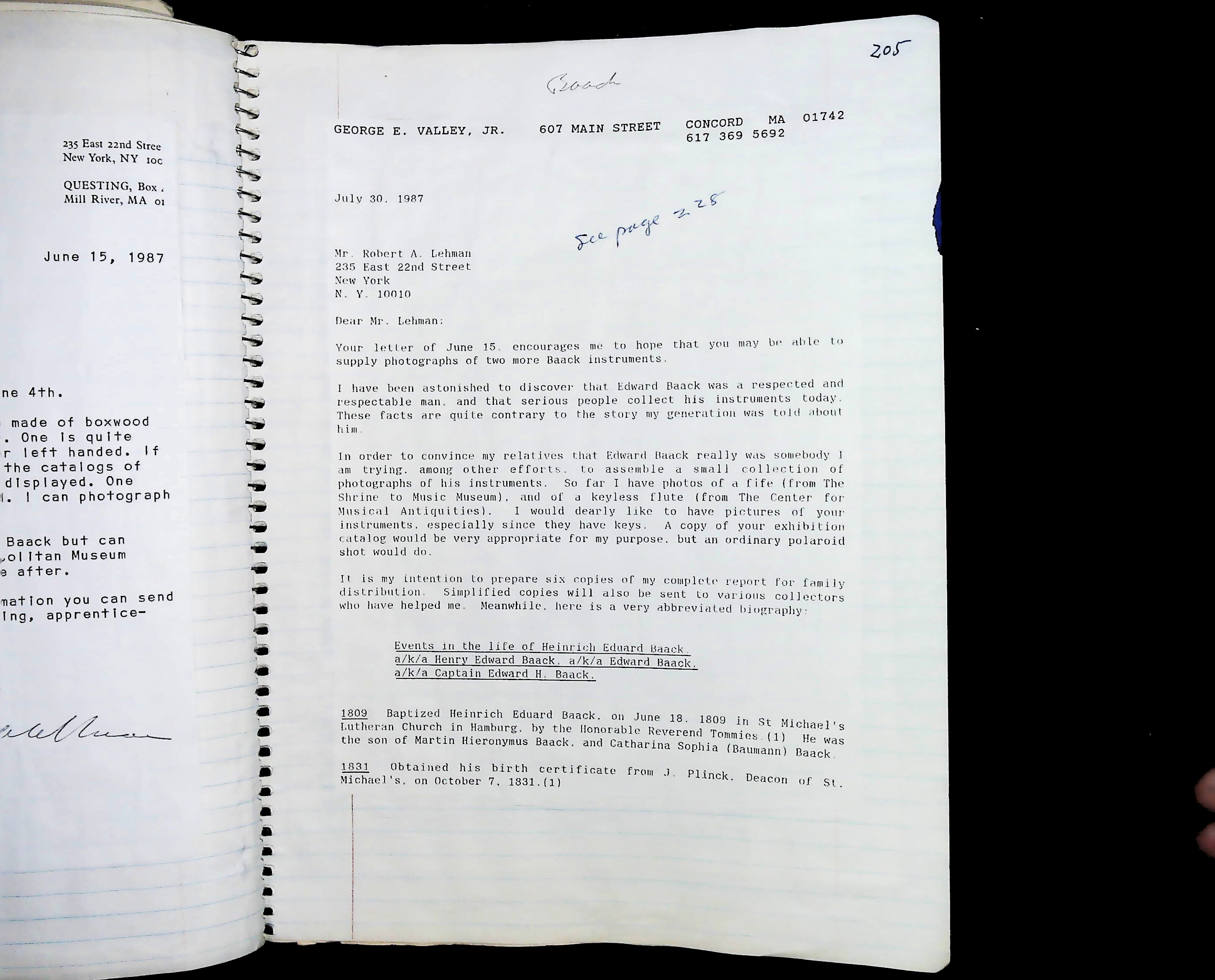
[Notebook p. 205. Copy of GEV's typed letter to Robert A. Lehman, page 1, pasted in. GEV's notes: "Baach"; "See page 225".] GEORGE E. VALLEY, JR. 607 MAIN STREET CONCORD MA 01742 617 369 5692
July 30, 1987
Mr. Robert A. Lehman 235 East 22nd Street New York N. Y. 10010
Dear Mr. Lehman:
Your letter of June 15, encourages me to hope that you may be able to supply photographs of two more Baack instruments.
I have been astonished to discover that Edward Baack was a respected and respectable man, and that serious people collect his instruments today. These facts are quite contrary to the story my generation was told about him.
In order to convince my relatives that Edward Baack really was somebody I am trying, among other efforts, to assemble a small collection of photographs of his instruments. So far I have photos of a fife (from The Shrine to Music Museum), and of a keyless flute (from The Center for Musical Antiquities). I would dearly like to have pictures of your instruments, especially since they have keys. A copy of your exhibition catalog would be very appropriate for my purpose, but an ordinary polaroid shot would do.
It is my intention to prepare six copies of my complete report for family distribution. Simplified copies will also be sent to various collectors who have helped me. Meanwhile, here is a very abbreviated biography:
[The chronology "Events in the life of Heinrich Eduard Baack, a/k/a Henry Edward Baack, a/k/a Edward Baack, a/k/a Captain Edward H. Baack" follows, beginning with his baptism on 18 June 1809 at St. Michael's, Hamburg, and his birth certificate of 7 October 1831; it continues on the next page.]
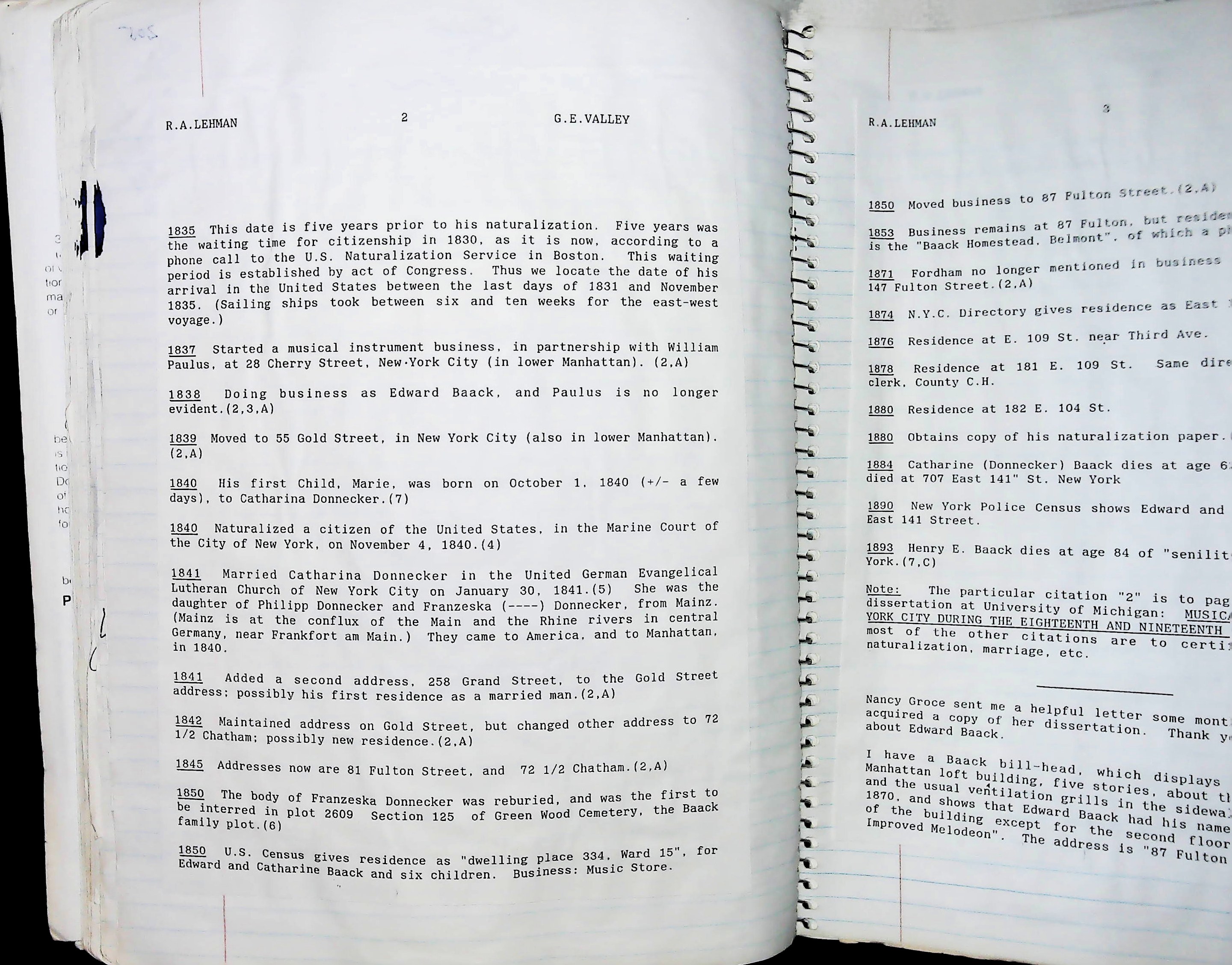
[Notebook p. 206. Page 2 of the letter to Lehman: the chronology of Edward Baack, 1835-1850. Largely the same as in the letters to Farrar and Banks, with these additions:] 1840 ... Catharina Donnecker ... was the daughter of Philipp Donnecker and Franzeska (----) Donnecker, from Mainz. ... They came to America, and to Manhattan, in 1840. 1850 U.S. Census gives residence as "dwelling place 334, Ward 15", for Edward and Catharine Baack and six children. Business: Music Store.
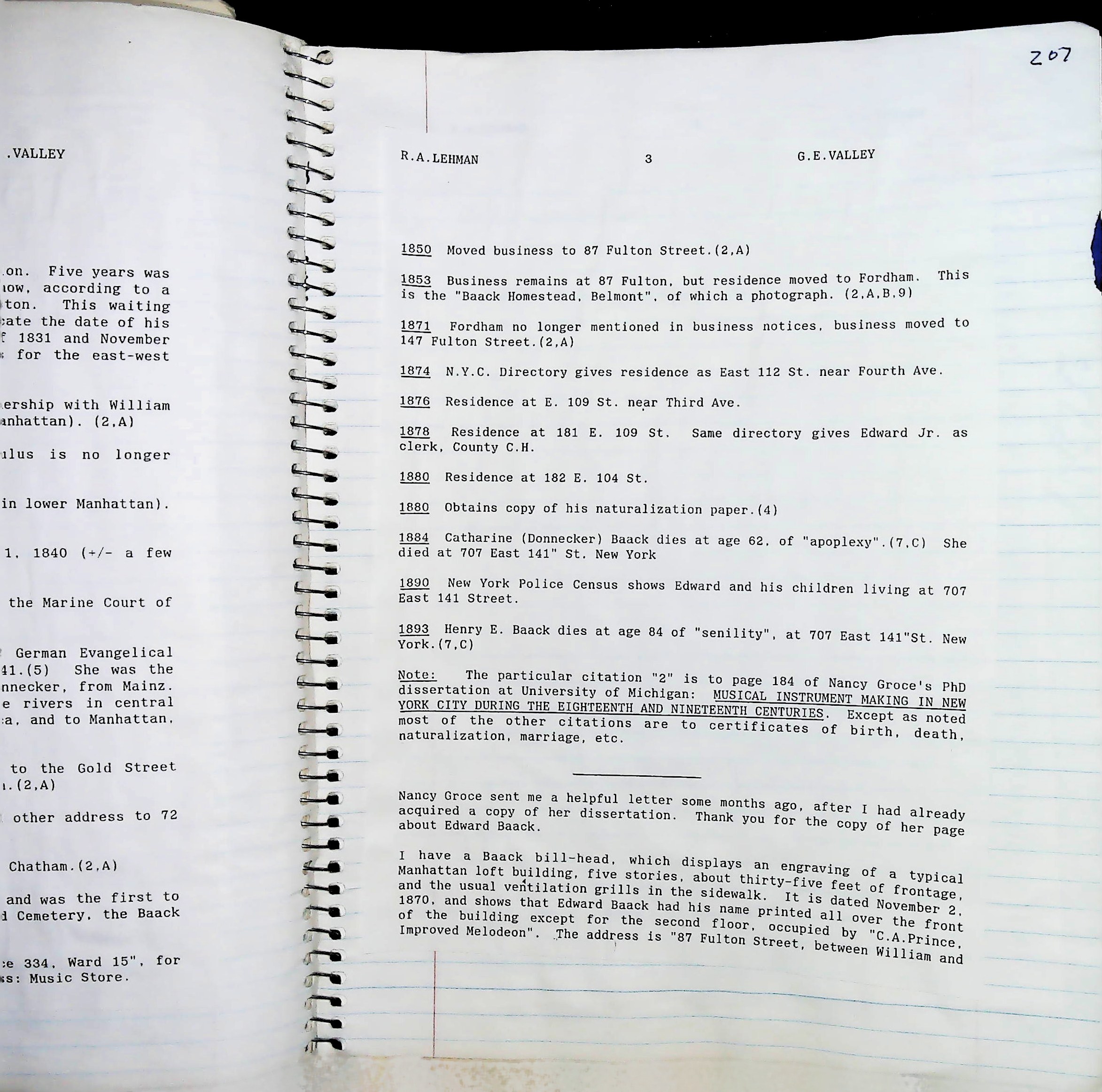
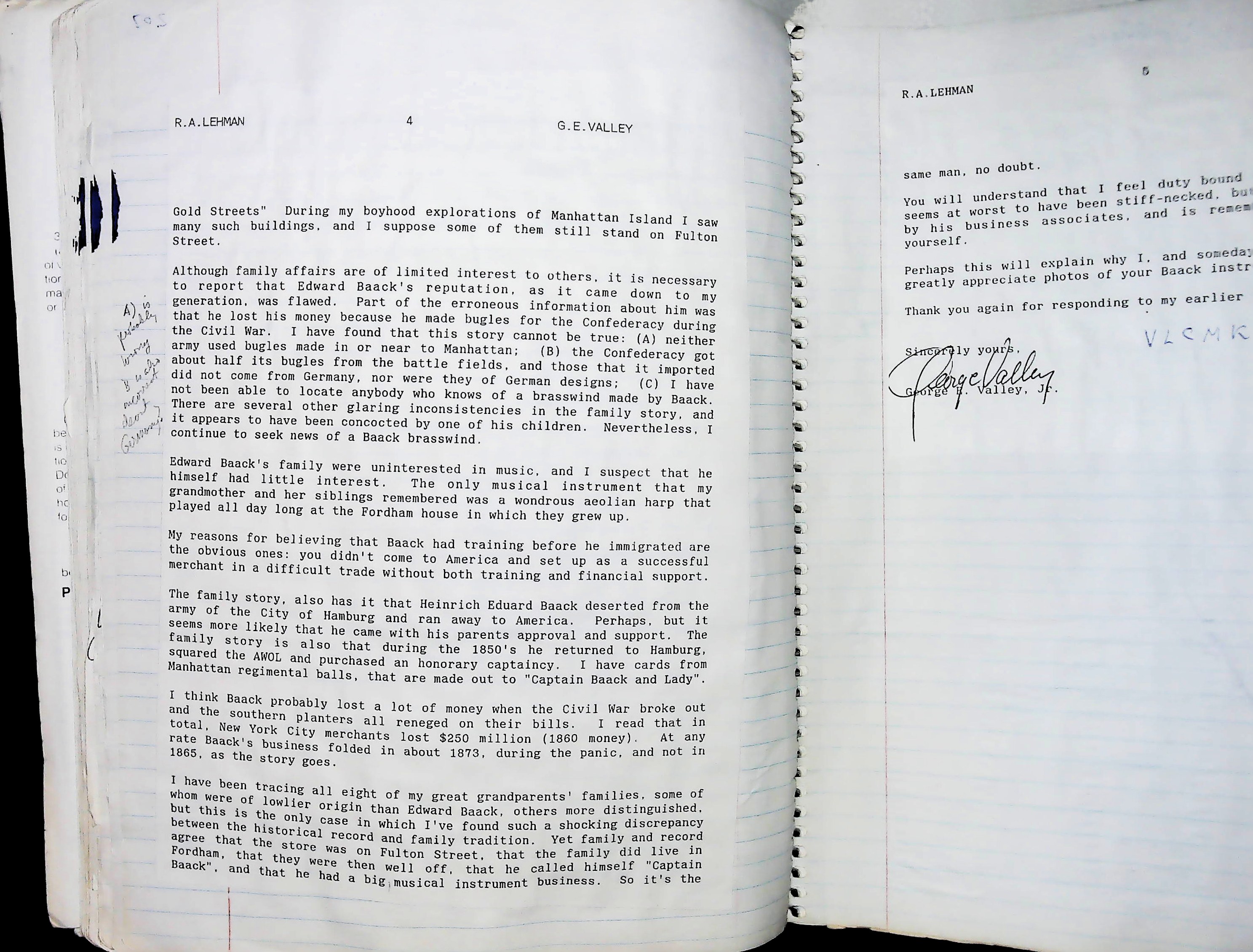
[Notebook p. 207. Page 3 of the letter to Lehman.] R.A.LEHMAN 3 G.E.VALLEY
1850 Moved business to 87 Fulton Street.(2,A)
1853 Business remains at 87 Fulton, but residence moved to Fordham. This is the "Baack Homestead, Belmont", of which a photograph. (2,A,B,9)
1871 Fordham no longer mentioned in business notices, business moved to 147 Fulton Street.(2,A)
1874 N.Y.C. Directory gives residence as East 112 St. near Fourth Ave.
1876 Residence at E. 109 St. near Third Ave.
1878 Residence at 181 E. 109 St. Same directory gives Edward Jr. as clerk, County C.H.
1880 Residence at 182 E. 104 St.
1880 Obtains copy of his naturalization paper.(4)
1884 Catharine (Donnecker) Baack dies at age 62, of "apoplexy".(7,C) She died at 707 East 141st St. New York
1890 New York Police Census shows Edward and his children living at 707 East 141 Street.
1893 Henry E. Baack dies at age 84 of "senility", at 707 East 141st St. New York.(7,C)
Note: The particular citation "2" is to page 184 of Nancy Groce's PhD dissertation at University of Michigan: MUSICAL INSTRUMENT MAKING IN NEW YORK CITY DURING THE EIGHTEENTH AND NINETEENTH CENTURIES. Except as noted most of the other citations are to certificates of birth, death, naturalization, marriage, etc.
Nancy Groce sent me a helpful letter some months ago, after I had already acquired a copy of her dissertation. Thank you for the copy of her page about Edward Baack.
I have a Baack bill-head, which displays an engraving of a typical Manhattan loft building, five stories, about thirty-five feet of frontage, and the usual ventilation grills in the sidewalk. It is dated November 2, 1870, and shows that Edward Baack had his name printed all over the front of the building except for the second floor, occupied by "C.A.Prince, Improved Melodeon". The address is "87 Fulton Street, between William and
[Notebook p. 208. Page 4 of the letter to Lehman. GEV's marginal note beside (A): "A) is probably wrong. I recall a newspaper item about Germany".] R.A.LEHMAN 4 G.E.VALLEY
Gold Streets" During my boyhood explorations of Manhattan Island I saw many such buildings, and I suppose some of them still stand on Fulton Street.
Although family affairs are of limited interest to others, it is necessary to report that Edward Baack's reputation, as it came down to my generation, was flawed. Part of the erroneous information about him was that he lost his money because he made bugles for the Confederacy during the Civil War. I have found that this story cannot be true: (A) neither army used bugles made in or near to Manhattan; (B) the Confederacy got about half its bugles from the battle fields, and those that it imported did not come from Germany, nor were they of German designs; (C) I have not been able to locate anybody who knows of a brasswind made by Baack. There are several other glaring inconsistencies in the family story, and it appears to have been concocted by one of his children. Nevertheless, I continue to seek news of a Baack brasswind.
Edward Baack's family were uninterested in music, and I suspect that he himself had little interest. The only musical instrument that my grandmother and her siblings remembered was a wondrous aeolian harp that played all day long at the Fordham house in which they grew up.
My reasons for believing that Baack had training before he immigrated are the obvious ones: you didn't come to America and set up as a successful merchant in a difficult trade without both training and financial support.
The family story, also has it that Heinrich Eduard Baack deserted from the army of the City of Hamburg and ran away to America. Perhaps, but it seems more likely that he came with his parents approval and support. The family story is also that during the 1850's he returned to Hamburg, squared the AWOL and purchased an honorary captaincy. I have cards from Manhattan regimental balls, that are made out to "Captain Baack and Lady".
I think Baack probably lost a lot of money when the Civil War broke out and the southern planters all reneged on their bills. I read that in total, New York City merchants lost $250 million (1860 money). At any rate Baack's business folded in about 1873, during the panic, and not in 1865, as the story goes.
I have been tracing all eight of my great grandparents' families, some of whom were of lowlier origin than Edward Baack, others more distinguished, but this is the only case in which I've found such a shocking discrepancy between the historical record and family tradition. Yet family and record agree that the store was on Fulton Street, that the family did live in Fordham, that they were then well off, that he called himself "Captain Baack", and that he had a big musical instrument business. So it's the
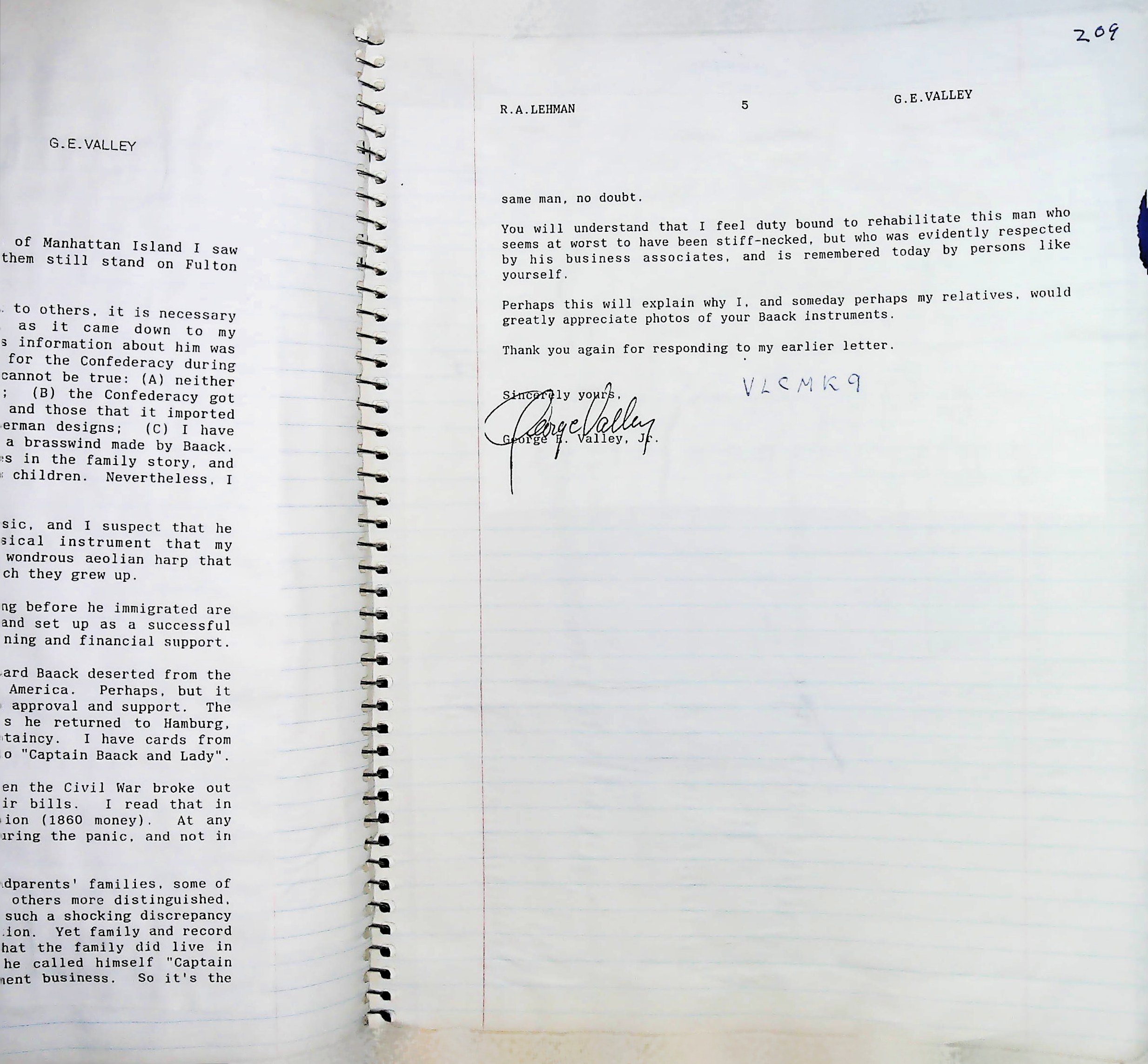
[Notebook p. 209. Page 5 of the letter to Lehman.] R.A.LEHMAN 5 G.E.VALLEY
same man, no doubt.
You will understand that I feel duty bound to rehabilitate this man who seems at worst to have been stiff-necked, but who was evidently respected by his business associates, and is remembered today by persons like yourself.
Perhaps this will explain why I, and someday perhaps my relatives, would greatly appreciate photos of your Baack instruments.
Thank you again for responding to my earlier letter.
Sincerely yours, [signed] George Valley George E. Valley, Jr. [handwritten:] VLCMK9
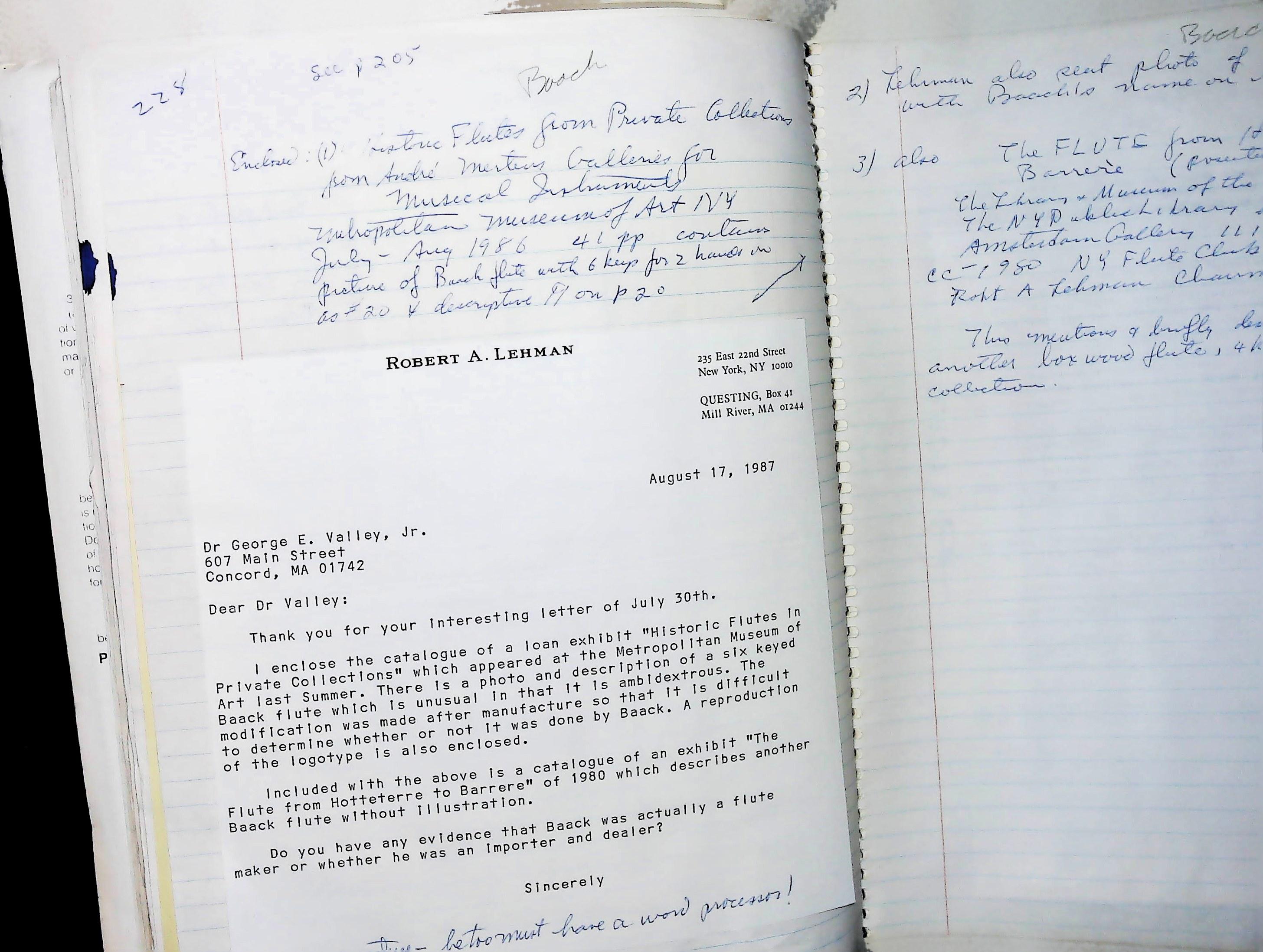
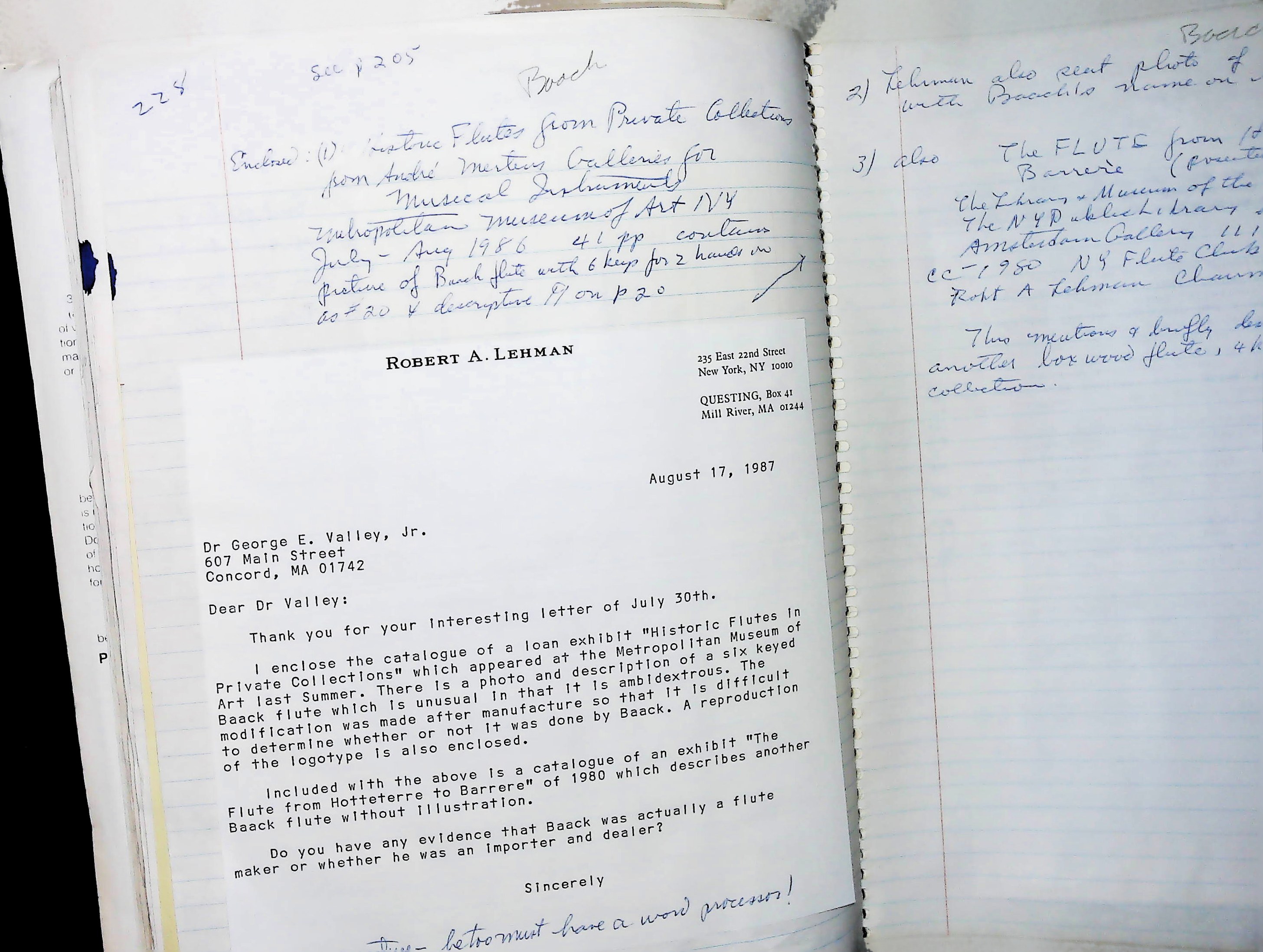
[Notebook p. 228. GEV's notes and a typed letter from Robert A. Lehman, pasted in. GEV's notes: "Baach"; "See p 205".] Enclosed: (1) Historic Flutes from Private Collections, from André Mertens Galleries for Musical Instruments, Metropolitan Museum of Art N.Y., July-Aug 1986, 41 pp; contains picture of Baach flute with 6 keys for 2 hands, as #20, & descriptive [paragraph] on p 20
ROBERT A. LEHMAN, 235 East 22nd Street, New York, NY 10010; QUESTING, Box 41, Mill River, MA 01244
August 17, 1987
Dr George E. Valley, Jr. 607 Main Street Concord, MA 01742
Dear Dr Valley:
Thank you for your interesting letter of July 30th.
I enclose the catalogue of a loan exhibit "Historic Flutes in Private Collections" which appeared at the Metropolitan Museum of Art last Summer. There is a photo and description of a six keyed Baack flute which is unusual in that it is ambidextrous. The modification was made after manufacture so that it is difficult to determine whether or not it was done by Baack. A reproduction of the logotype is also enclosed.
Included with the above is a catalogue of an exhibit "The Flute from Hotteterre to Barrere" of 1980 which describes another Baack flute without illustration.
Do you have any evidence that Baack was actually a flute maker or whether he was an importer and dealer?
Sincerely [GEV's note below:] Typed - he too must have a word processor!
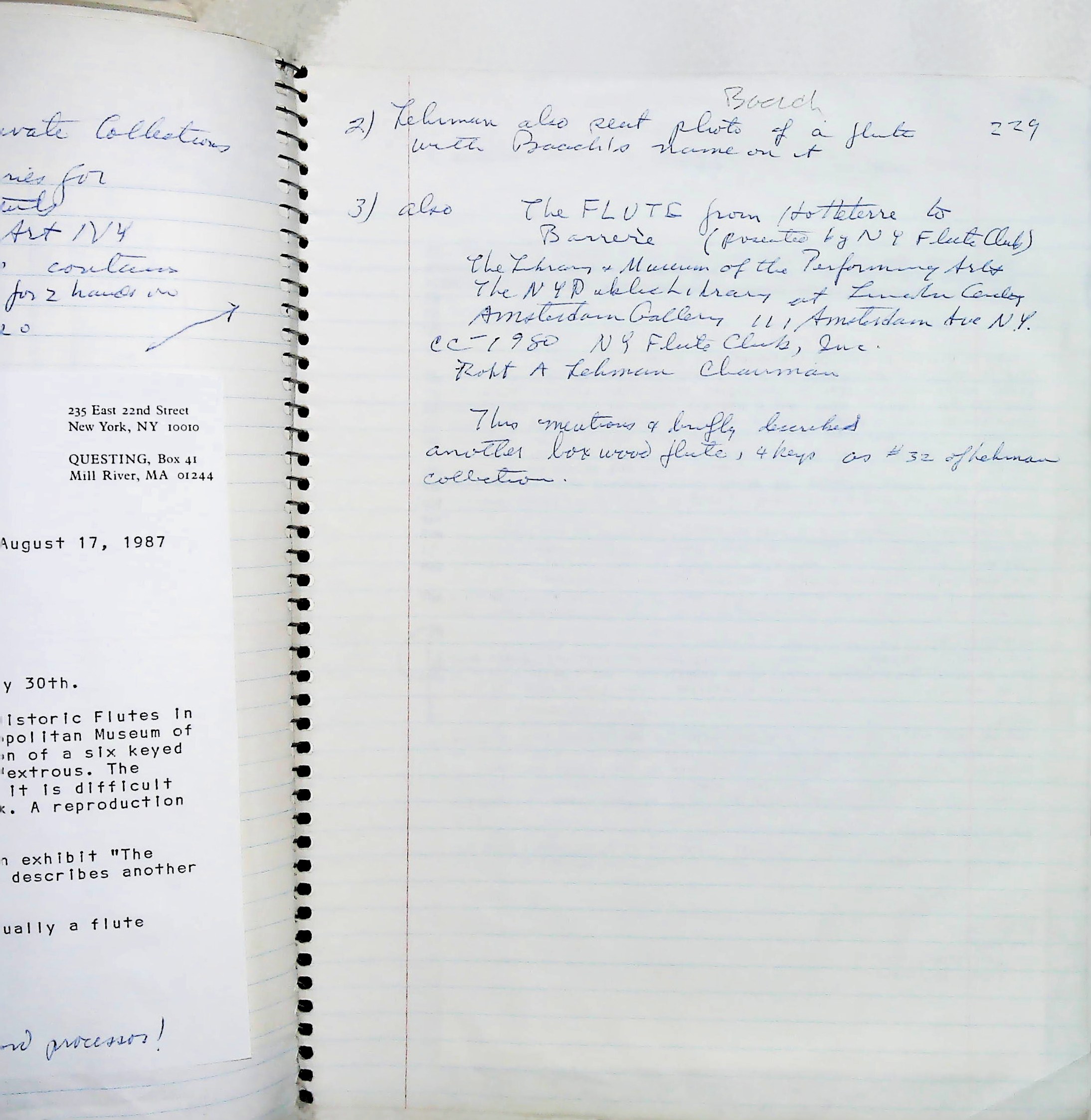
[Notebook p. 229. GEV's notes. Heading "Baach".] 2) Lehman also sent photo of a flute with Baach's name on it 3) also The FLUTE from Hotteterre to Barrere (presented by N Y Flute Club), The Library & Museum of the Performing Arts, The N Y Public Library at Lincoln Center, Amsterdam Gallery, 111 Amsterdam Ave N.Y. (c) 1980 N Y Flute Club, Inc. Robt A Lehman Chairman. This mentions & briefly describes another boxwood flute, 4 keys, as #32 of Lehman collection.
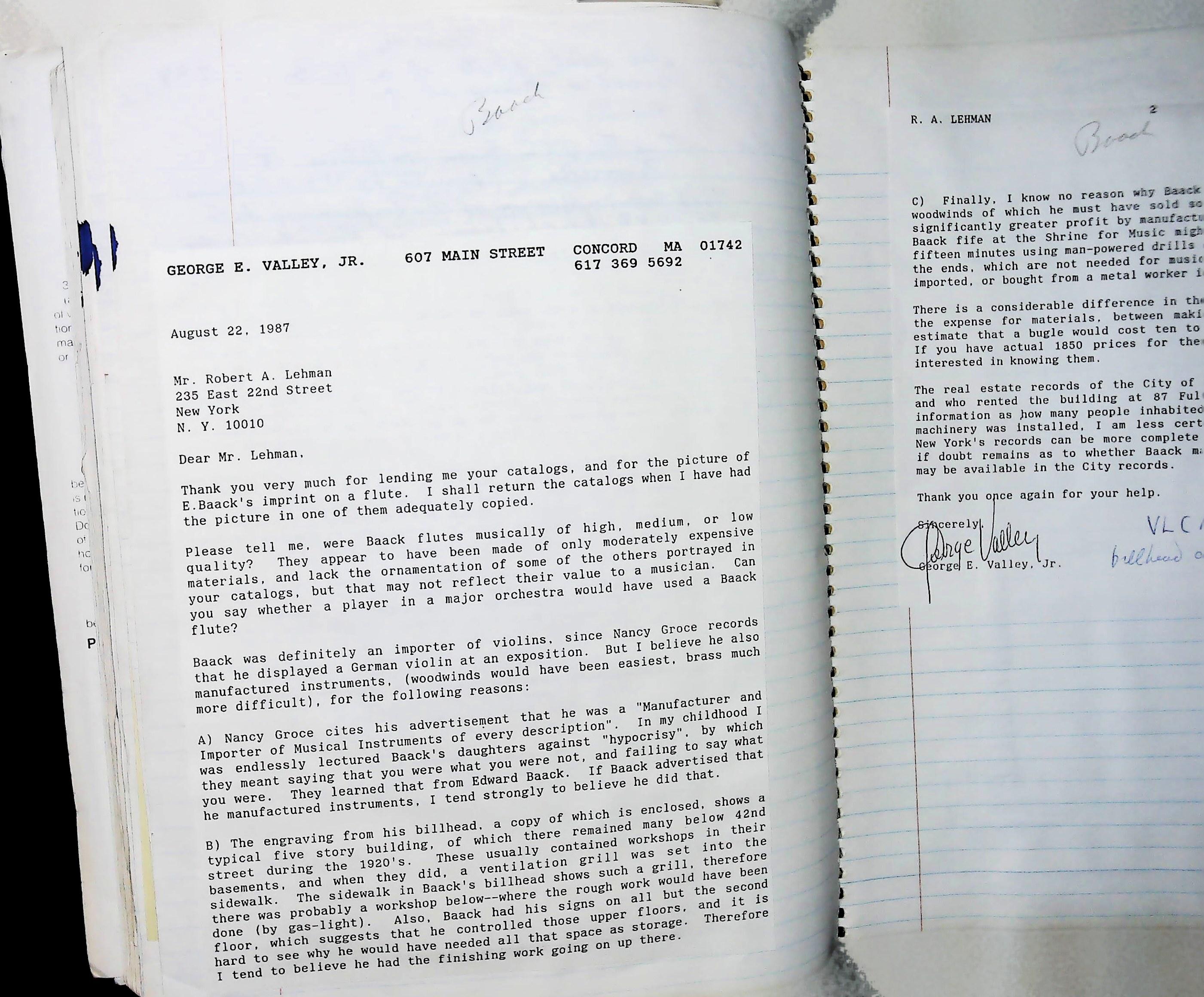
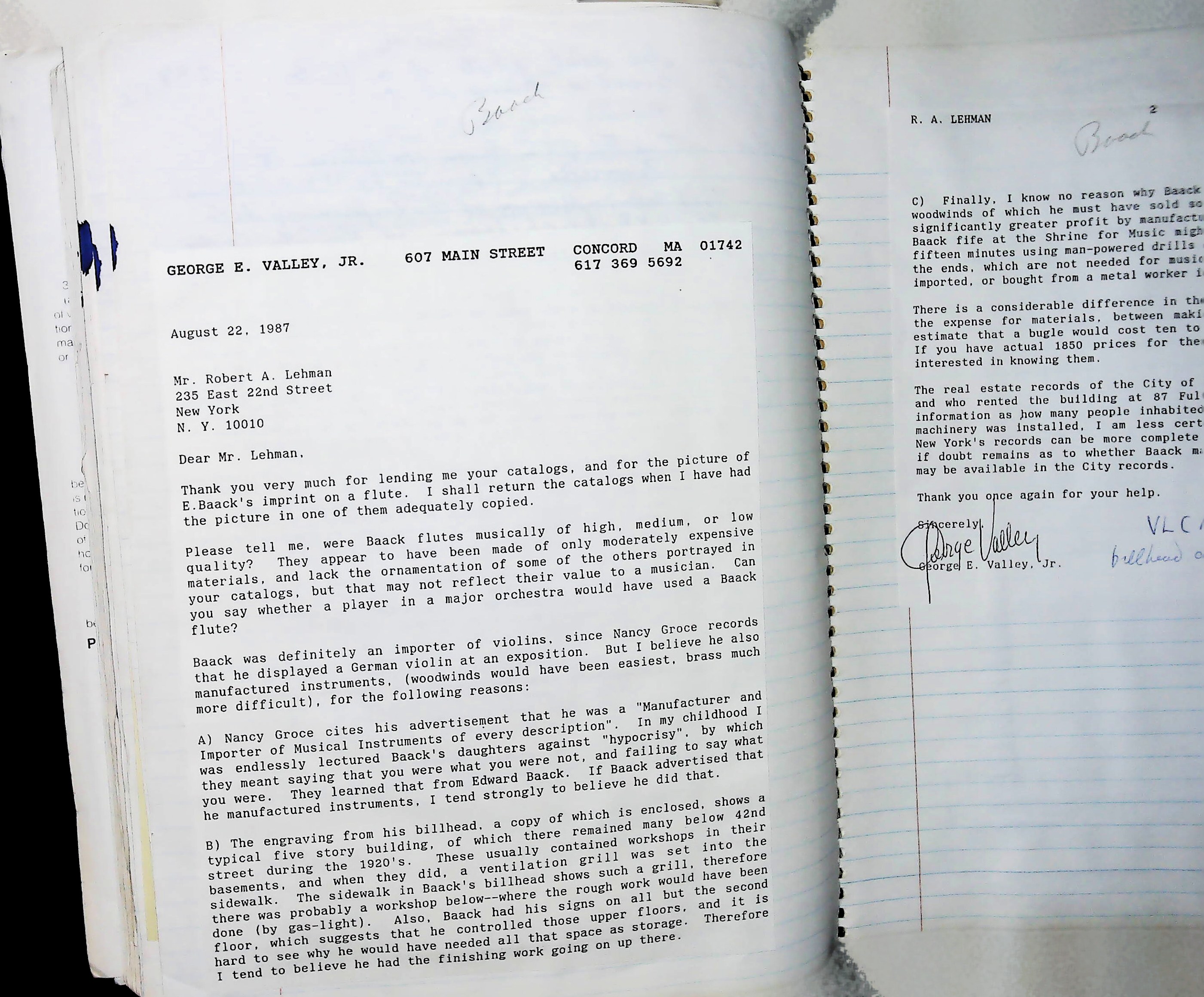
[Notebook p. 230. Copy of GEV's typed letter to Robert A. Lehman, page 1, pasted in. GEV's note: "Baach".] GEORGE E. VALLEY, JR. 607 MAIN STREET CONCORD MA 01742 617 369 5692
August 22, 1987
Mr. Robert A. Lehman 235 East 22nd Street New York N. Y. 10010
Dear Mr. Lehman,
Thank you very much for lending me your catalogs, and for the picture of E.Baack's imprint on a flute. I shall return the catalogs when I have had the picture in one of them adequately copied.
Please tell me, were Baack flutes musically of high, medium, or low quality? They appear to have been made of only moderately expensive materials, and lack the ornamentation of some of the others portrayed in your catalogs, but that may not reflect their value to a musician. Can you say whether a player in a major orchestra would have used a Baack flute?
Baack was definitely an importer of violins, since Nancy Groce records that he displayed a German violin at an exposition. But I believe he also manufactured instruments, (woodwinds would have been easiest, brass much more difficult), for the following reasons:
A) Nancy Groce cites his advertisement that he was a "Manufacturer and Importer of Musical Instruments of every description". In my childhood I was endlessly lectured Baack's daughters against "hypocrisy", by which they meant saying that you were what you were not, and failing to say what you were. They learned that from Edward Baack. If Baack advertised that he manufactured instruments, I tend strongly to believe he did that.
B) The engraving from his billhead, a copy of which is enclosed, shows a typical five story building, of which there remained many below 42nd street during the 1920's. These usually contained workshops in their basements, and when they did, a ventilation grill was set into the sidewalk. The sidewalk in Baack's billhead shows such a grill, therefore there was probably a workshop below--where the rough work would have been done (by gas-light). Also, Baack had his signs on all but the second floor, which suggests that he controlled those upper floors, and it is hard to see why he would have needed all that space as storage. Therefore I tend to believe he had the finishing work going on up there.
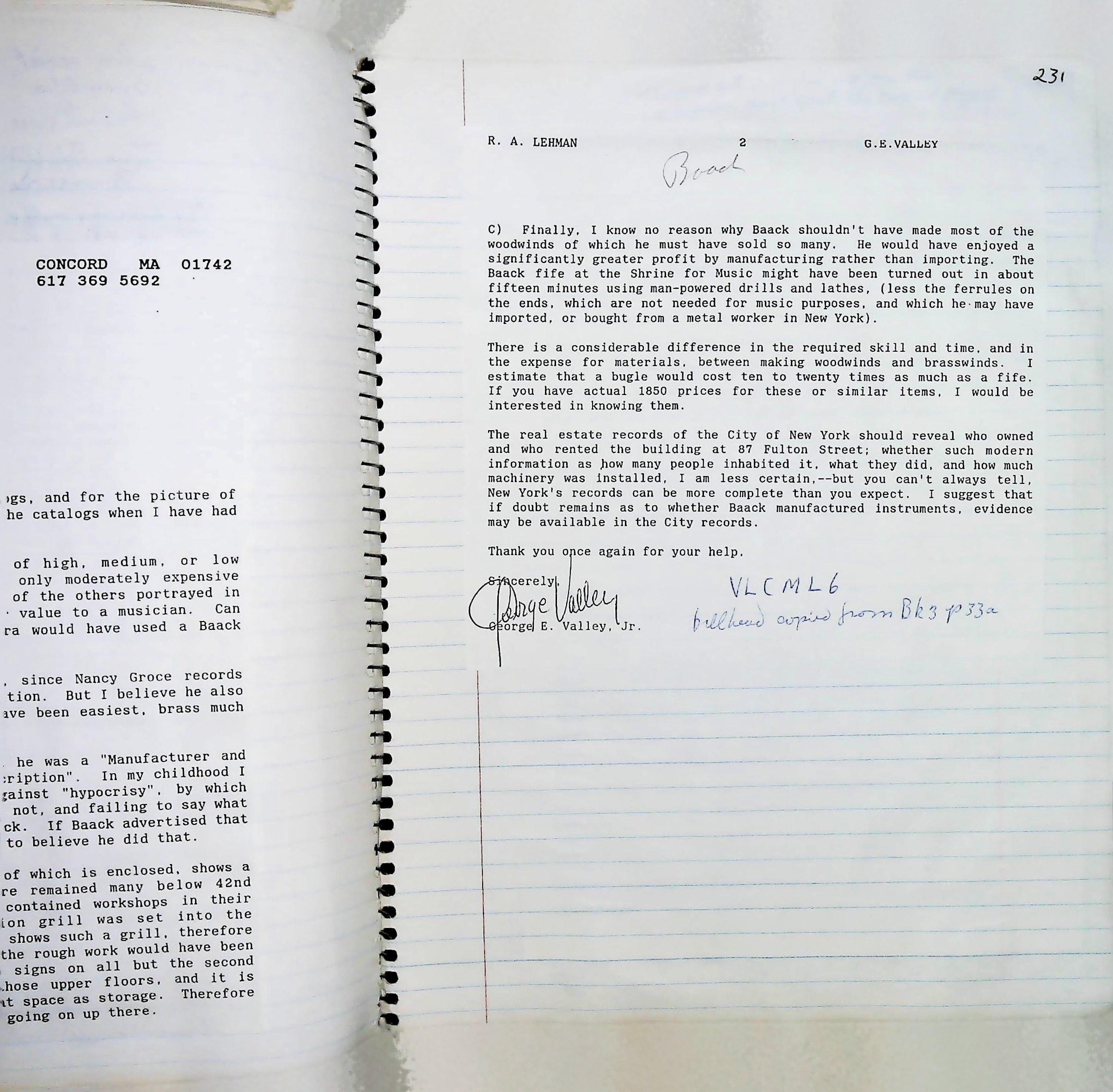
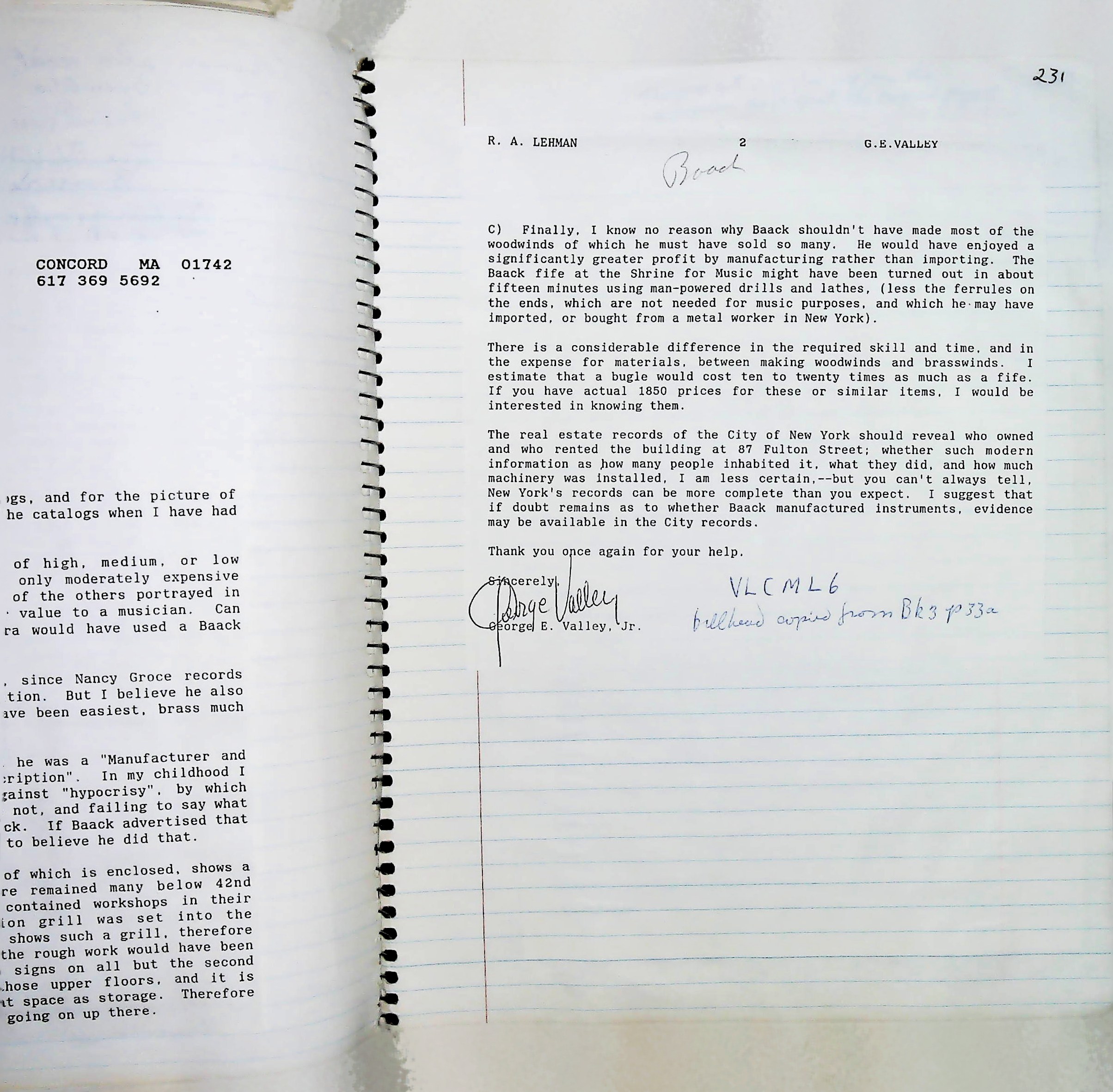
[Notebook p. 231. Page 2 of the letter to Lehman.] R. A. LEHMAN 2 G.E.VALLEY
C) Finally, I know no reason why Baack shouldn't have made most of the woodwinds of which he must have sold so many. He would have enjoyed a significantly greater profit by manufacturing rather than importing. The Baack fife at the Shrine for Music might have been turned out in about fifteen minutes using man-powered drills and lathes, (less the ferrules on the ends, which are not needed for music purposes, and which he may have imported, or bought from a metal worker in New York).
There is a considerable difference in the required skill and time, and in the expense for materials, between making woodwinds and brasswinds. I estimate that a bugle would cost ten to twenty times as much as a fife. If you have actual 1850 prices for these or similar items, I would be interested in knowing them.
The real estate records of the City of New York should reveal who owned and who rented the building at 87 Fulton Street; whether such modern information as how many people inhabited it, what they did, and how much machinery was installed, I am less certain,--but you can't always tell, New York's records can be more complete than you expect. I suggest that if doubt remains as to whether Baack manufactured instruments, evidence may be available in the City records.
Thank you once again for your help.
Sincerely, [signed] George Valley George E. Valley, Jr. [handwritten:] VLCML6; billhead copied from Bk 3 p 33a
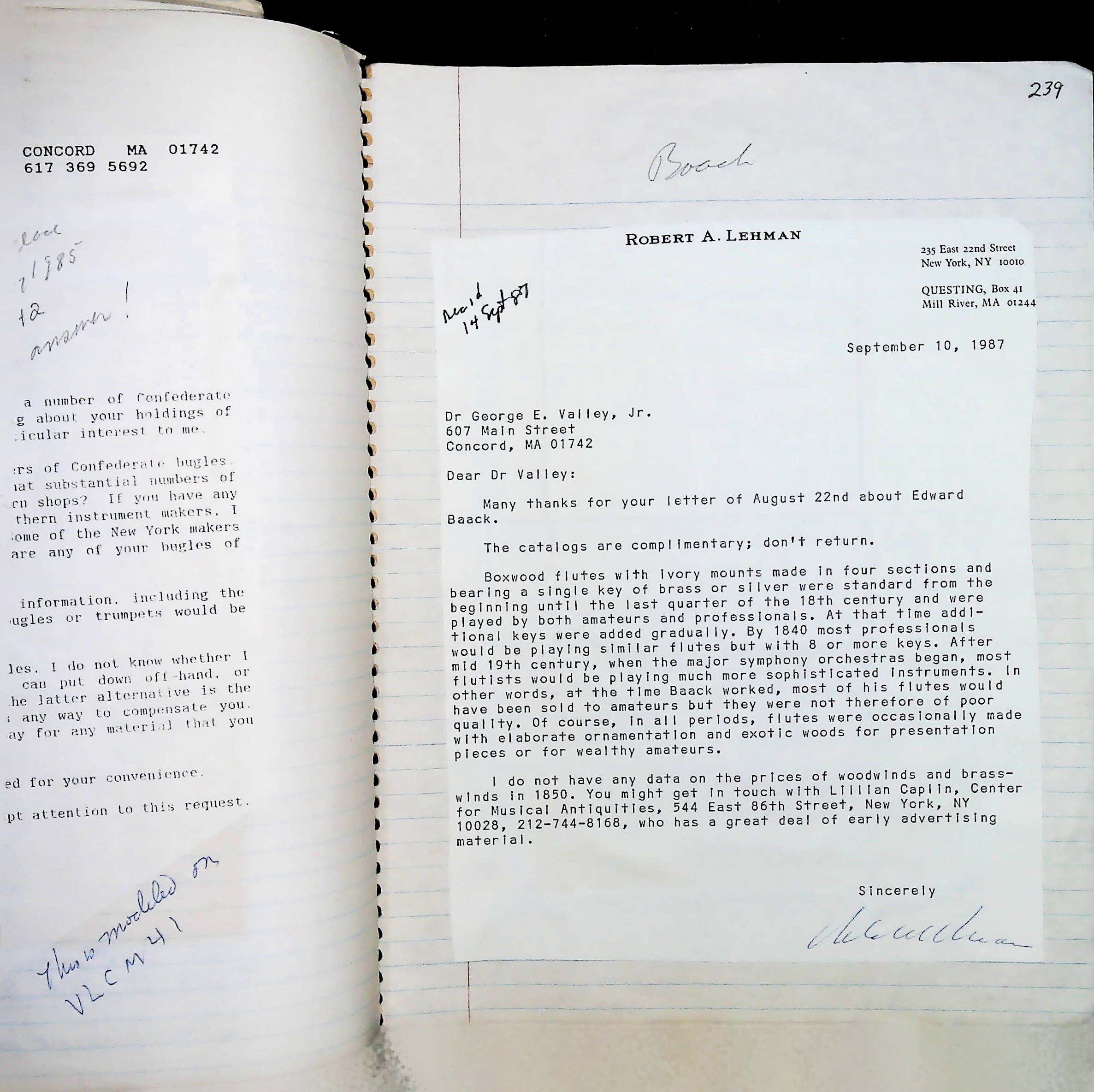
[Notebook p. 239. Typed letter from Robert A. Lehman to GEV, pasted in. GEV's notes: "Baach"; "rec'd 14 Sept 87".] ROBERT A. LEHMAN, 235 East 22nd Street, New York, NY 10010; QUESTING, Box 41, Mill River, MA 01244
September 10, 1987
Dr George E. Valley, Jr. 607 Main Street Concord, MA 01742
Dear Dr Valley:
Many thanks for your letter of August 22nd about Edward Baack.
The catalogs are complimentary; don't return.
Boxwood flutes with ivory mounts made in four sections and bearing a single key of brass or silver were standard from the beginning until the last quarter of the 18th century and were played by both amateurs and professionals. At that time additional keys were added gradually. By 1840 most professionals would be playing similar flutes but with 8 or more keys. After mid 19th century, when the major symphony orchestras began, most flutists would be playing much more sophisticated instruments. In other words, at the time Baack worked, most of his flutes would have been sold to amateurs but they were not therefore of poor quality. Of course, in all periods, flutes were occasionally made with elaborate ornamentation and exotic woods for presentation pieces or for wealthy amateurs.
I do not have any data on the prices of woodwinds and brasswinds in 1850. You might get in touch with Lillian Caplin, Center for Musical Antiquities, 544 East 86th Street, New York, NY 10028, who has a great deal of early advertising material.
Sincerely [signed] R. A. Lehman
[Rear cover of notebook VLCM #4, marked with a large X and "Rear of Book".]
Notes
Source: Correspondence of G. E. Valley Jr. and Robert A. Lehman about Edward Baack's flutes, Jun-Sep 1987 (notebook VLCM 4) Location: G. E. Valley Jr.'s research notebook VLCM #4 (1 Jul 1986 - 14 Sep 1987), part 3, pp. 191, 204, 205, 206, 207, 208, 209, 228, 229, 230, 231, 239 and rear cover; Valley family papers, storage bin Found by: Claude research assistant