Letters between Lloyd P. Farrar of the American Musical Instrument Society and G. E. Valley Jr., October 1986 to June 1987, about Edward Baack: Farrar's account of Baack's instruments and their value, GEV's chronology of Baack's life (baptism in Hamburg 1809, business in New York 1837-1871, death 1893), family stories, the Baack plot at Green-Wood Cemetery, and a letter to the Center for Musical Antiquities.
History · Oct 1986 - Jun 1987 · Concord, Middlesex, Massachusetts, United States
Linked to Christina Franzeska Mohr, Catharina Sophie Baumann, Emma Baack, Martin Hieronymus Baack, Philipp Jakob Donnecker, Mary C. C. Baack, Katharina Donnecker, Edward Baack, Jr., Frances Jane Baack, Heinrich Eduard Baack, Sr. and George Edward Valley Jr
10 pages. Open one to read it full size.
Notebook p. 147
Notebook p. 148
Notebook p. 149
Notebook p. 150
Notebook p. 151
Notebook p. 184
Notebook p. 185
Notebook p. 186
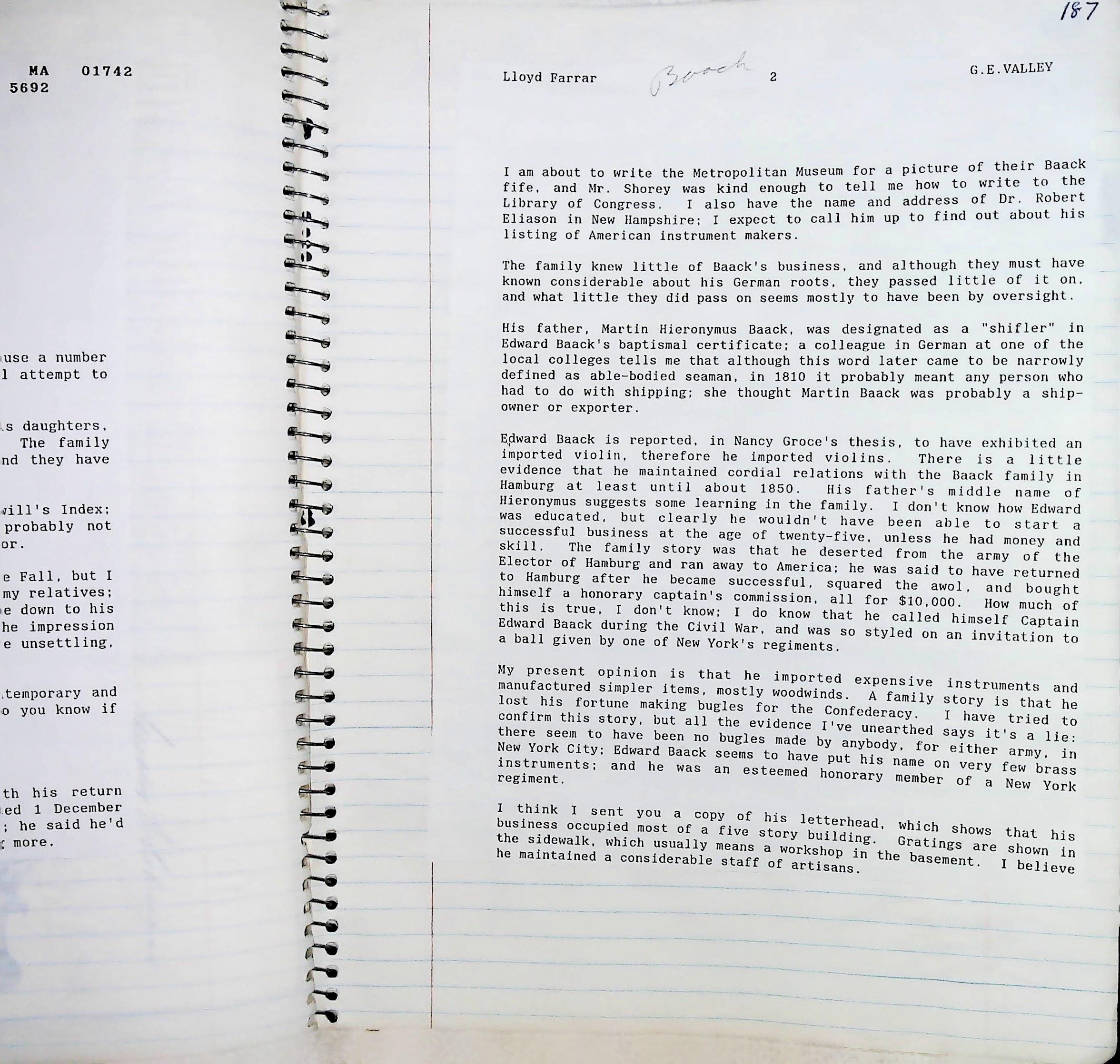
Notebook p. 187
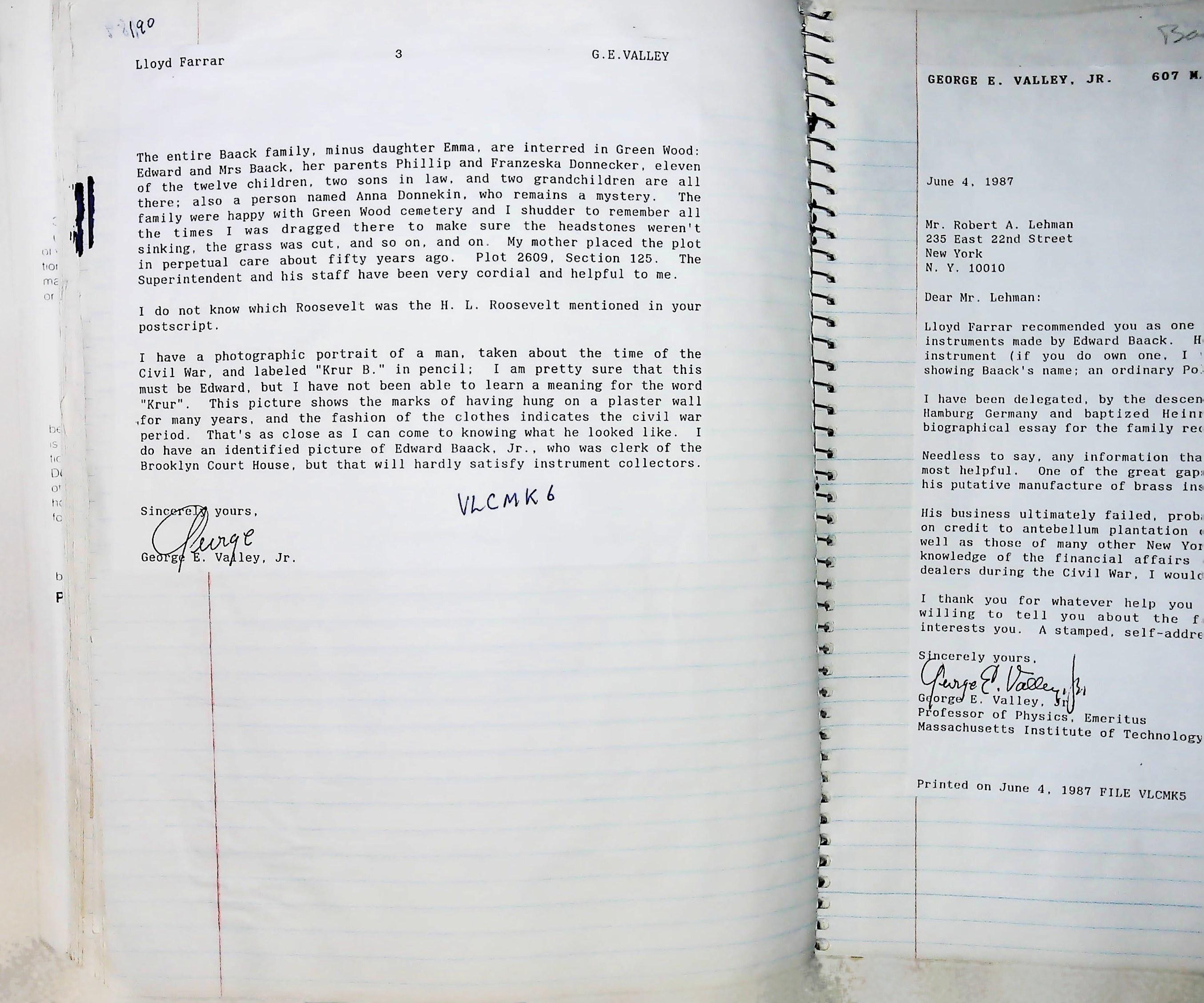
Notebook p. 190
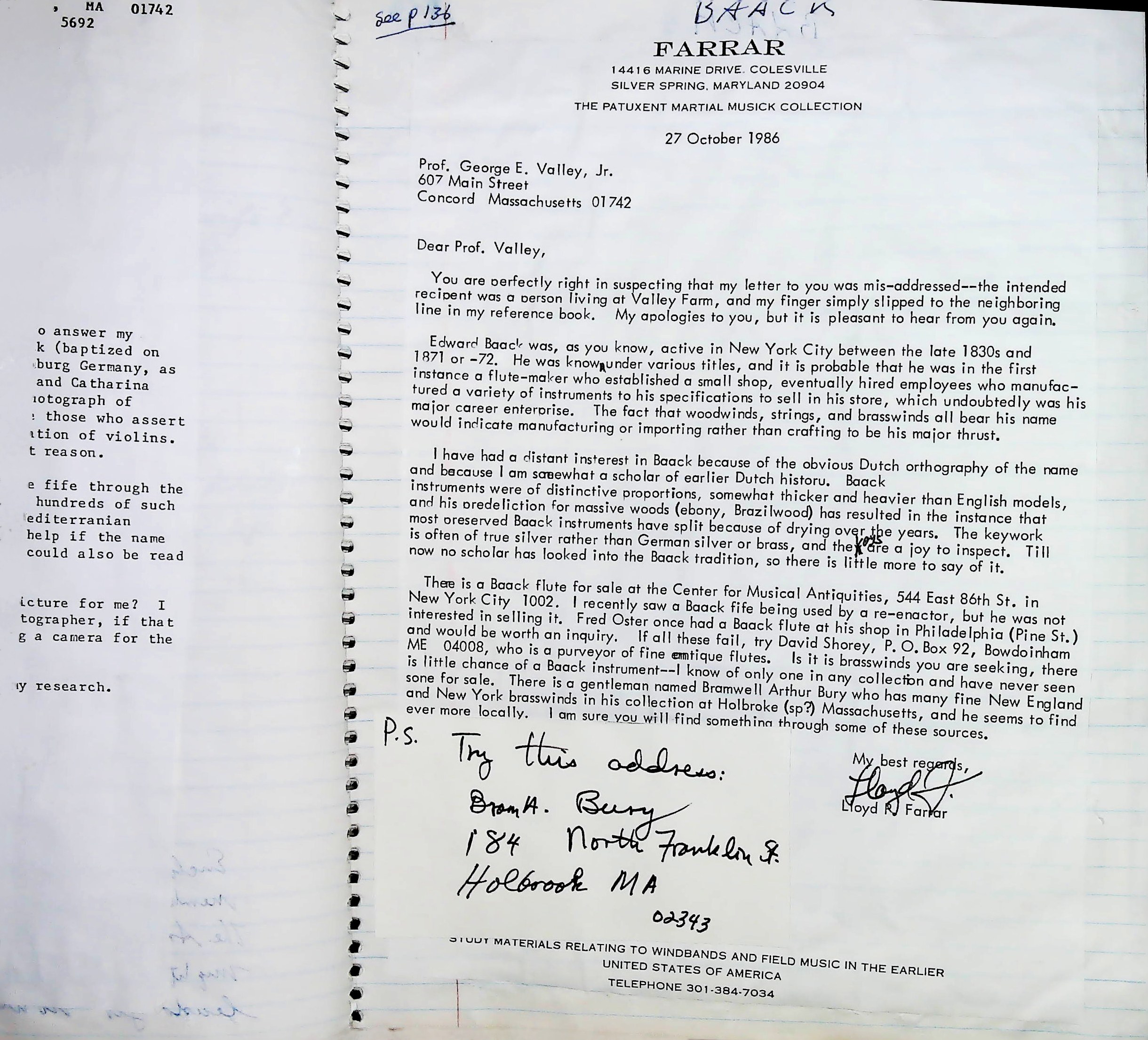
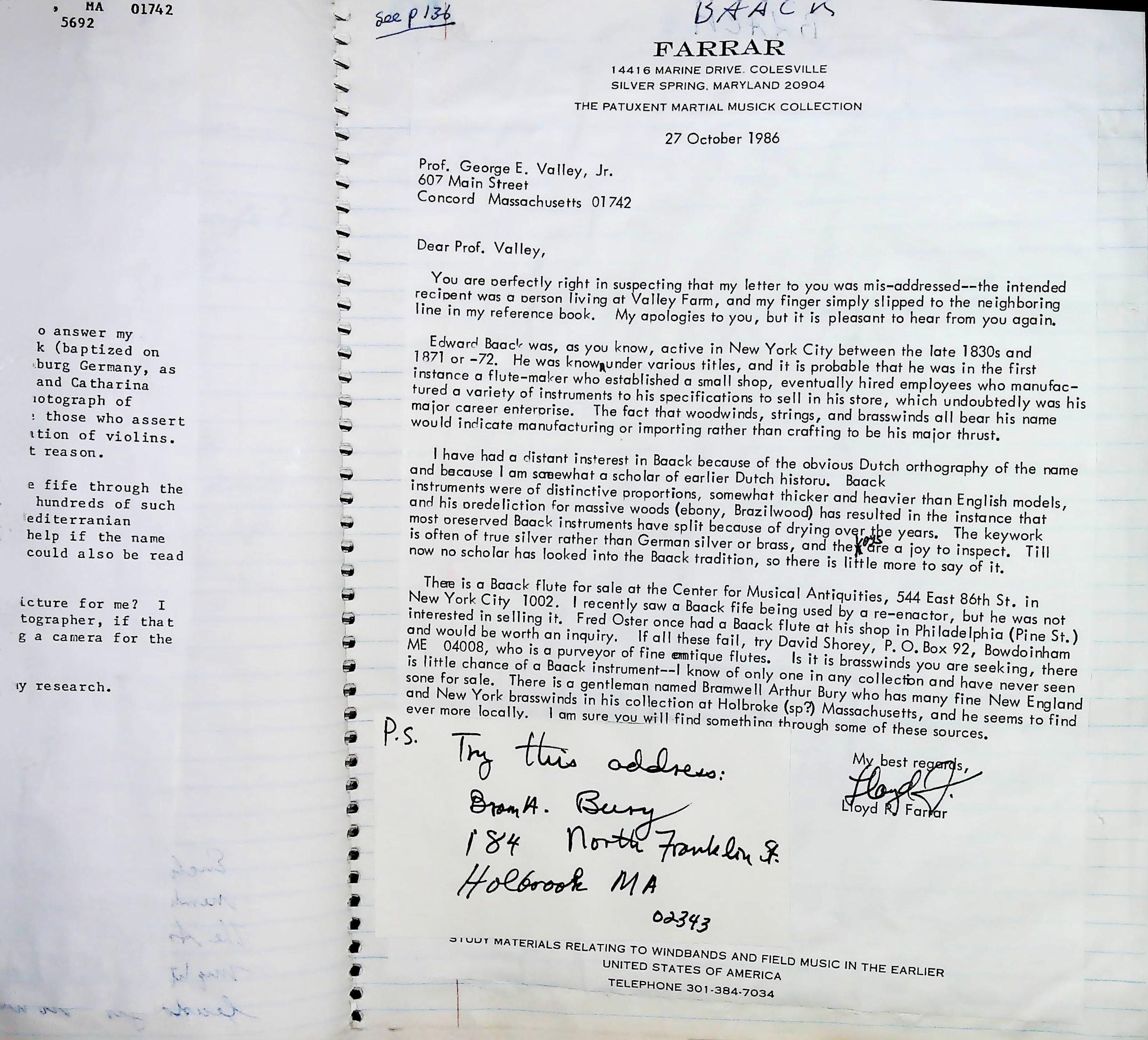
[Notebook p. 147. Typed letter from Lloyd P. Farrar to GEV, pasted in. GEV's notes: "see p 136"; "BAACK".] FARRAR, 14416 Marine Drive, Colesville, Silver Spring, Maryland 20904. The Patuxent Martial Musick Collection
27 October 1986
Prof. George E. Valley, Jr. 607 Main Street Concord Massachusetts 01742
Dear Prof. Valley,
You are perfectly right in suspecting that my letter to you was mis-addressed--the intended recipient was a person living at Valley Farm, and my finger simply slipped to the neighboring line in my reference book. My apologies to you, but it is pleasant to hear from you again.
Edward Baack was, as you know, active in New York City between the late 1830s and 1871 or -72. He was known under various titles, and it is probable that he was in the first instance a flute-maker who established a small shop, eventually hired employees who manufactured a variety of instruments to his specifications to sell in his store, which undoubtedly was his major career enterprise. The fact that woodwinds, strings, and brasswinds all bear his name would indicate manufacturing or importing rather than crafting to be his major thrust.
I have had a distant interest in Baack because of the obvious Dutch orthography of the name and because I am somewhat a scholar of earlier Dutch history. Baack instruments were of distinctive proportions, somewhat thicker and heavier than English models, and his predeliction for massive woods (ebony, Brazilwood) has resulted in the instance that most preserved Baack instruments have split because of drying over the years. The keywork is often of true silver rather than German silver or brass, and the keys are a joy to inspect. Till now no scholar has looked into the Baack tradition, so there is little more to say of it.
There is a Baack flute for sale at the Center for Musical Antiquities, 544 East 86th St. in New York City 1002. I recently saw a Baack fife being used by a re-enactor, but he was not interested in selling it. Fred Oster once had a Baack flute at his shop in Philadelphia (Pine St.) and would be worth an inquiry. If all these fail, try David Shorey, P. O. Box 92, Bowdoinham ME 04008, who is a purveyor of fine antique flutes. Is it is brasswinds you are seeking, there is little chance of a Baack instrument--I know of only one in any collection and have never seen sone for sale. There is a gentleman named Bramwell Arthur Bury who has many fine New England and New York brasswinds in his collection at Holbroke (sp?) Massachusetts, and he seems to find ever more locally. I am sure you will find something through some of these sources.
My best regards, [signed] Lloyd P. Farrar P.S. Try this address: Bram A. Bury, 184 North Franklin St., Holbrook MA 02343
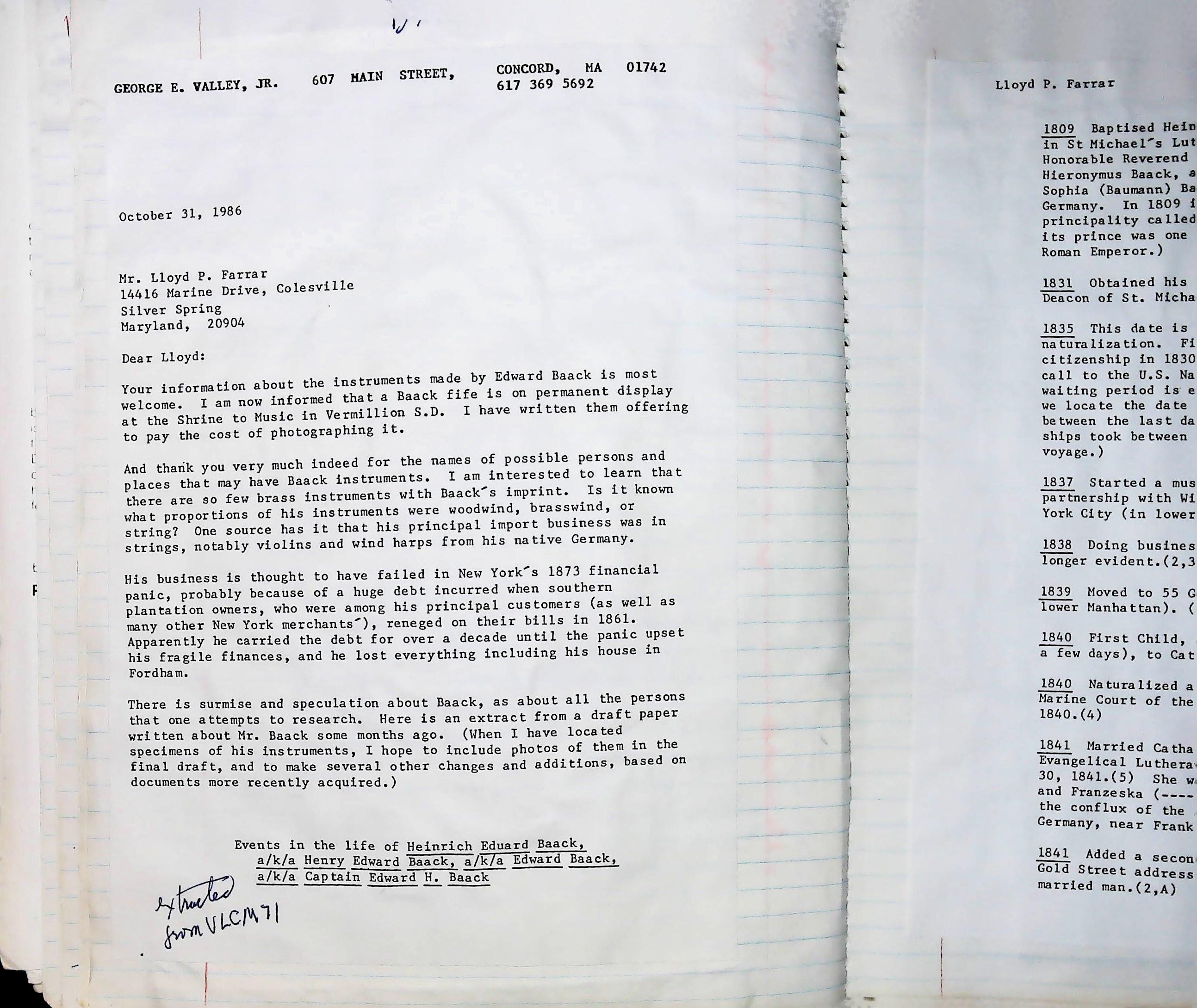
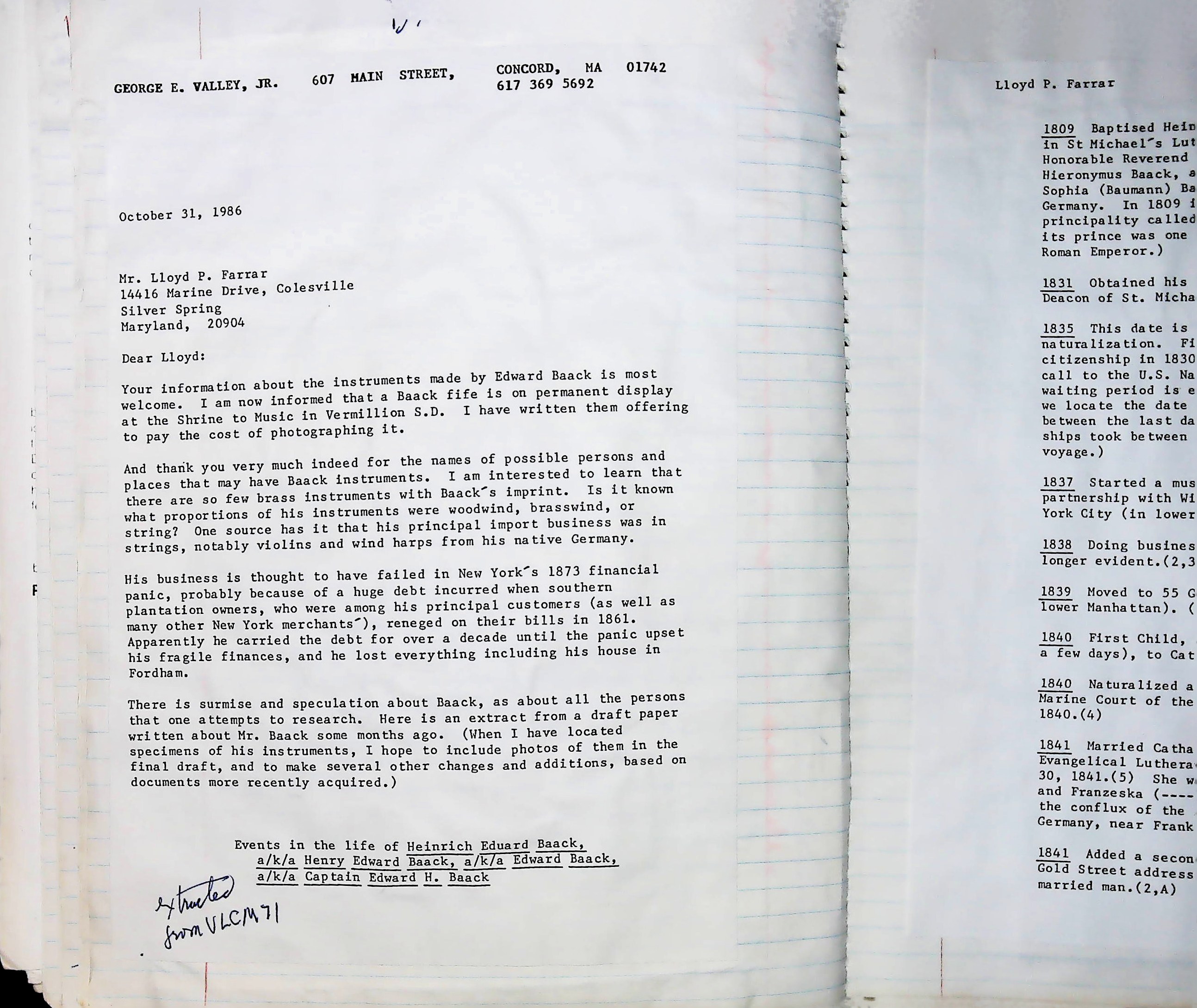
[Notebook p. 148. Copy of GEV's typed letter to Lloyd P. Farrar, page 1, pasted in. GEV's note: "extracted from VLCM 71".] GEORGE E. VALLEY, JR. 607 MAIN STREET, CONCORD, MA 01742 617 369 5692
October 31, 1986
Mr. Lloyd P. Farrar 14416 Marine Drive, Colesville Silver Spring Maryland, 20904
Dear Lloyd:
Your information about the instruments made by Edward Baack is most welcome. I am now informed that a Baack fife is on permanent display at the Shrine to Music in Vermillion S.D. I have written them offering to pay the cost of photographing it.
And thank you very much indeed for the names of possible persons and places that may have Baack instruments. I am interested to learn that there are so few brass instruments with Baack's imprint. Is it known what proportions of his instruments were woodwind, brasswind, or string? One source has it that his principal import business was in strings, notably violins and wind harps from his native Germany.
His business is thought to have failed in New York's 1873 financial panic, probably because of a huge debt incurred when southern plantation owners, who were among his principal customers (as well as many other New York merchants'), reneged on their bills in 1861. Apparently he carried the debt for over a decade until the panic upset his fragile finances, and he lost everything including his house in Fordham.
There is surmise and speculation about Baack, as about all the persons that one attempts to research. Here is an extract from a draft paper written about Mr. Baack some months ago. (When I have located specimens of his instruments, I hope to include photos of them in the final draft, and to make several other changes and additions, based on documents more recently acquired.)
Events in the life of Heinrich Eduard Baack, a/k/a Henry Edward Baack, a/k/a Edward Baack, a/k/a Captain Edward H. Baack
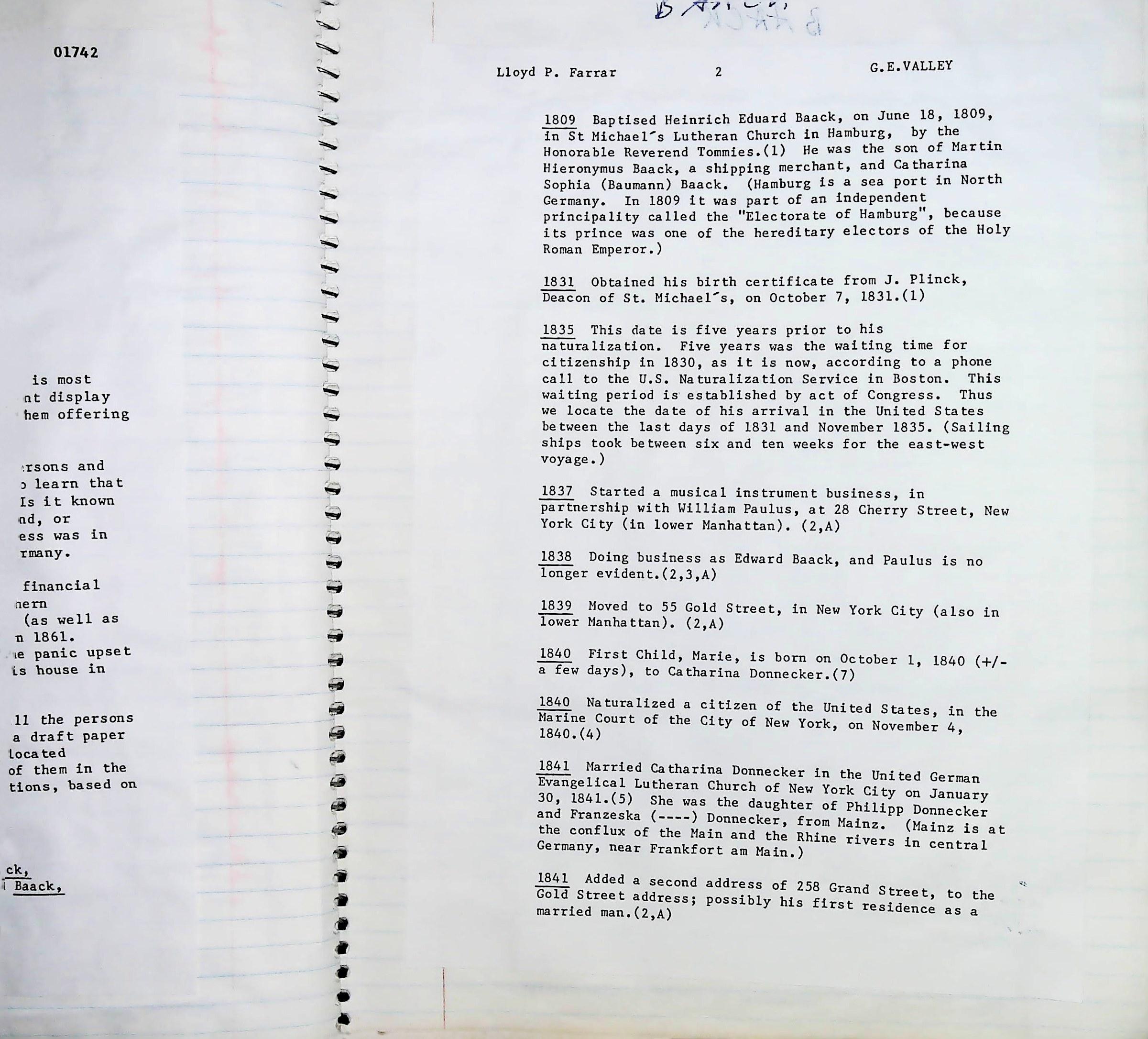
[Notebook p. 149. Page 2 of the letter to Farrar.] Lloyd P. Farrar 2 G.E.VALLEY
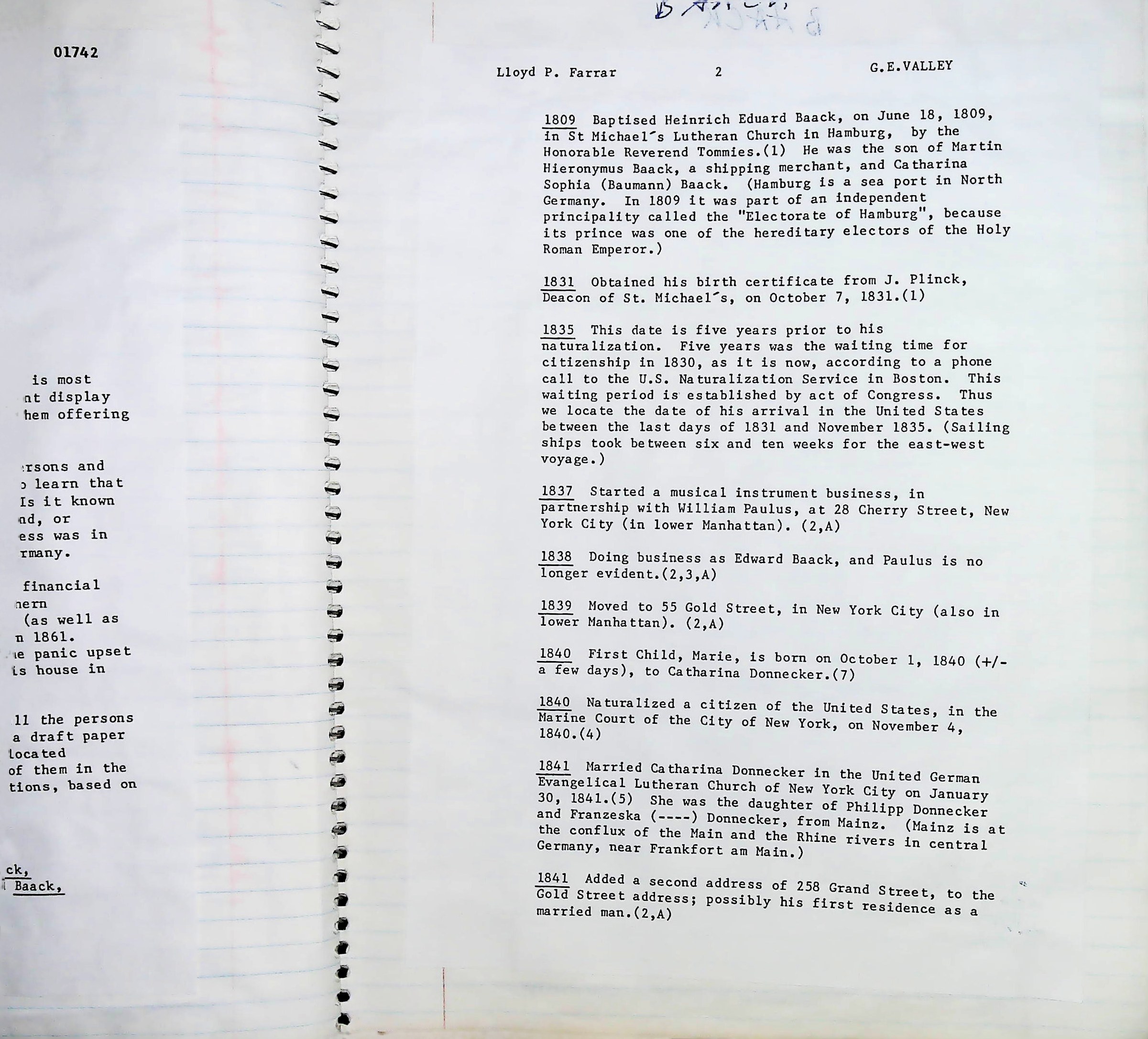
1809 Baptised Heinrich Eduard Baack, on June 18, 1809, in St Michael's Lutheran Church in Hamburg, by the Honorable Reverend Tommies.(1) He was the son of Martin Hieronymus Baack, a shipping merchant, and Catharina Sophia (Baumann) Baack. (Hamburg is a sea port in North Germany. In 1809 it was part of an independent principality called the "Electorate of Hamburg", because its prince was one of the hereditary electors of the Holy Roman Emperor.)
1831 Obtained his birth certificate from J. Plinck, Deacon of St. Michael's, on October 7, 1831.(1)
1835 This date is five years prior to his naturalization. Five years was the waiting time for citizenship in 1830, as it is now, according to a phone call to the U.S. Naturalization Service in Boston. This waiting period is established by act of Congress. Thus we locate the date of his arrival in the United States between the last days of 1831 and November 1835. (Sailing ships took between six and ten weeks for the east-west voyage.)
1837 Started a musical instrument business, in partnership with William Paulus, at 28 Cherry Street, New York City (in lower Manhattan). (2,A)
1838 Doing business as Edward Baack, and Paulus is no longer evident.(2,3,A)
1839 Moved to 55 Gold Street, in New York City (also in lower Manhattan). (2,A)
1840 First Child, Marie, is born on October 1, 1840 (+/- a few days), to Catharina Donnecker.(7)
1840 Naturalized a citizen of the United States, in the Marine Court of the City of New York, on November 4, 1840.(4)
1841 Married Catharina Donnecker in the United German Evangelical Lutheran Church of New York City on January 30, 1841.(5) She was the daughter of Philipp Donnecker and Franzeska (----) Donnecker, from Mainz. (Mainz is at the conflux of the Main and the Rhine rivers in central Germany, near Frankfort am Main.)
1841 Added a second address of 258 Grand Street, to the Gold Street address; possibly his first residence as a married man.(2,A)
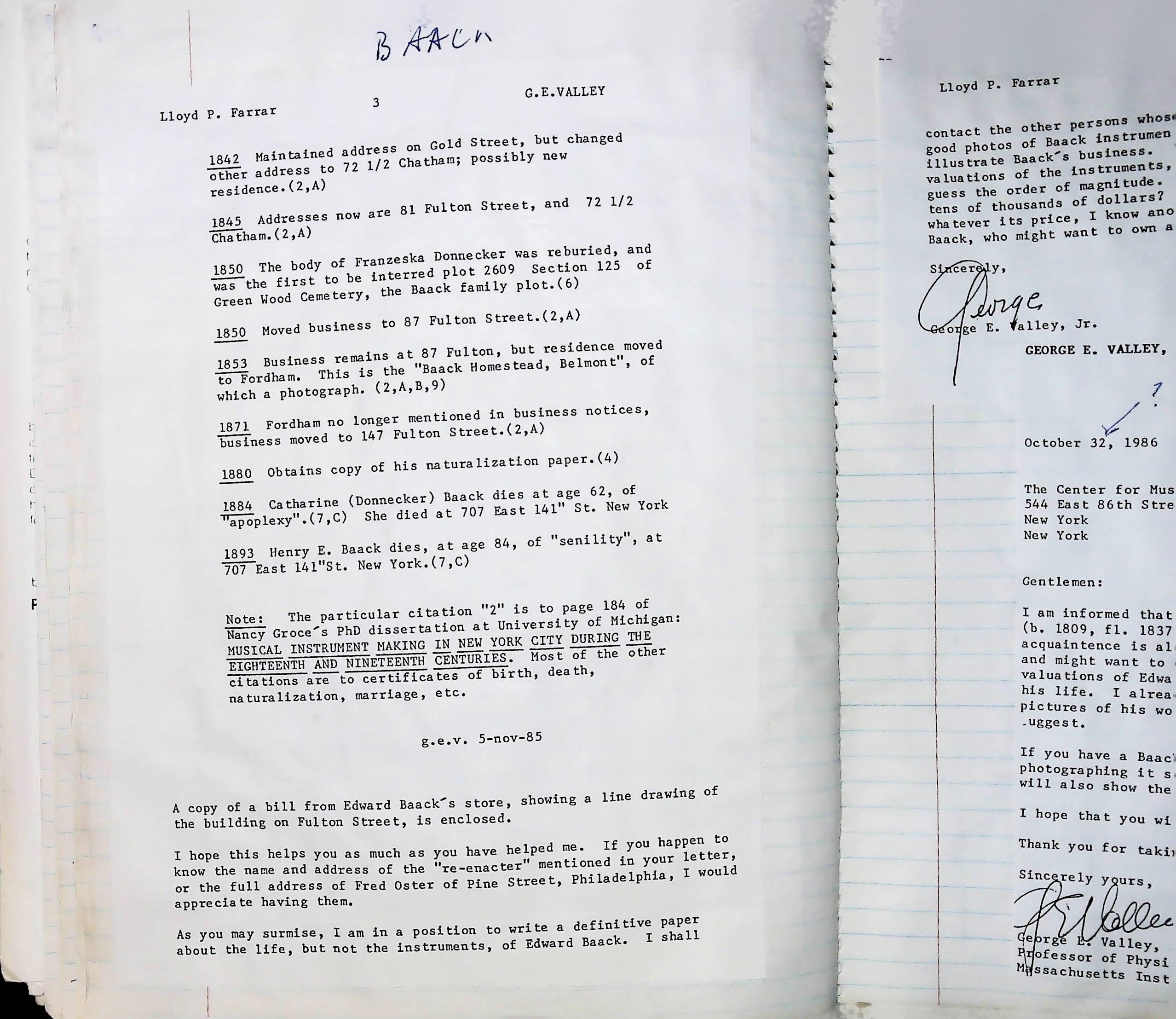
[Notebook p. 150. Page 3 of the letter to Farrar.] Lloyd P. Farrar 3 G.E.VALLEY
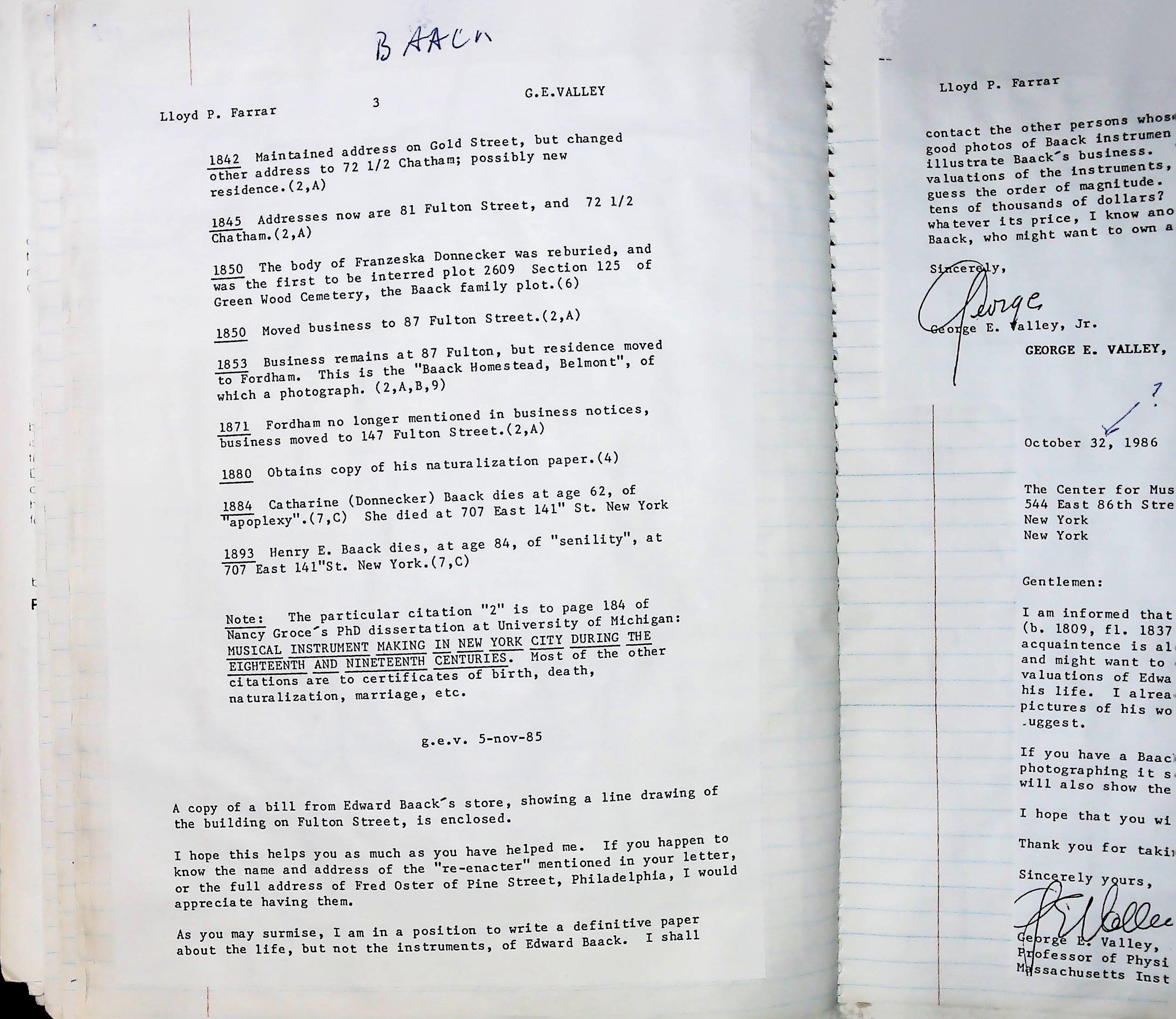
1842 Maintained address on Gold Street, but changed other address to 72 1/2 Chatham; possibly new residence.(2,A)
1845 Addresses now are 81 Fulton Street, and 72 1/2 Chatham.(2,A)
1850 The body of Franzeska Donnecker was reburied, and was the first to be interred plot 2609 Section 125 of Green Wood Cemetery, the Baack family plot.(6)
1850 Moved business to 87 Fulton Street.(2,A)
1853 Business remains at 87 Fulton, but residence moved to Fordham. This is the "Baack Homestead, Belmont", of which a photograph. (2,A,B,9)
1871 Fordham no longer mentioned in business notices, business moved to 147 Fulton Street.(2,A)
1880 Obtains copy of his naturalization paper.(4)
1884 Catharine (Donnecker) Baack dies at age 62, of "apoplexy".(7,C) She died at 707 East 141st St. New York
1893 Henry E. Baack dies, at age 84, of "senility", at 707 East 141st St. New York.(7,C)
Note: The particular citation "2" is to page 184 of Nancy Groce's PhD dissertation at University of Michigan: MUSICAL INSTRUMENT MAKING IN NEW YORK CITY DURING THE EIGHTEENTH AND NINETEENTH CENTURIES. Most of the other citations are to certificates of birth, death, naturalization, marriage, etc.
g.e.v. 5-nov-85
A copy of a bill from Edward Baack's store, showing a line drawing of the building on Fulton Street, is enclosed.
I hope this helps you as much as you have helped me. If you happen to know the name and address of the "re-enacter" mentioned in your letter, or the full address of Fred Oster of Pine Street, Philadelphia, I would appreciate having them.
As you may surmise, I am in a position to write a definitive paper about the life, but not the instruments, of Edward Baack. I shall
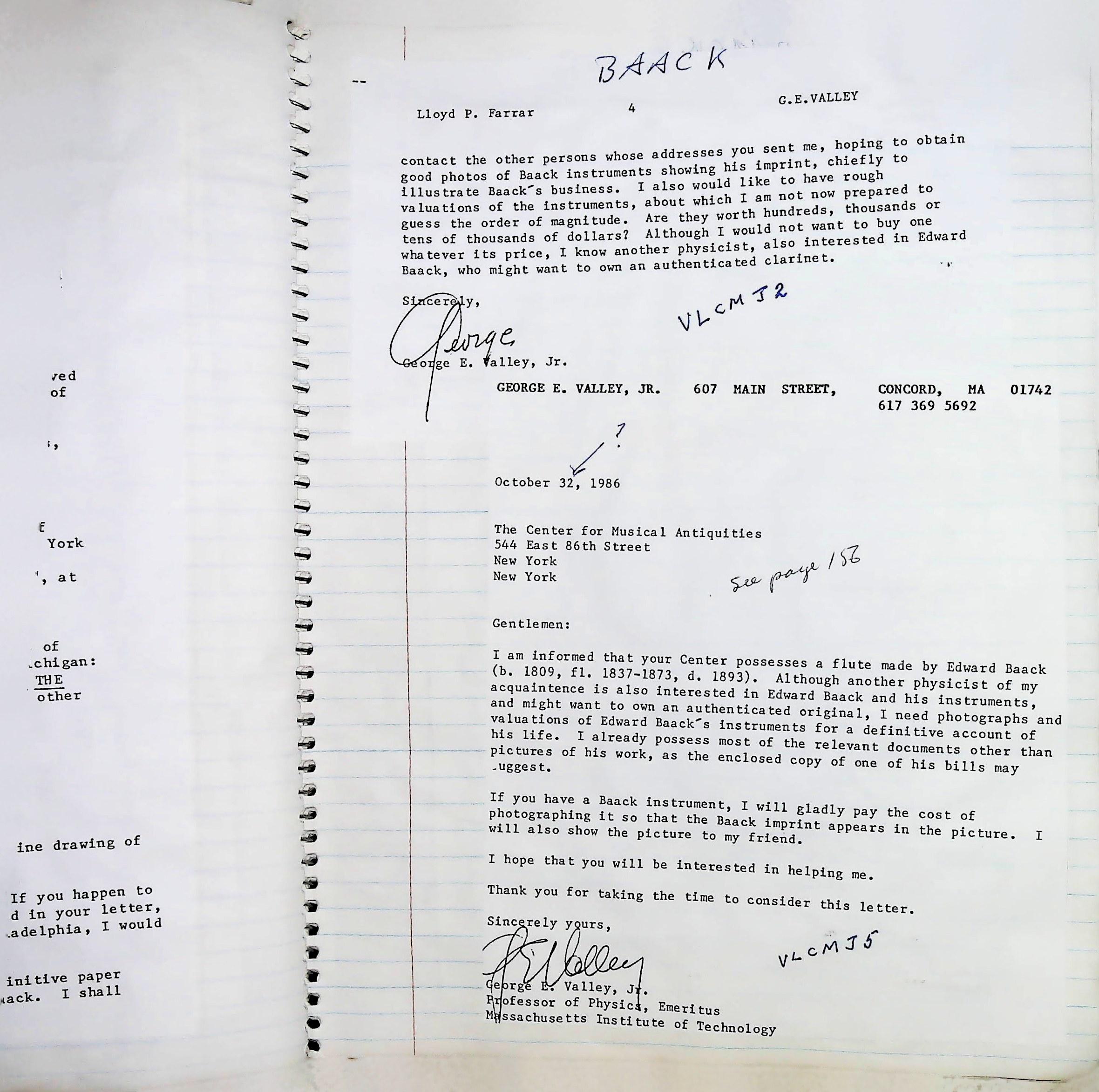
[Notebook p. 151. Page 4 of the letter to Farrar, with a copy of GEV's letter to the Center for Musical Antiquities pasted below it.] Lloyd P. Farrar 4 G.E.VALLEY
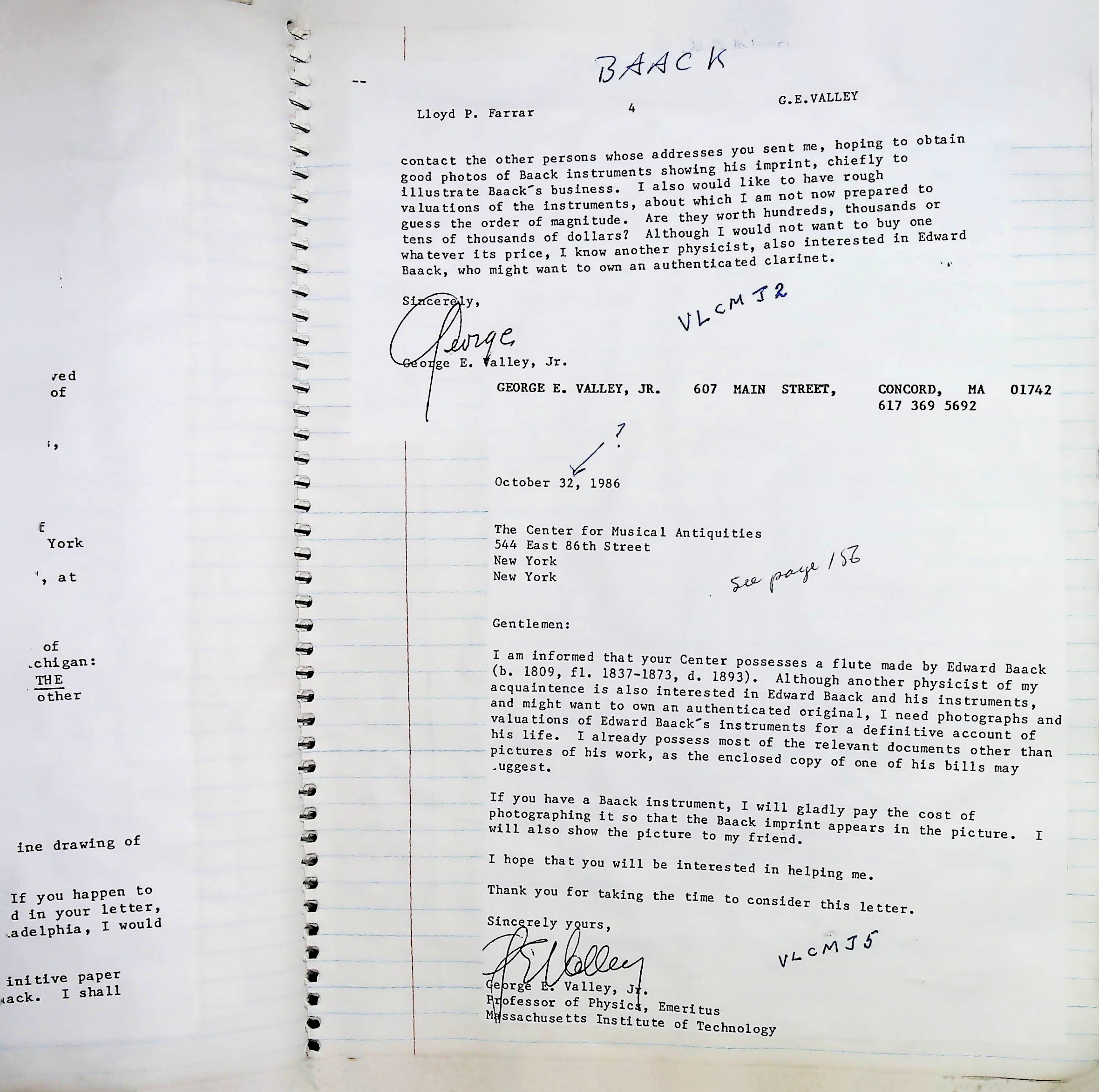
contact the other persons whose addresses you sent me, hoping to obtain good photos of Baack instruments showing his imprint, chiefly to illustrate Baack's business. I also would like to have rough valuations of the instruments, about which I am not now prepared to guess the order of magnitude. Are they worth hundreds, thousands or tens of thousands of dollars? Although I would not want to buy one whatever its price, I know another physicist, also interested in Edward Baack, who might want to own an authenticated clarinet.
Sincerely, [signed] George George E. Valley, Jr. [handwritten:] VLCMJ2
GEORGE E. VALLEY, JR. 607 MAIN STREET, CONCORD, MA 01742 617 369 5692 October 32, 1986 [GEV's mark beside the impossible date: "?"]
The Center for Musical Antiquities 544 East 86th Street New York New York
Gentlemen:
I am informed that your Center possesses a flute made by Edward Baack (b. 1809, fl. 1837-1873, d. 1893). Although another Physicist of my acquaintence is also interested in Edward Baack and his instruments, and might want to own an authenticated original, I need photographs and valuations of Edward Baack's instruments for a definitive account of his life. I already possess most of the relevant documents other than pictures of his work, as the enclosed copy of one of his bills may suggest.
If you have a Baack instrument, I will gladly pay the cost of photographing it so that the Baack imprint appears in the picture. I will also show the picture to my friend.
I hope that you will be interested in helping me.
Thank you for taking the time to consider this letter.
Sincerely yours, [signed] G. E. Valley George E. Valley, Jr. Professor of Physics, Emeritus Massachusetts Institute of Technology
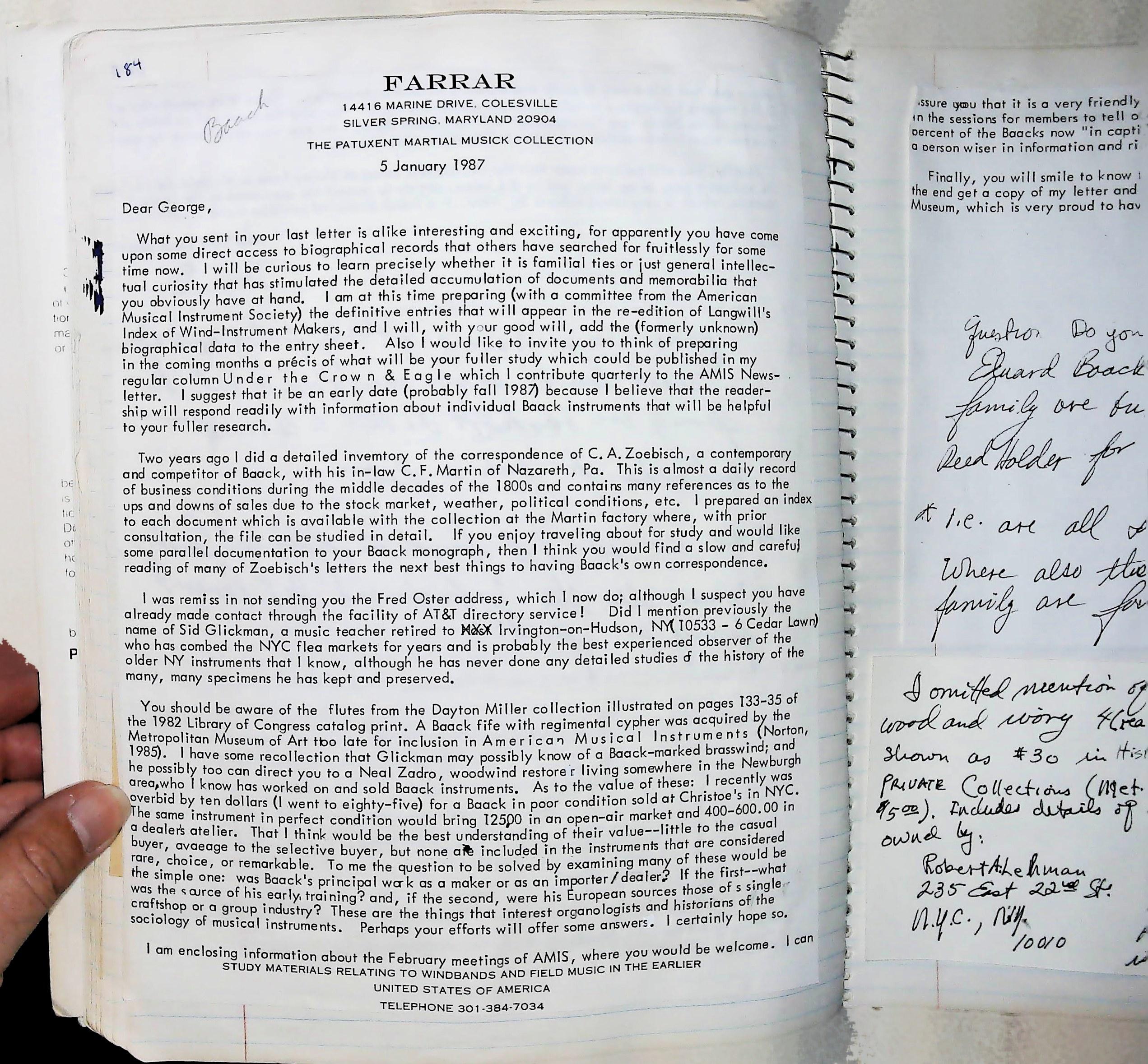
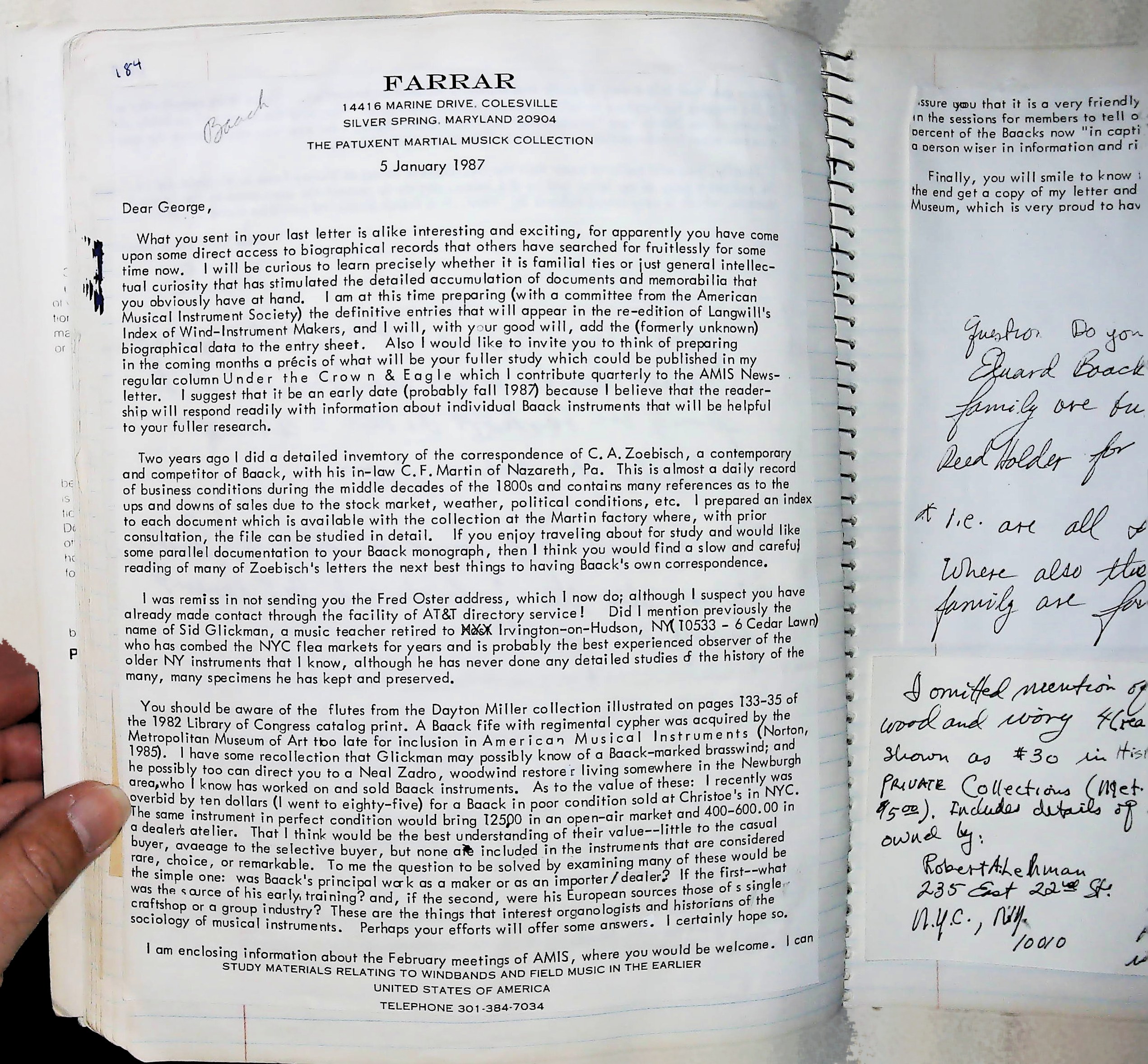
[Notebook p. 184. Typed letter from Lloyd P. Farrar to GEV, page 1, pasted in. GEV's note: "Baach".] FARRAR, 14416 Marine Drive, Colesville, Silver Spring, Maryland 20904. The Patuxent Martial Musick Collection
5 January 1987
Dear George,
What you sent in your last letter is alike interesting and exciting, for apparently you have come upon some direct access to biographical records that others have searched for fruitlessly for some time now. I will be curious to learn precisely whether it is familial ties or just general intellectual curiosity that has stimulated the detailed accumulation of documents and memorabilia that you obviously have at hand. I am at this time preparing (with a committee from the American Musical Instrument Society) the definitive entries that will appear in the re-edition of Langwill's Index of Wind-Instrument Makers, and I will, with your good will, add the (formerly unknown) biographical data to the entry sheet. Also I would like to invite you to think of preparing in the coming months a précis of what will be your fuller study which could be published in my regular column Under the Crown & Eagle which I contribute quarterly to the AMIS Newsletter. I suggest that it be an early date (probably fall 1987) because I believe that the readership will respond readily with information about individual Baack instruments that will be helpful to your fuller research.
Two years ago I did a detailed inventory of the correspondence of C. A. Zoebisch, a contemporary and competitor of Baack, with his in-law C. F. Martin of Nazareth, Pa. This is almost a daily record of business conditions during the middle decades of the 1800s and contains many references as to the ups and downs of sales due to the stock market, weather, political conditions, etc. I prepared an index to each document which is available with the collection at the Martin factory where, with prior consultation, the file can be studied in detail. If you enjoy traveling about for study and would like some parallel documentation to your Baack monograph, then I think you would find a slow and careful reading of many of Zoebisch's letters the next best things to having Baack's own correspondence.
I was remiss in not sending you the Fred Oster address, which I now do; although I suspect you have already made contact through the facility of AT&T directory service! Did I mention previously the name of Sid Glickman, a music teacher retired to Irvington-on-Hudson, NY (10533 - 6 Cedar Lawn) who has combed the NYC flea markets for years and is probably the best experienced observer of the older NY instruments that I know, although he has never done any detailed studies of the history of the many, many specimens he has kept and preserved.
You should be aware of the flutes from the Dayton Miller collection illustrated on pages 133-35 of the 1982 Library of Congress catalog print. A Baack fife with regimental cypher was acquired by the Metropolitan Museum of Art too late for inclusion in American Musical Instruments (Norton, 1985). I have some recollection that Glickman may possibly know of a Baack-marked brasswind; and he possibly too can direct you to a Neal Zadro, woodwind restorer living somewhere in the Newburgh area, who I know has worked on and sold Baack instruments. As to the value of these: I recently was overbid by ten dollars (I went to eighty-five) for a Baack in poor condition sold at Christoe's in NYC. The same instrument in perfect condition would bring 125.00 in an open-air market and 400-600.00 in a dealer's atelier. That I think would be the best understanding of their value--little to the casual buyer, average to the selective buyer, but none are included in the instruments that are considered rare, choice, or remarkable. To me the question to be solved by examining many of these would be the simple one: was Baack's principal work as a maker or as an importer/dealer? If the first--what was the source of his early training? and, if the second, were his European sources those of a single craftshop or a group industry? These are the things that interest organologists and historians of the sociology of musical instruments. Perhaps your efforts will offer some answers. I certainly hope so.
I am enclosing information about the February meetings of AMIS, where you would be welcome. I can
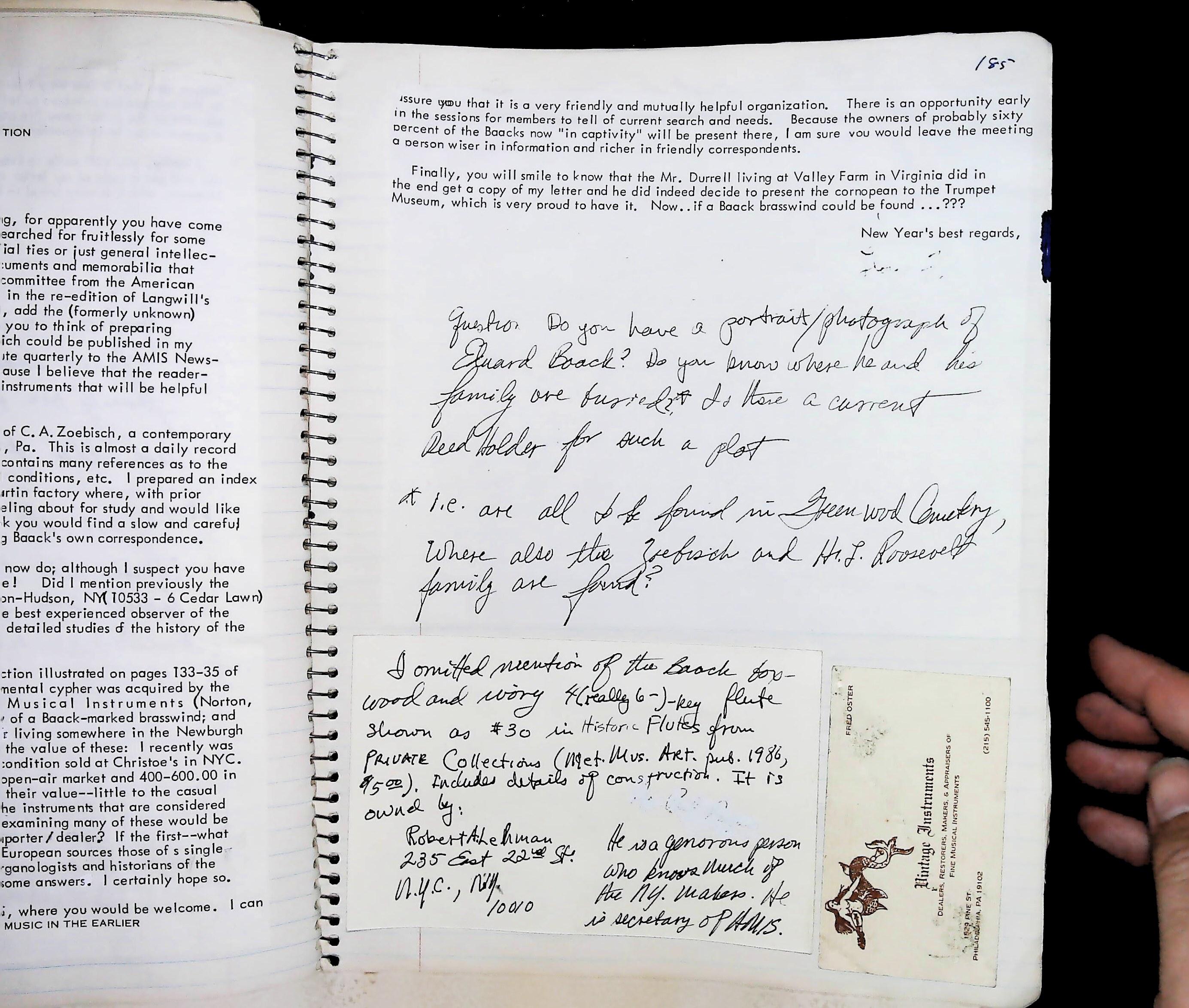
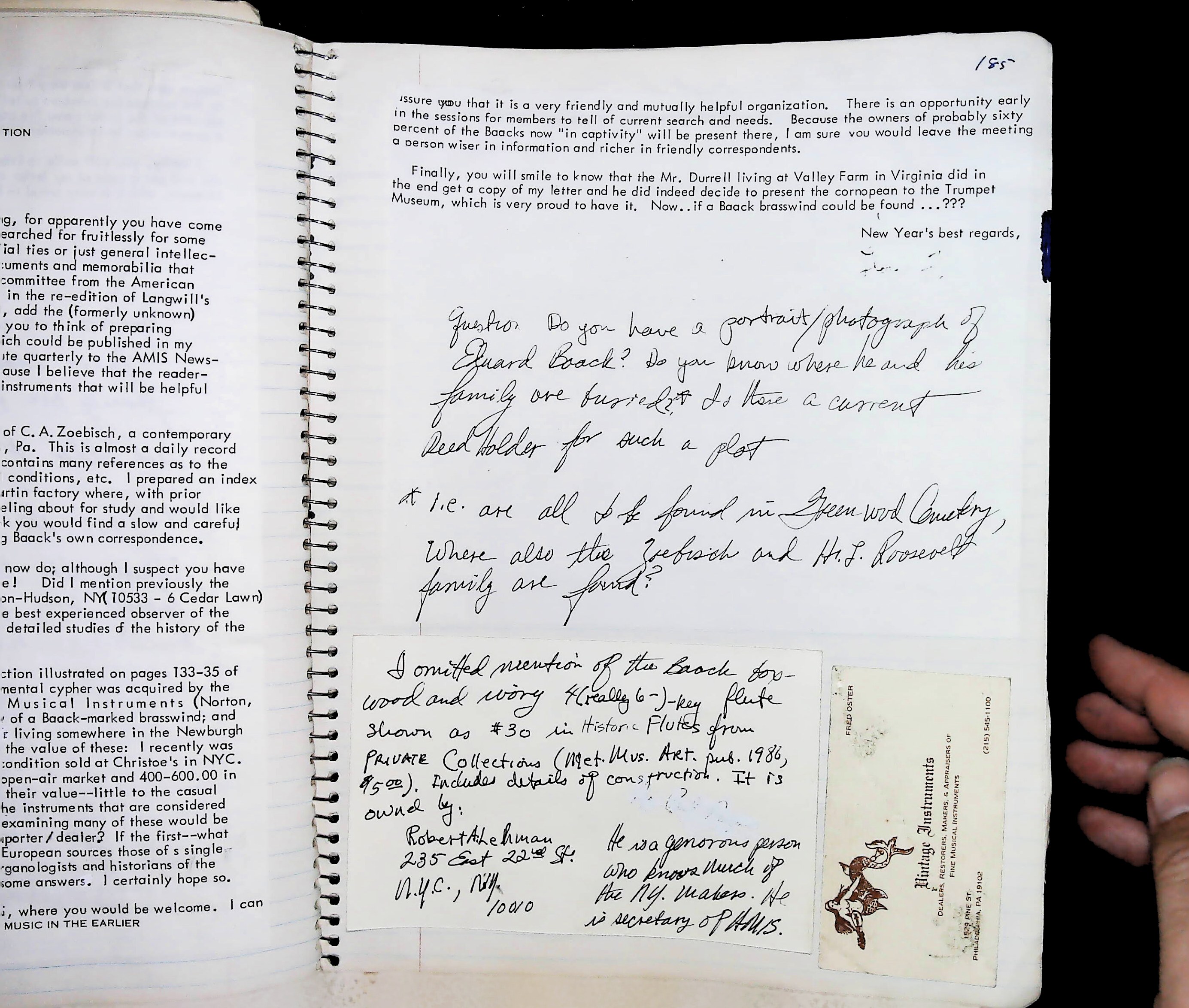
[Notebook p. 185. Page 2 of Farrar's letter, with GEV's notes, a handwritten note from Farrar (or another correspondent) and Fred Oster's business card pasted in.] assure you that it is a very friendly and mutually helpful organization. There is an opportunity early in the sessions for members to tell of current search and needs. Because the owners of probably sixty percent of the Baacks now "in captivity" will be present there, I am sure you would leave the meeting a person wiser in information and richer in friendly correspondents.
Finally, you will smile to know that the Mr. Durrell living at Valley Farm in Virginia did in the end get a copy of my letter and he did indeed decide to present the cornopean to the Trumpet Museum, which is very proud to have it. Now..if a Baack brasswind could be found ...???
New Year's best regards, [signed] Lloyd
[GEV's notes:] Question: Do you have a portrait/photograph of Eduard Baack? Do you know where he and his family are buried?* Is there a current Deed Holder for such a plot. * i.e. are all [of them] found in Green-wood Cemetery, where also the Zoebisch and H. J. Roosevelt family are found?
[Handwritten note, pasted in:] I omitted mention of the Baack boxwood and ivory 4 (really 6-)-key flute shown as #30 in Historic Flutes from Private Collections (Met. Mus. Art. pub. 1986, $5.00). Includes details of construction. It is owned by: Robert A. Lehman, 235 East 22nd St., N.Y.C., N.Y. 10010. He is a generous person who knows much of the N.Y. makers. He is secretary of AMIS.
[Business card:] Fred Oster, Vintage Instruments, Dealers, Restorers, Makers, & Appraisers of Fine Musical Instruments, 1529 Pine St., Philadelphia, PA 19102
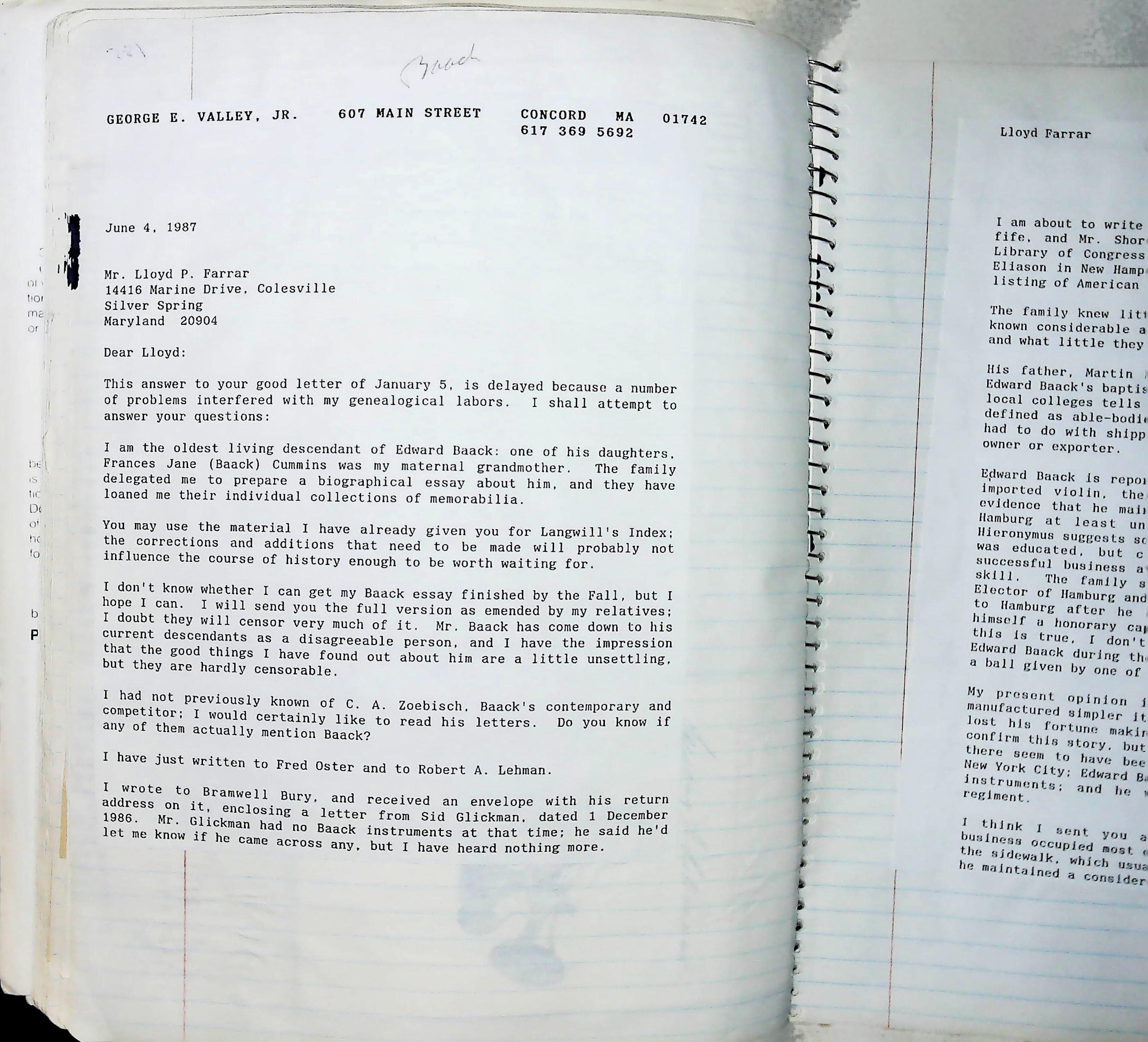
[Notebook p. 186. Copy of GEV's typed letter to Lloyd P. Farrar, page 1, pasted in. GEV's note: "Baach".] GEORGE E. VALLEY, JR. 607 MAIN STREET CONCORD MA 01742 617 369 5692
June 4, 1987
Mr. Lloyd P. Farrar 14416 Marine Drive, Colesville Silver Spring Maryland 20904
Dear Lloyd:
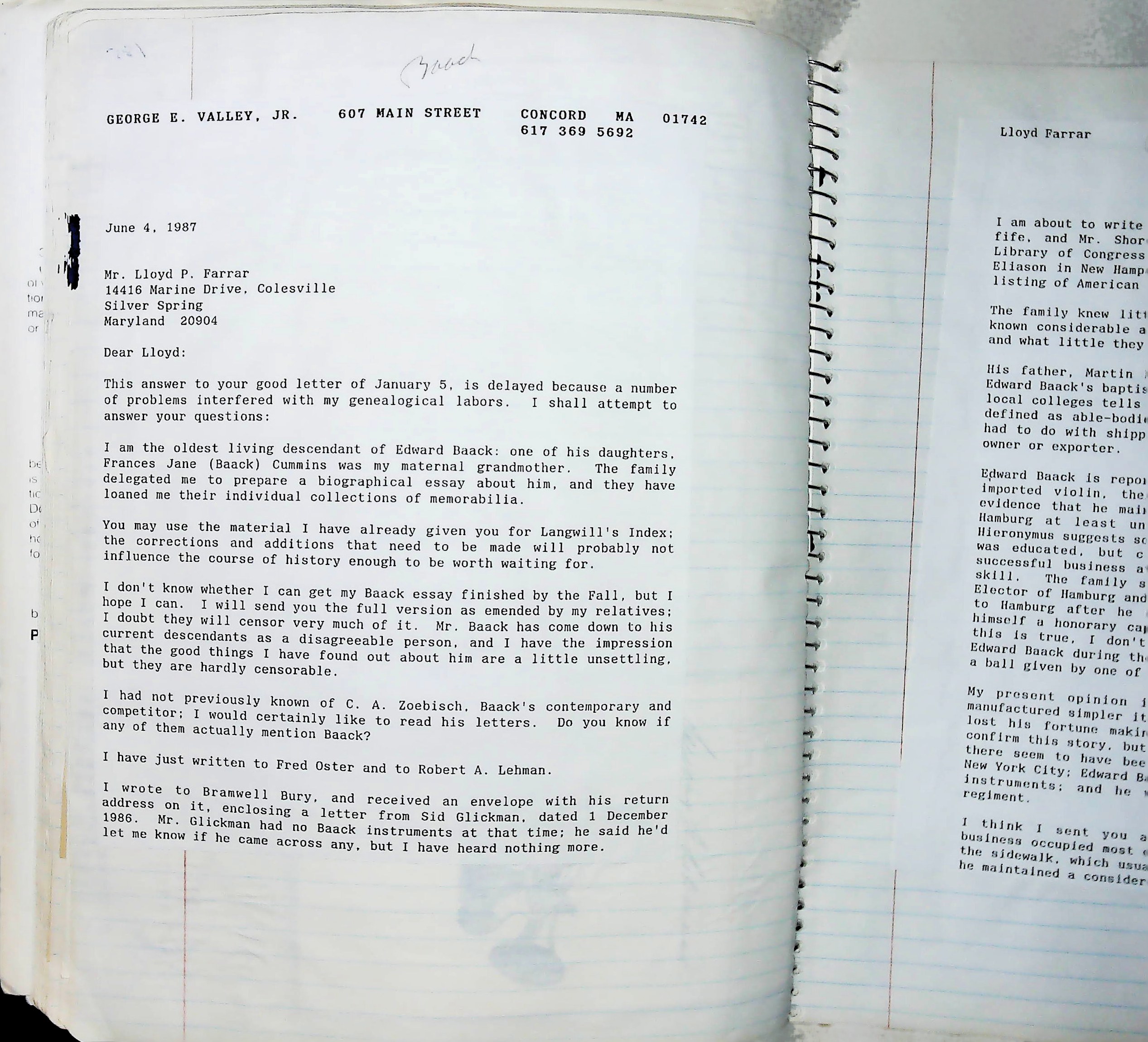
This answer to your good letter of January 5, is delayed because a number of problems interfered with my genealogical labors. I shall attempt to answer your questions:
I am the oldest living descendant of Edward Baack: one of his daughters, Frances Jane (Baack) Cummins was my maternal grandmother. The family delegated me to prepare a biographical essay about him, and they have loaned me their individual collections of memorabilia.
You may use the material I have already given you for Langwill's Index; the corrections and additions that need to be made will probably not influence the course of history enough to be worth waiting for.
I don't know whether I can get my Baack essay finished by the Fall, but I hope I can. I will send you the full version as emended by my relatives; I doubt they will censor very much of it. Mr. Baack has come down to his current descendants as a disagreeable person, and I have the impression that the good things I have found out about him are a little unsettling, but they are hardly censorable.
I had not previously known of C. A. Zoebisch, Baack's contemporary and competitor; I would certainly like to read his letters. Do you know if any of them actually mention Baack?
I have just written to Fred Oster and to Robert A. Lehman.
I wrote to Bramwell Bury, and received an envelope with his return address on it, enclosing a letter from Sid Glickman, dated 1 December 1986. Mr. Glickman had no Baack instruments at that time; he said he'd let me know if he came across any, but I have heard nothing more.
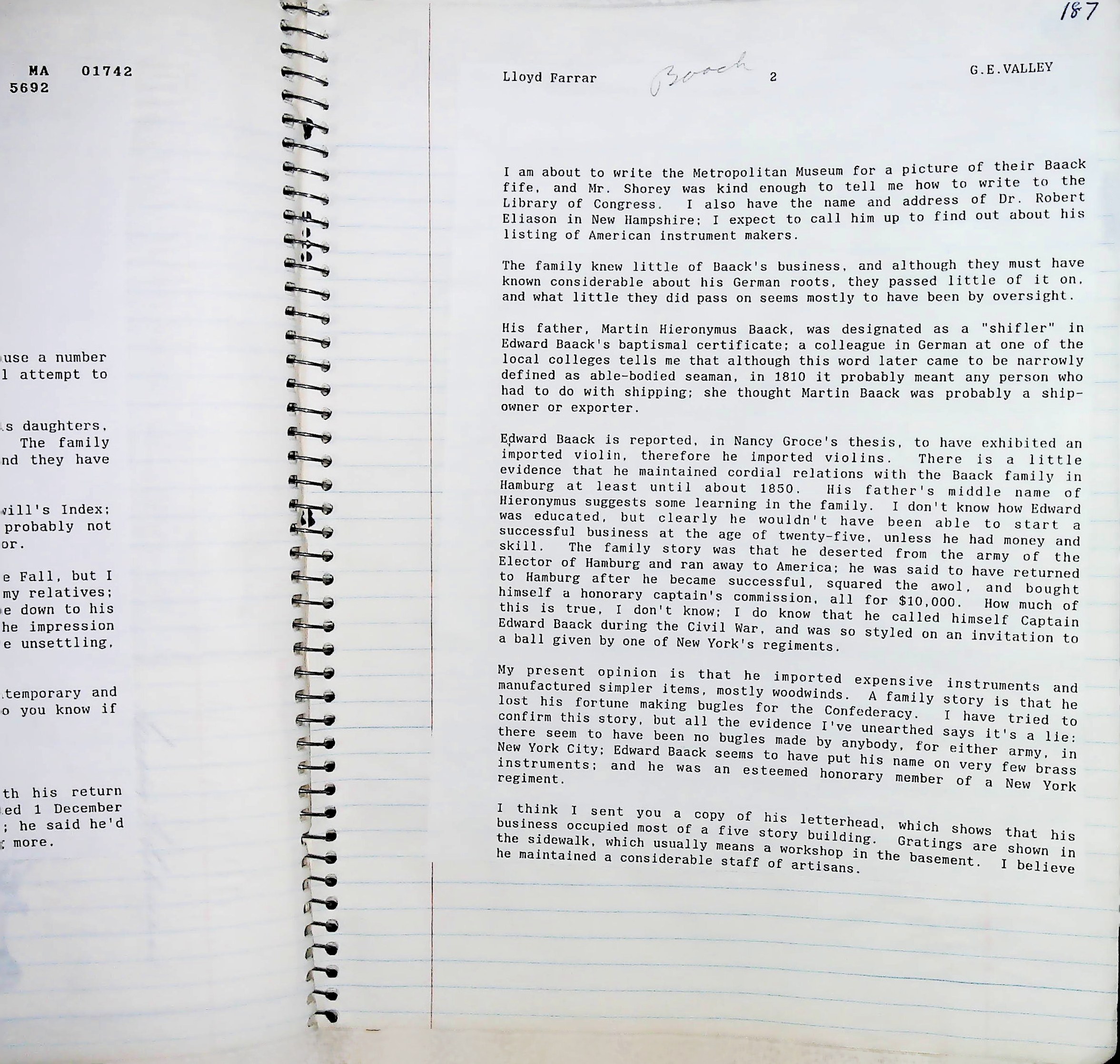
[Notebook p. 187. Page 2 of the letter to Farrar.] Lloyd Farrar 2 G.E.VALLEY
I am about to write the Metropolitan Museum for a picture of their Baack fife, and Mr. Shorey was kind enough to tell me how to write to the Library of Congress. I also have the name and address of Dr. Robert Eliason in New Hampshire; I expect to call him up to find out about his listing of American instrument makers.
The family knew little of Baack's business, and although they must have known considerable about his German roots, they passed little of it on, and what little they did pass on seems mostly to have been by oversight.
His father, Martin Hieronymus Baack, was designated as a "shifler" in Edward Baack's baptismal certificate; a colleague in German at one of the local colleges tells me that although this word later came to be narrowly defined as able-bodied seaman, in 1810 it probably meant any person who had to do with shipping; she thought Martin Baack was probably a ship-owner or exporter.
Edward Baack is reported, in Nancy Groce's thesis, to have exhibited an imported violin, therefore he imported violins. There is a little evidence that he maintained cordial relations with the Baack family in Hamburg at least until about 1850. His father's middle name of Hieronymus suggests some learning in the family. I don't know how Edward was educated, but clearly he wouldn't have been able to start a successful business at the age of twenty-five, unless he had money and skill. The family story was that he deserted from the army of the Elector of Hamburg and ran away to America; he was said to have returned to Hamburg after he became successful, squared the awol, and bought himself a honorary captain's commission, all for $10,000. How much of this is true, I don't know; I do know that he called himself Captain Edward Baack during the Civil War, and was so styled on an invitation to a ball given by one of New York's regiments.
My present opinion is that he imported expensive instruments and manufactured simpler items, mostly woodwinds. A family story is that he lost his fortune making bugles for the Confederacy. I have tried to confirm this story, but all the evidence I've unearthed says it's a lie: there seem to have been no bugles made by anybody, for either army, in New York City; Edward Baack seems to have put his name on very few brass instruments; and he was an esteemed honorary member of a New York regiment.
I think I sent you a copy of his letterhead, which shows that his business occupied most of a five story building. Gratings are shown in the sidewalk, which usually means a workshop in the basement. I believe he maintained a considerable staff of artisans.
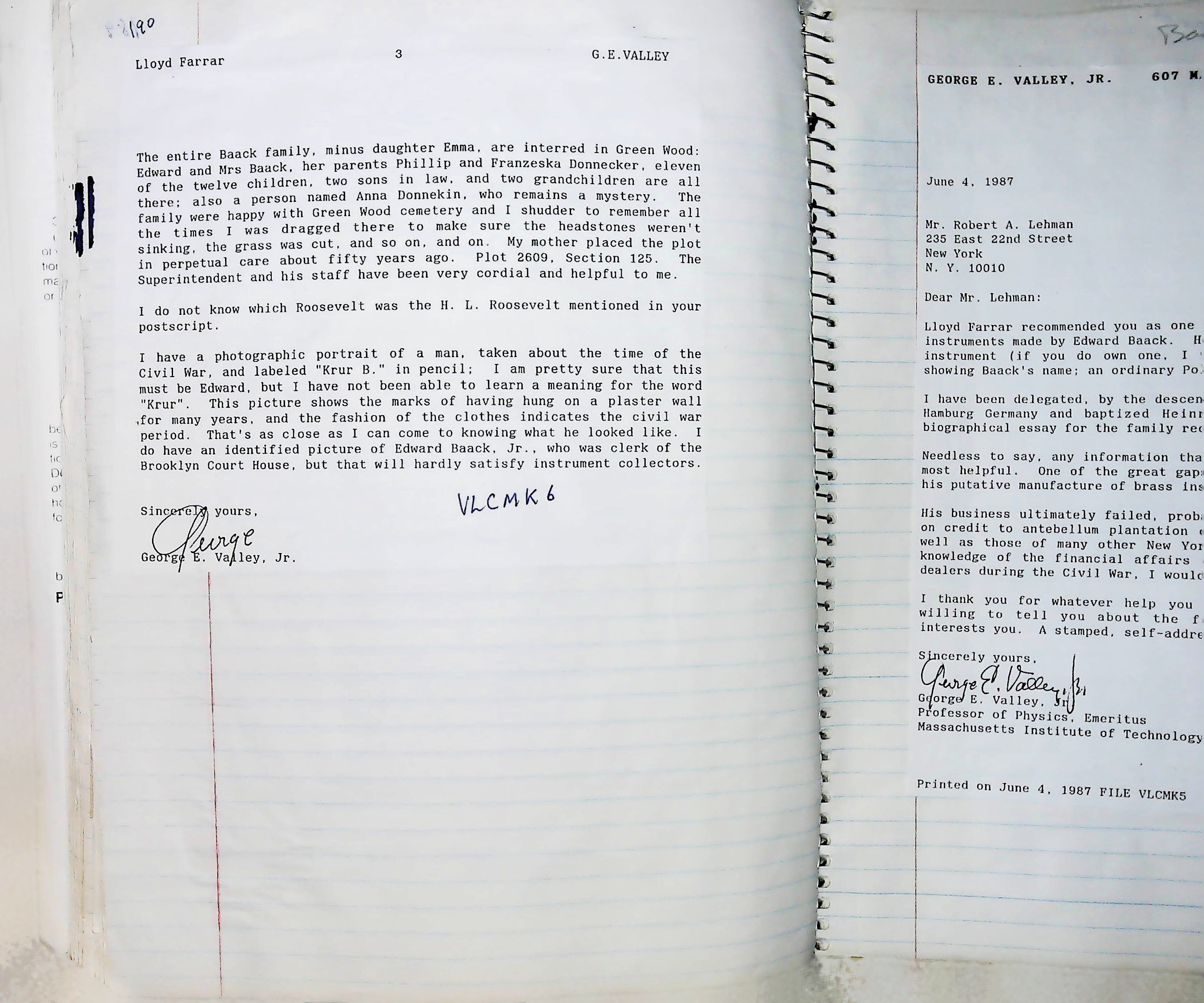
[Notebook p. 190. Page 3 of the letter to Farrar. The facing page, a copy of GEV's letter to Robert A. Lehman of 4 June 1987 (FILE VLCMK5), is only partly in view and continues in the next part of the notebook.] Lloyd Farrar 3 G.E.VALLEY
The entire Baack family, minus daughter Emma, are interred in Green Wood: Edward and Mrs Baack, her parents Phillip and Franzeska Donnecker, eleven of the twelve children, two sons in law, and two grandchildren are all there; also a person named Anna Donnekin, who remains a mystery. The family were happy with Green Wood cemetery and I shudder to remember all the times I was dragged there to make sure the headstones weren't sinking, the grass was cut, and so on, and on. My mother placed the plot in perpetual care about fifty years ago. Plot 2609, Section 125. The Superintendent and his staff have been very cordial and helpful to me.
I do not know which Roosevelt was the H. L. Roosevelt mentioned in your postscript.
I have a photographic portrait of a man, taken about the time of the Civil War, and labeled "Krur B." in pencil; I am pretty sure that this must be Edward, but I have not been able to learn a meaning for the word "Krur". This picture shows the marks of having hung on a plaster wall for many years, and the fashion of the clothes indicates the civil war period. That's as close as I can come to knowing what he looked like. I do have an identified picture of Edward Baack, Jr., who was clerk of the Brooklyn Court House, but that will hardly satisfy instrument collectors.
Sincerely yours, [signed] George George E. Valley, Jr. [handwritten:] VLCMK6
[Facing page, partly visible:] June 4, 1987. Mr. Robert A. Lehman, 235 East 22nd Street, New York, N. Y. 10010. Dear Mr. Lehman: Lloyd Farrar recommended you as one [who knows about] instruments made by Edward Baack. ... I have been delegated, by the descen[dants of a man born in] Hamburg Germany and baptized Heinr[ich Eduard Baack, to write a] biographical essay for the family rec[ord]. ... His business ultimately failed, proba[bly because of sales] on credit to antebellum plantation [owners] ... Printed on June 4, 1987 FILE VLCMK5
Notes
Source: Letters between Lloyd P. Farrar and G. E. Valley Jr. about Edward Baack, Oct 1986 - Jun 1987 (notebook VLCM 4) Location: G. E. Valley Jr.'s research notebook VLCM #4 (1 Jul 1986 - 14 Sep 1987), part 2, pp. 147, 148, 149, 150, 151, 184, 185, 186, 187, 190; Valley family papers, storage bin Found by: Claude research assistant