A misaddressed letter from Lloyd P. Farrar of the Patuxent Martial Musick Collection about an old Squires cornopean (meant for a Mr. Durrell of Valley Farm), G. E. Valley Jr.'s replies forwarding it to Jack T. Carter and asking Farrar about Edward Baack's instruments, and Carter's answer. Also GEV's note of a 10 Nov 1986 call to the Baltimore Museum of Art about the Ringgold portraits (a remark about the museum employee is left out).
History · Oct-Nov 1986 · Concord, Middlesex, Massachusetts, United States
Linked to Heinrich Eduard Baack, Sr. and George Edward Valley Jr
4 pages. Open one to read it full size.
Notebook p. 135
Notebook p. 136
Notebook p. 137
Notebook p. 154
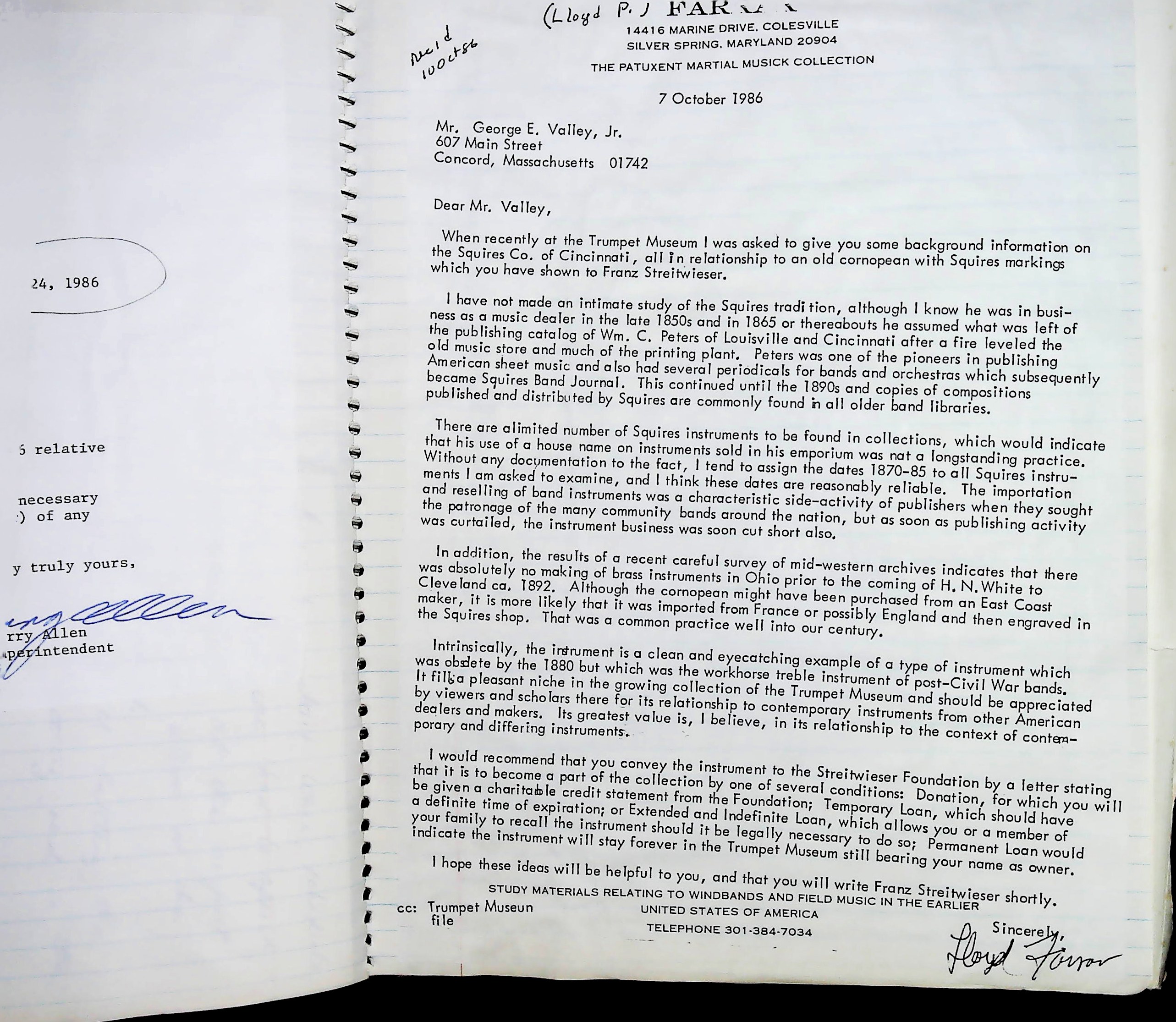
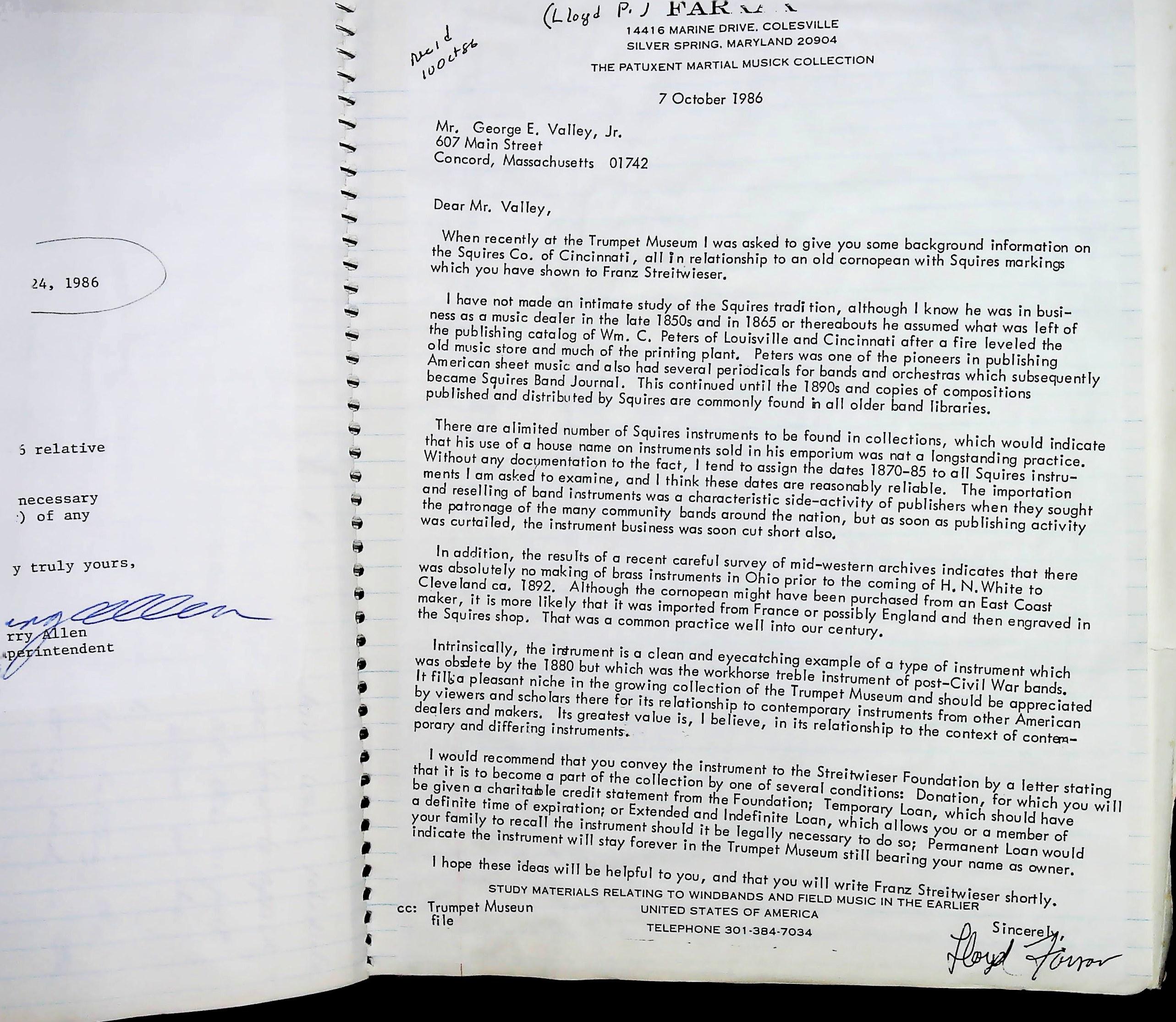
[Notebook p. 135. Typed letter from Lloyd P. Farrar of The Patuxent Martial Musick Collection, Silver Spring, Maryland, to GEV, pasted in. GEV's note: "rec'd 10 Oct 86".] 7 October 1986
Mr. George E. Valley, Jr. 607 Main Street Concord, Massachusetts 01742
Dear Mr. Valley,
When recently at the Trumpet Museum I was asked to give you some background information on the Squires Co. of Cincinnati, all in relationship to an old cornopean with Squires markings which you have shown to Franz Streitwieser.
I have not made an intimate study of the Squires tradition, although I know he was in business as a music dealer in the late 1850s and in 1865 or thereabouts he assumed what was left of the publishing catalog of Wm. C. Peters of Louisville and Cincinnati after a fire leveled the old music store and much of the printing plant. Peters was one of the pioneers in publishing American sheet music and also had several periodicals for bands and orchestras which subsequently became Squires Band Journal. This continued until the 1890s and copies of compositions published and distributed by Squires are commonly found in all older band libraries.
There are a limited number of Squires instruments to be found in collections, which would indicate that his use of a house name on instruments sold in his emporium was not a longstanding practice. Without any documentation to the fact, I tend to assign the dates 1870-85 to all Squires instruments I am asked to examine, and I think these dates are reasonably reliable. The importation and reselling of band instruments was a characteristic side-activity of publishers when they sought the patronage of the many community bands around the nation, but as soon as publishing activity was curtailed, the instrument business was soon cut short also.
In addition, the results of a recent careful survey of mid-western archives indicates that there was absolutely no making of brass instruments in Ohio prior to the coming of H. N. White to Cleveland ca. 1892. Although the cornopean might have been purchased from an East Coast maker, it is more likely that it was imported from France or possibly England and then engraved in the Squires shop. That was a common practice well into our century.
Intrinsically, the instrument is a clean and eyecatching example of a type of instrument which was obsolete by the 1880 but which was the workhorse treble instrument of post-Civil War bands. It fills a pleasant niche in the growing collection of the Trumpet Museum and should be appreciated by viewers and scholars there for its relationship to contemporary instruments from other American dealers and makers. Its greatest value is, I believe, in its relationship to the context of contemporary and differing instruments.
I would recommend that you convey the instrument to the Streitwieser Foundation by a letter stating that it is to become a part of the collection by one of several conditions: Donation, for which you will be given a charitable credit statement from the Foundation; Temporary Loan, which should have a definite time of expiration; or Extended and Indefinite Loan, which allows you or a member of your family to recall the instrument should it be legally necessary to do so; Permanent Loan would indicate the instrument will stay forever in the Trumpet Museum still bearing your name as owner.
I hope these ideas will be helpful to you, and that you will write Franz Streitwieser shortly.
Sincerely, [signed] Lloyd Farrar cc: Trumpet Museum, file [Letterhead foot:] STUDY MATERIALS RELATING TO WINDBANDS AND FIELD MUSIC IN THE EARLIER UNITED STATES OF AMERICA
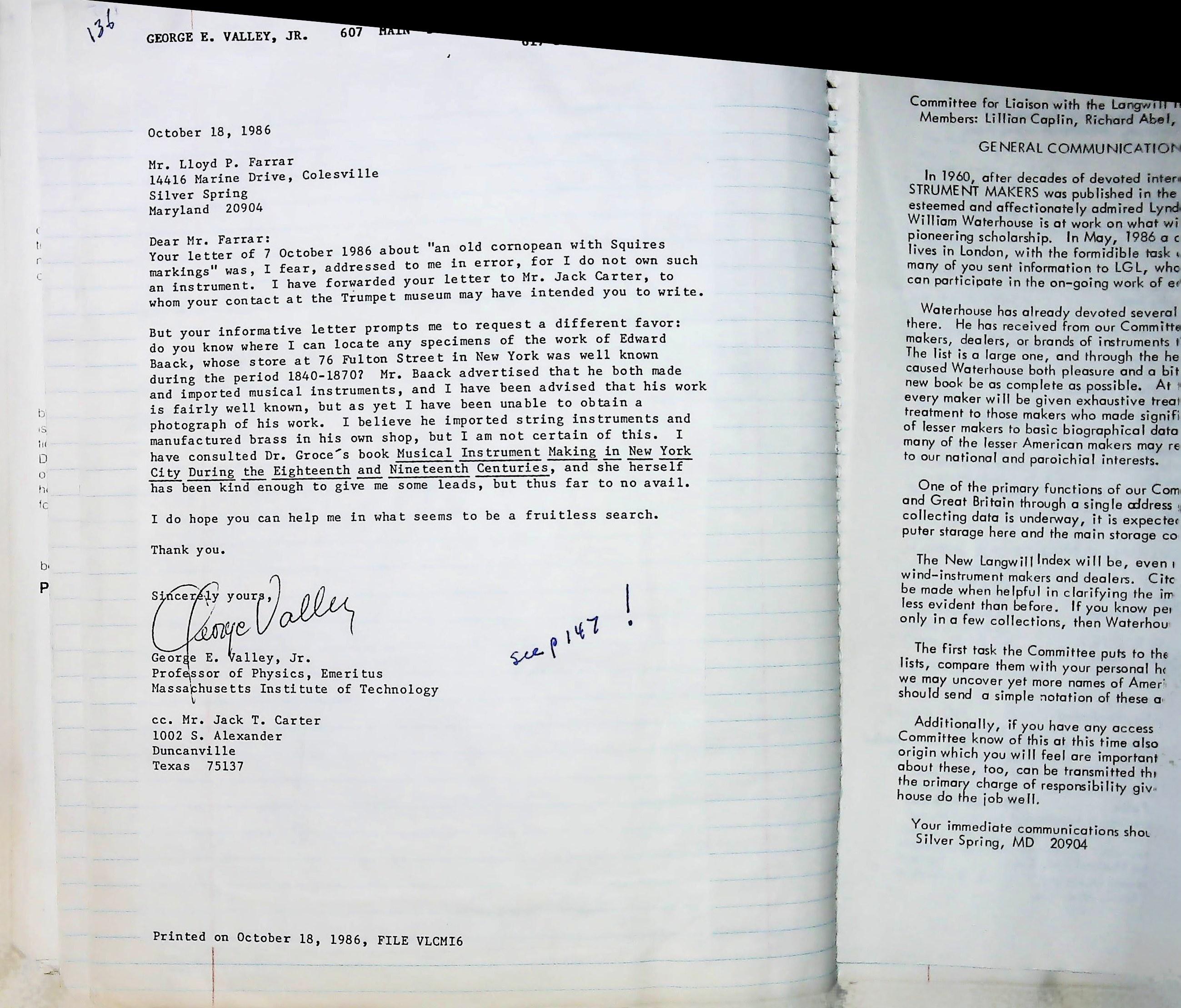
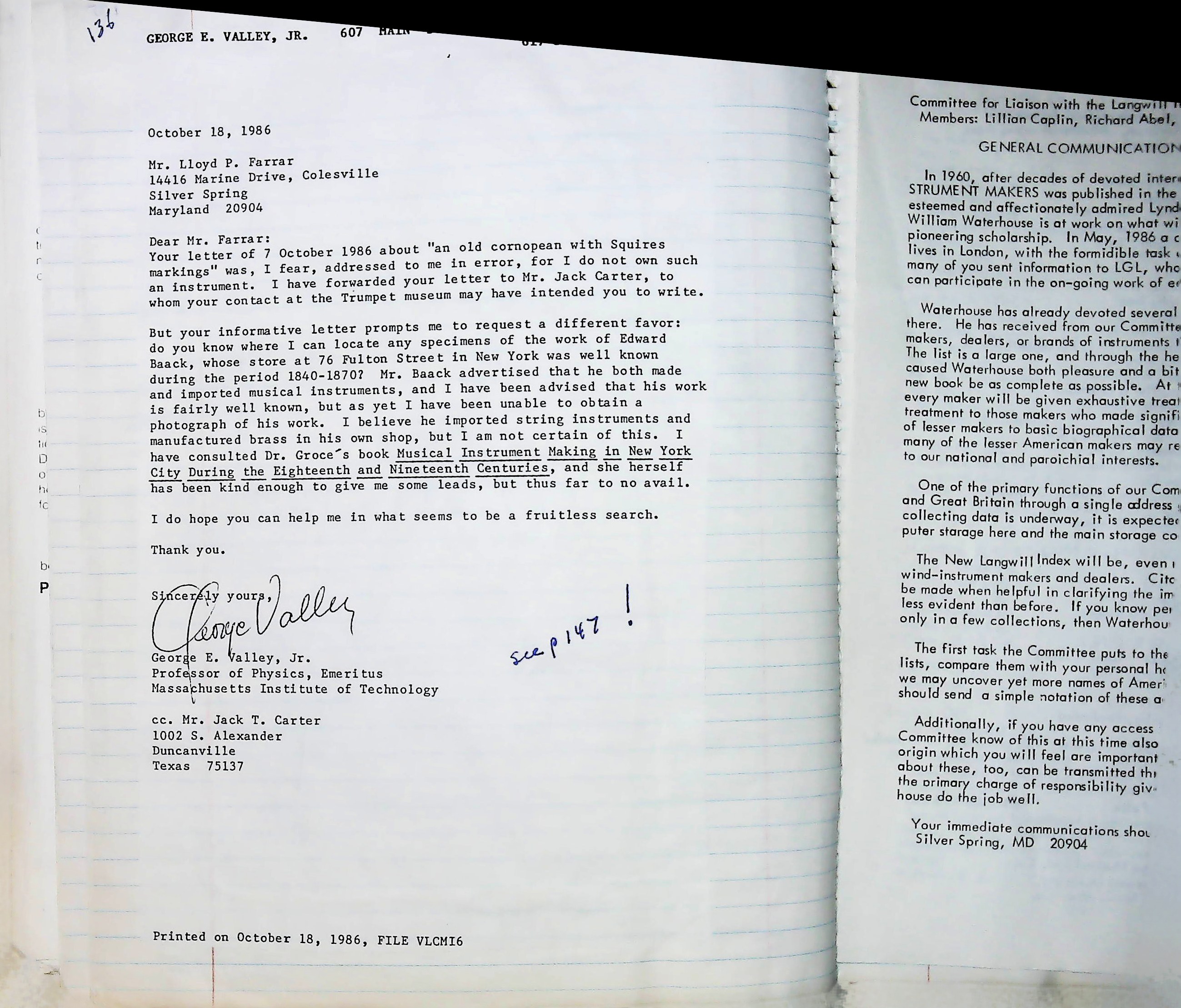
[Notebook p. 136 (GEV's page number). Copy of GEV's typed letter to Lloyd P. Farrar, pasted in. GEV's note: "see p 147 !".] GEORGE E. VALLEY, JR. 607 MAIN STREET, ...
October 18, 1986
Mr. Lloyd P. Farrar 14416 Marine Drive, Colesville Silver Spring Maryland 20904
Dear Mr. Farrar: Your letter of 7 October 1986 about "an old cornopean with Squires markings" was, I fear, addressed to me in error, for I do not own such an instrument. I have forwarded your letter to Mr. Jack Carter, to whom your contact at the Trumpet museum may have intended you to write.
But your informative letter prompts me to request a different favor: do you know where I can locate any specimens of the work of Edward Baack, whose store at 76 Fulton Street in New York was well known during the period 1840-1870? Mr. Baack advertised that he both made and imported musical instruments, and I have been advised that his work is fairly well known, but as yet I have been unable to obtain a photograph of his work. I believe he imported string instruments and manufactured brass in his own shop, but I am not certain of this. I have consulted Dr. Groce's book Musical Instrument Making in New York City During the Eighteenth and Nineteenth Centuries, and she herself has been kind enough to give me some leads, but thus far to no avail.
I do hope you can help me in what seems to be a fruitless search.
Thank you.
Sincerely yours, [signed] George Valley George E. Valley, Jr. Professor of Physics, Emeritus Massachusetts Institute of Technology
cc. Mr. Jack T. Carter, 1002 S. Alexander, Duncanville, Texas 75137
Printed on October 18, 1986, FILE VLCMI6
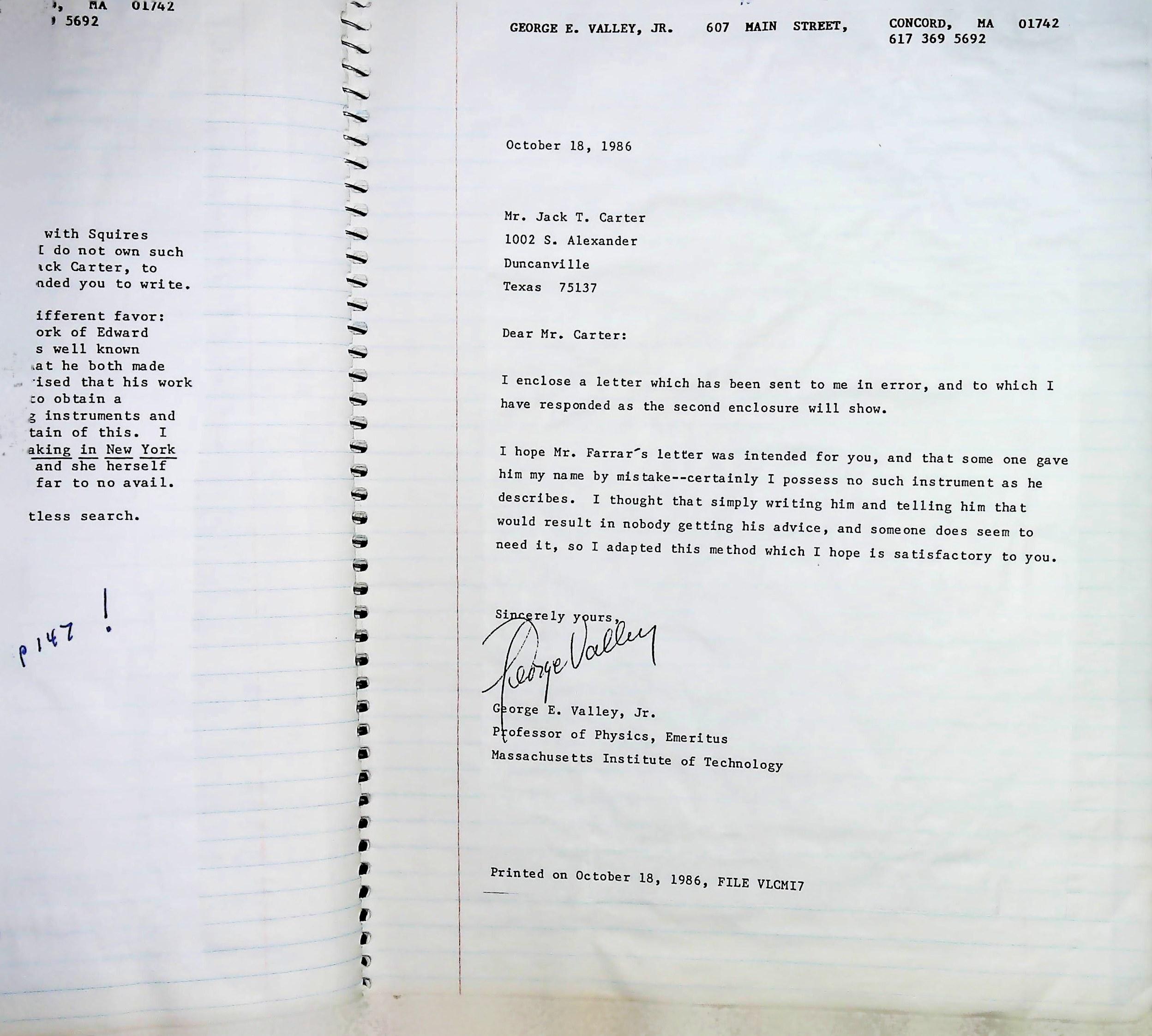
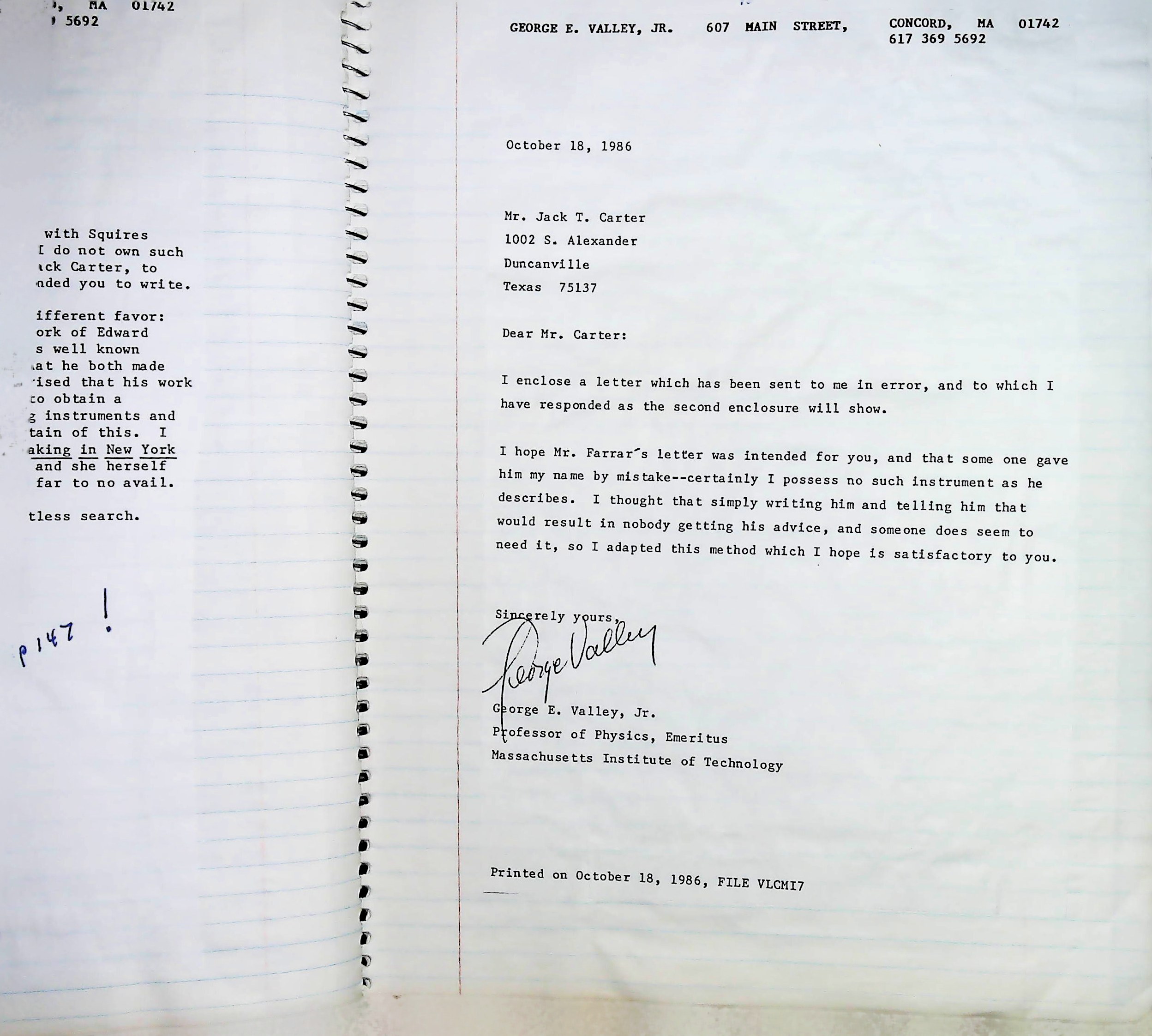
[Notebook p. 137. Copy of GEV's typed letter to Jack T. Carter, pasted in.] GEORGE E. VALLEY, JR. 607 MAIN STREET, CONCORD, MA 01742 617 369 5692
October 18, 1986
Mr. Jack T. Carter 1002 S. Alexander Duncanville Texas 75137
Dear Mr. Carter:
I enclose a letter which has been sent to me in error, and to which I have responded as the second enclosure will show.
I hope Mr. Farrar's letter was intended for you, and that some one gave him my name by mistake--certainly I possess no such instrument as he describes. I thought that simply writing him and telling him that would result in nobody getting his advice, and someone does seem to need it, so I adapted this method which I hope is satisfactory to you.
Sincerely yours, [signed] George Valley George E. Valley, Jr. Professor of Physics, Emeritus Massachusetts Institute of Technology
Printed on October 18, 1986, FILE VLCMI7
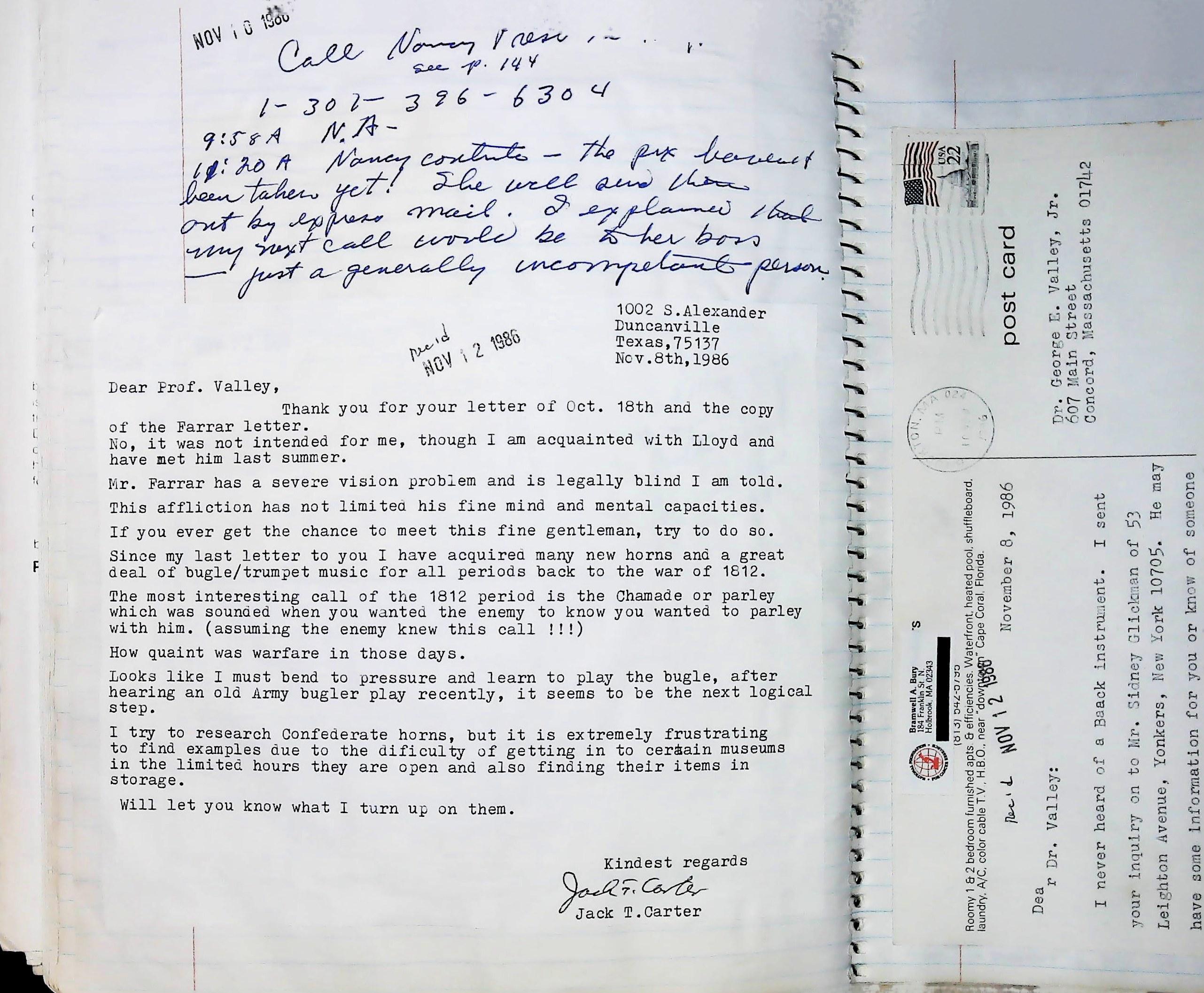
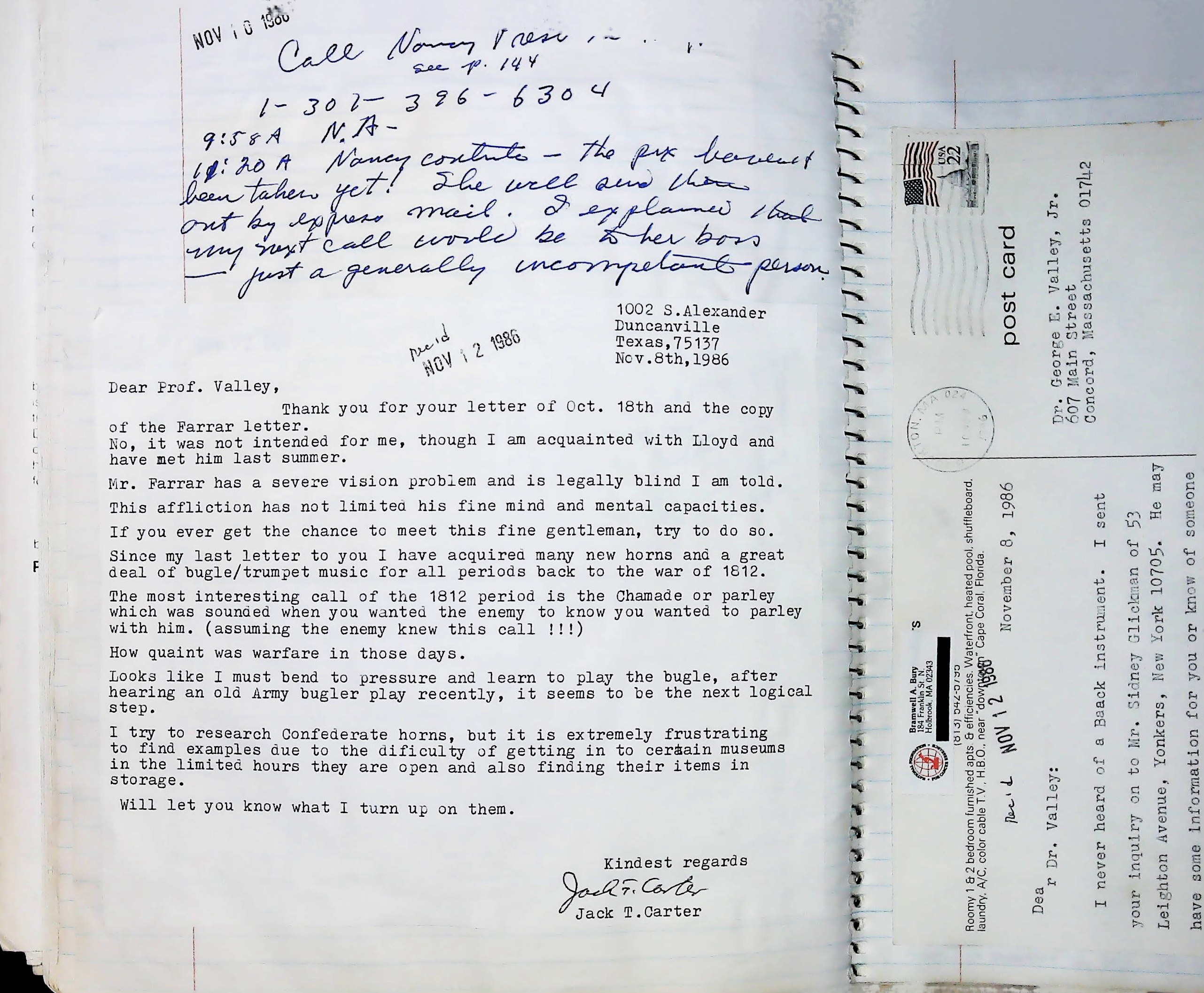
[Notebook p. 154. GEV's call note (date stamp NOV 10 1986), and a typed letter from Jack T. Carter pasted in (date stamp "rec'd NOV 12 1986").] Call Nancy Press (see p. 144) 1-301-396-6304 9:58A N.A. 10:20A Nancy contacted - the pix haven't been taken yet! She will send them out by express mail. I explained that my next call would be to her boss [the rest of the sentence, a remark about the museum employee, is left out of this transcription].
1002 S. Alexander Duncanville Texas, 75137 Nov. 8th, 1986
Dear Prof. Valley, Thank you for your letter of Oct. 18th and the copy of the Farrar letter. No, it was not intended for me, though I am acquainted with Lloyd and have met him last summer. [A sentence about Mr. Farrar's health is left out of this transcription.] If you ever get the chance to meet this fine gentleman, try to do so. Since my last letter to you I have acquired many new horns and a great deal of bugle/trumpet music for all periods back to the war of 1812. The most interesting call of the 1812 period is the Chamade or parley which was sounded when you wanted the enemy to know you wanted to parley with him. (assuming the enemy knew this call !!!) How quaint was warfare in those days. Looks like I must bend to pressure and learn to play the bugle, after hearing an old Army bugler play recently, it seems to be the next logical step. I try to research Confederate horns, but it is extremely frustrating to find examples due to the dificulty of getting in to certain museums in the limited hours they are open and also finding their items in storage. Will let you know what I turn up on them.
Kindest regards [signed] Jack T. Carter Jack T. Carter
Notes
Source: Letters about a misaddressed inquiry: Lloyd P. Farrar to G. E. Valley Jr., 7 Oct 1986, GEV's replies of 18 Oct, and Jack T. Carter's answer, 8 Nov 1986 (notebook VLCM 4) Location: G. E. Valley Jr.'s research notebook VLCM #4 (1 Jul 1986 - 14 Sep 1987), part 2, pp. 135, 136, 137, 154; Valley family papers, storage bin Found by: Claude research assistant